Chinese President Xi Jinping holds talks with French President Emmanuel Macron, who is on a state visit to China, at the Great Hall of the People in Beijing, capital of China, Dec. 4, 2025. (Xinhua/Yin Bogu)
President Xi Jinping held talks on Thursday with French President Emmanuel Macron, who is on a state visit to China from Wednesday to Friday, in Beijing. Macron's visit to China comes at a crucial moment, as the global governance system needs to be rethought.France and China, along with Europe more broadly, can work well together to hopefully shape a framework that endures, even if the US continues to stand apart.
As a founding member of the EU and the second-largest economy in the eurozone, France is a key player in European trade affairs. Trade issues are especially critical today. The trade war initiated by the US has complicated economic conditions worldwide, and we urgently need mechanisms to safeguard global trade - an area where France and Europe can make meaningful contributions.
I think the greatest potential for cooperation between France and China - and more broadly between Europe and China, since France is a key member of the EU - lies in finding new ways to revitalize multilateralism. The theme of the 2025 Imperial Springs International Forum recently held in Guangzhou, South China's Guangdong Province - "For Global Cooperation and Solidarity" - is highly fitting.
We live in a deeply interconnected world where globalization cannot be reversed, yet cooperation is unfortunately retreating.
There is an urgent need to rethink how we work together globally, because only through joint efforts can we deliver the public goods the world desperately needs: health, climate action, pandemic preparedness and more.
On global security, we know that China and France do not see eye to eye on every issue, but there is still room for dialogue and for working toward solutions.
Another crucial area of cooperation between France and China is the joint provision of global public goods, with climate change being the most important and typical example.
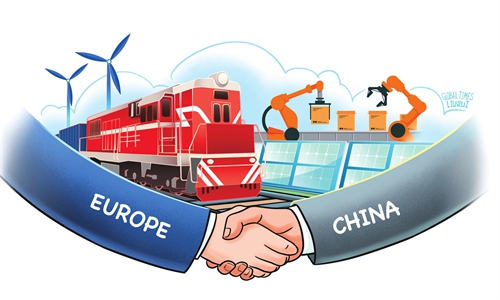
Europe is firmly committed to the green transition and has introduced a series of regulations to accelerate the shift from fossil fuels and high-carbon energy to clean energy. Meanwhile, China is a global leader in technological innovation in electric vehicles, batteries, solar panels and other fields.
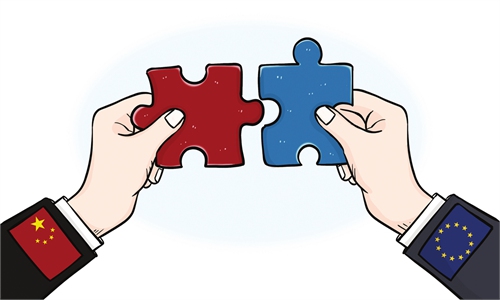
This is precisely where we should deepen cooperation - ideally, genuine cooperation rather than competition - because Europe and China competing against each other instead of joining forces would harm both sides.
Recently, some analysts have argued that Macron's strategic goal for this visit is to ensure that "Europe is respected as an important partner of China, rather than becoming a variable in rising tensions." This reflects a certain degree of anxiety within Europe. Europe is anxious because it is lagging behind in the technological race.
Beyond climate technologies, Europe is also falling behind in AI and the broader digital revolution. We want to remain major players, but we are struggling to keep pace.
But at the same time, the response to this anxiety should not be to close ourselves off. That's why I am very pleased that European leaders come to China and that Chinese leaders come to the EU, because we need to ensure that internal problems - especially those in Europe - do not become obstacles to further cooperation.
In fact, these problems should motivate us to pursue more cooperation so that we can solve them. Europe may be lagging behind, but the right strategy for catching up is not economic closure; it is strengthening cooperation with partners such as China.
Overall, Macron's visit underscores the importance of stability in China-France relations. From my perspective, stability means predictability, and predictability means the capacity to plan for the long term.
Stability facilitates investment and supports what we previously termed "investing in global public goods": advancing knowledge, preparing for climate change and ensuring financial stability in principle.
Thus, stable trade and political relations are crucial for economic development. There is no greater enemy of the economy and investment than uncertainty - we need stability. That is why I believe every channel of communication between these two major economies is highly valuable.
Although Europe is lagging behind, it remains a large and wealthy economy - we should not forget that. Therefore, any channel of dialogue connecting these two significant economies is, in my view, very welcome.
The article was compiled by Global Times reporter Qian Jiayin based on an interview with Francesco Saraceno, deputy department director at OFCE-Sciences Po, a Paris-based economic policy think tank. opinion@globaltimes.com.cn
RELATED ARTICLES