Time for Wall Street Journal, the ‘self-styled preacher,’ to leave the podium: Global Times editorial
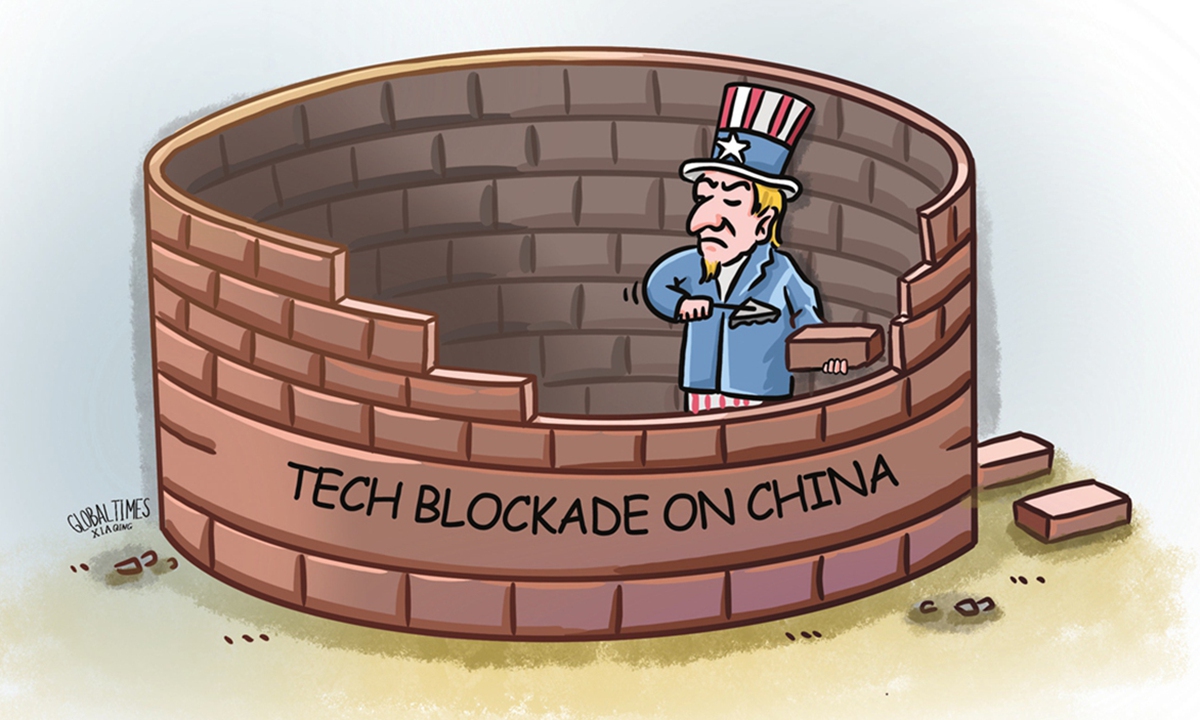
US blockade on China llustration: Xia Qing/GT
Whether it is the general perception of countries around the world, or the actual experiences of Americans who have come to China for business or tourism, they all point to the same fact: China is far more open than the US. It is the US itself that truly needs profound reform and opening-up.
The Wall Street Journal (WSJ) recently published an opinion piece calling to "reform and open China on America's terms." The article suggests that the US government should adopt a differentiated approach toward different Chinese regions and companies: offering preferential treatment to those willing to cooperate with US investigations, sanctions, and export control rules. It also specifically called for continuing the crackdown on products from China's Xinjiang region.
Though presented as a "policy proposal," the piece adopts the posture of "a self-styled preacher," as if China's development process needs to be designed and priced by the US. This attitude is representative of views held by some in the US. In reality, it is the US itself that truly needs profound reform and opening-up.
Reform and opening-up was a landmark choice made by the Chinese people under the leadership of the Communist Party of China. It is a grand process and a profound transformation that China has proactively advanced based on its own national conditions and development needs. The development achievements China has made today were not bestowed or granted by others; they were earned through the diligence, ingenuity, and courage of the Chinese people.
From proactively reviewing and revising tens of thousands of laws and regulations upon joining the WTO, to significantly shortening the negative list for foreign investment access and completely removing restrictions in the manufacturing sector in the new era, to granting zero-tariff treatment to all products from the least developed countries and offering 240-hour visa-free transit to citizens of 57 countries - every step of China's opening-up has been grounded in its own development needs and has served the broader goal of building a more open and inclusive world. China's opening-up is independent and proactive. It is by no means a case of someone presenting a "menu" and China having to order from it.
Opening-up means reducing barriers, expanding exchanges, and offering mutual opportunities. If one country demands that others accept its so-called "standards" that violate international rules and turn openness into a form of permission, that is not openness - it is hegemony. Why do some in the US remain obsessed with the idea of "doing things on our terms"? Ultimately, they are still viewing China and the world through the outdated "center-periphery" theory.
In terms of purchasing power parity, in 2000, the G7 accounted for over 43 percent of global GDP; by 2024, that share had fallen to less than 30 percent. Meanwhile, the share of BRICS countries rose from 21 percent to over 35 percent. Since 2000, merchandise trade among developing countries has grown 4.6 times, way faster than that of developed economies, with their share of the global total rising from 30 percent to 45 percent. The once unipolar world is being replaced by a more diverse and flatter global trade network. China has remained the world's largest goods trading country for many consecutive years, serves as the main trading partner of more than 160 countries and regions, and contributes around 30 percent to global economic growth annually on average. It is time for some in the US to catch up with this world.
In fact, whether it is the general perception of countries around the world, or the actual experiences of Americans who have come to China for business or tourism, they all point to the same fact: China is far more open than the US. They have personally experienced China's sincerity in streamlined visa requirements, expanded market access, improved business environment, as well as a more open and inclusive social environment. By contrast, they have witnessed the US raising visa barriers, restricting academic exchanges, and arbitrarily disrupting normal cooperation in the name of overstretched national security and so-called "human rights" issues. If anyone needs to become more open, the US today may need it more than most countries in the world. From goods to technology, and from investment to talent, the US is closing its doors one by one across virtually every dimension. What gives the US the right to tell others how they should open up?
The international community sees this clearly. The World Openness Report 2025 shows that North America had become one of only two regions in the world where openness contracted in 2024, while China's openness index had risen by nearly 30 percent over the previous 35 years, with its growth rate ranking among the highest globally.
A 2025 Gallup global survey found that approval of China's leadership rose from 32 percent in 2024 to 36 percent, while approval of US leadership fell from 39 percent to 31 percent. China thus surpassed the US for the first time, by a margin of five percentage points. A Morning Consult survey of 41 countries also showed, as of May 2025, China with a global net favorability score of 8.8, compared with -1.5 for the US. These extensive and objective figures clearly reveal the international community's direct response to the policy trajectories of the two countries. Who is building roads and bridges and who is shutting the door and building walls? The answer is plain to see.
At present, China and the US stand at a critical juncture in building a "constructive relationship of strategic stability." US media and think tanks, in particular, should face the reality, set aside their shortsighted sense of superiority and play a constructive role in building confidence and dispelling doubts, rather than disrupting the healthy development of bilateral relations with grossly biased and outdated lectures.
China's door of opening-up will never close; it will only open wider. Whether the US can engage with China and the rest of the world peacefully on an equal footing will affect not only the trajectory of China-US relations, but also the US' own future.
RELATED ARTICLES