Chinese tech companies Huawei, iFlytek join Brazil’s $444 million AI infrastructure push: media reports
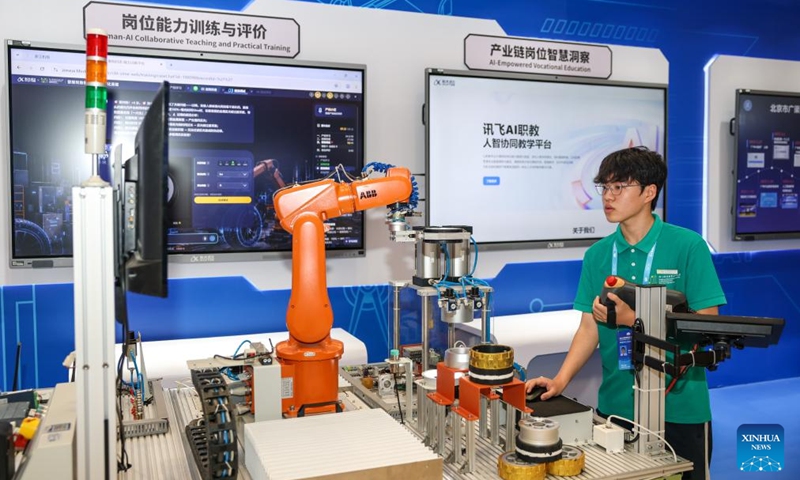
A student from Zhejiang Polytechnic University of Mechanical and Electrical Engineering demonstrates an AI educational platform developed by Chinese AI company iFLYTEK at an exhibition on achievements of global digital education held during the 2026 World Digital Education Conference in Hangzhou, east China's Zhejiang Province, May 11, 2026.
Brazil's government announced on Thursday local time investments of about 2.3 billion reais (444.2 million) to strengthen its artificial intelligence (AI) infrastructure and accelerate the development of its domestic AI ecosystem, including AI supercomputing infrastructure, AI models, and related projects in chips, cloud computing, according to Reuters and Brazilian media reports.
A key part of the plan involves an investment of 1.3 billion reais, more than half of the funding, to build supercomputing infrastructure in Rio de Janeiro in cooperation with Chinese technology companies Huawei and iFlytek, Reuters reported on Thursday.
The infrastructure cooperation with China is intended to support the development of large language models (LLMs) and both general-purpose and industry-specific AI applications, a representative from iFlytek told the Global Times on Friday.
The move marks another vivid case of China's AI infrastructure going global, specifically reaching the Global South nations.
According to a report by Brazil's UOL Media Group, the measures are part of PBIA (the Brazilian Artificial Intelligence Plan), which includes 23 billion reais in investments in computational infrastructure, training specialized workers, creating national AI models, and developing public services using the technology.
According to media reports, the partnership between Brazil and Chinese tech companies is expected to begin operating in July 2027 and will be implemented through the National Education and Research Network, or RNP, a social organization linked to the Ministry of Science, Technology and Innovation.
The funding will come from Brazil's National Fund for Scientific and Technological Development, known as FNDC, through phased disbursements.
UOL Media Group reported that the project also includes training for 3,000 local professionals over a five-year period.
Chinese AI company iFlytek, known for its expertise in translation and transcription, is expected to help develop a Brazilian LLM that can operate in both Portuguese and Spanish, according to UOL Media Group. Meanwhile, Huawei will be involved in the supercomputing infrastructure segment, said Brazilian media outlets, noting that Brazilian officials recently discussed cooperation with the company during a visit to China for the World Artificial Intelligence Conference in Shanghai.
In addition, Brazil plans to invest about 1 billion reais in a supercomputer through a public bidding process, with the stated goal of placing the country among the world's top 10 in AI processing capacity, according to Reuters.
The latest investment also underscores the growing role of Chinese enterprises in Brazil's digital infrastructure. In July, Bloomberg reported that ByteDance, the Chinese parent company of TikTok, had selected Brazil for its largest data center outside China, in a $39 billion project on the country's northeast coast.
According to analysts, these projects show that Chinese AI companies are moving beyond exporting standalone products and services, and are further advancing into overseas national-level AI infrastructure and large-model ecosystem development.
The latest move underscores the growing strategic importance of China-Brazil digital cooperation, Tian Feng, former dean of SenseTime's Intelligence Industry Research Institute, told the Global Times on Friday.
It also illustrates a new phase in Chinese AI globalization: not just exporting tools, apps or cloud services, but helping overseas partners build sovereign AI capacity, compute power, local model ecosystems and domestic talent pipelines, Tian said, adding that as governments across the Global South seek greater development opportunities over their AI futures, partnerships like this one may become a template for how China's AI industry expands abroad while help bridge digital divides.
By combining government funding, local talent development, and international technical cooperation, the China-Brazil AI projects may help Brazil strengthen its sovereign AI capabilities while offering Chinese companies a larger role in global AI expansion, Tian added.
Global Times
RELATED ARTICLES