From hotels to homes, China's service robots move beyond showrooms as commercial deployment gains pace
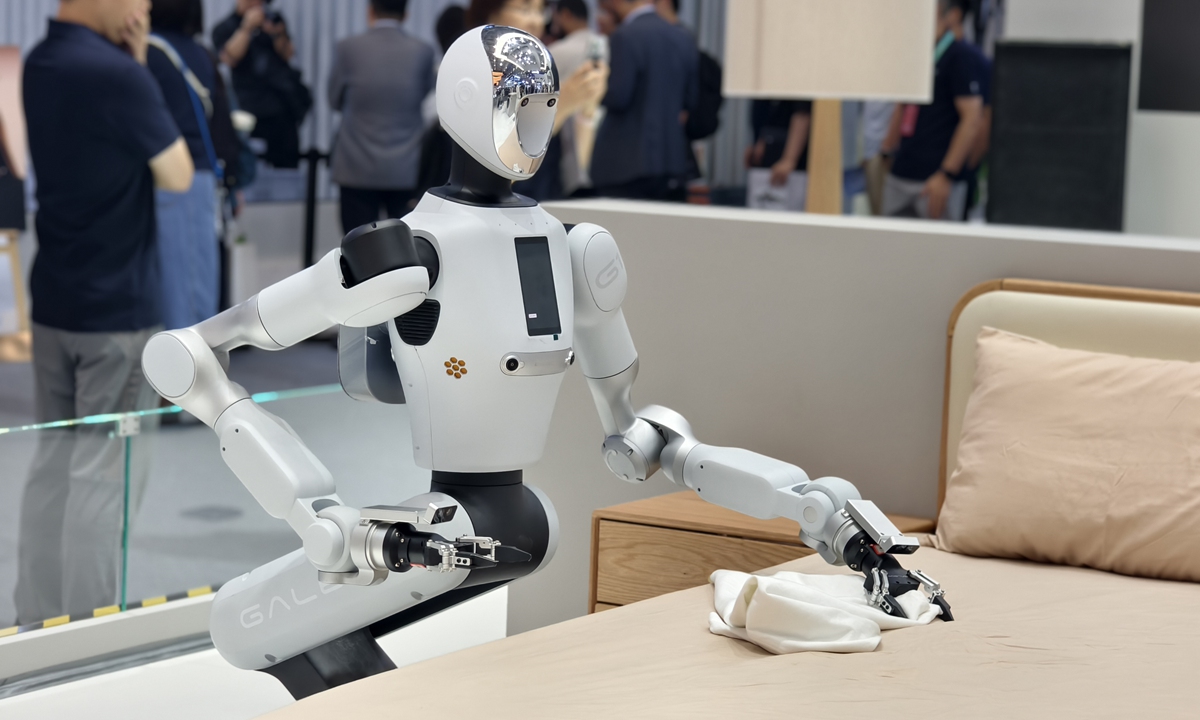
A humanoid robot folds bed linens in a bedroom setting during the 2026 World Robot Conference in Beijing on August 19, 2026. Photo: VCG
One robot bent down to pick up and neatly fold scattered clothes, while another carefully tidied household items on a table. At a living room-style booth at the 2026 World Robot Conference, three robots busied themselves around visitors, looking like new members of the makeshift household.
A visitor surnamed Ye said that she visited the same event last year and noticed marked progress now. "This year, the robots can do more things and move much faster and more accurately. I heard one robot costs tens of thousands of yuan. If I can afford it someday, I'd like to have one at my home," Ye told the Global Times.
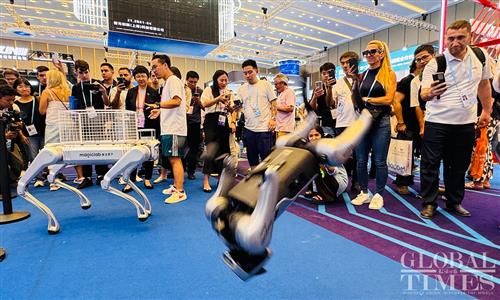
Across the exhibition halls, robots could be seen collecting takeout orders, folding clothes, tidying rooms and delivering items, while visitors queued for coffee and cocktails served by robots and robotic arms. Compared with previous years, when much of the attention centered on walking, running and dancing capabilities, this year's conference featured noticeably more demonstrations of seemingly ordinary tasks closely tied to real-world needs.
Currently, robots are moving beyond labs and exhibition floors to move into living rooms, hotels, airports, hospitals and more sites.
Really on the job
How efficiently a robot can autonomously complete a sequence of tasks in real-world environments is a key test before deployment.
TianYi 2.0, developed by the Beijing Humanoid Robot Innovation Center, competed in several scenario-based events at the concurrent World Humanoid Robot Games. Robots were seen to carry luggage, restock rooms and make beds in a hotel, while household tasks included tidying a living room, folding clothes, and doing laundry.
Liu Hao, a staff member at the Beijing Humanoid Robot Innovation Center, told the Global Times that all its competing robots were powered by the center's self-developed Huisi Kaiwu platform, which integrates motion control, environmental perception, and task execution.
Autonomous runs carried twice the weight of teleoperated ones, with penalties for collisions, dropped items and boundary violations. Multi-step tasks offer a tougher test of efficiency, reliability and adaptability than one-off demonstrations, Liu said.
Hotels are among the first service settings where robots have entered routine operation.
A representative of KEENON Robotics told the Global Times that a Shangri-La hotel in Shanghai has deployed eight robots. A humanoid robot greets guests, hands out welcome gifts and provides interactive services, while task-specific robots handle standardized delivery and cleaning work. KEENON said that its cumulative global shipments across its full products portfolio have exceeded 100,000 units, covering more than 70 countries and regions.
However, many hotel robots remain in the testing and validation phase. Liu Zhao, chief operating officer of Simple AI Hong Kong, told the Global Times that the company's Simbot is undergoing a proof-of-concept trial at the Metropark Lido Hotel Beijing, where it is being tested for deliveries, public-area patrols, room service and cleaning jobs. Simple AI has also signed a strategic cooperation framework agreement with China Travel Group Hotels, which operates more than 400 hotels.
Beyond hotels, service robots are also entering the more complex home environment.
Sherry Song, head of overseas branding at X Square Robot, told the Global Times that the company partnered with 58 Daojia in March to offer in-home housekeeping services, with robots and human cleaners working together. She said the robot has received several hundred bookings, which the company describes as the industry's first large-scale deployment of robots in home services.
New growth engine
The expansion of service robots into hotels, restaurants and homes is not simply generating rising orders for robot makers, it also signals that AI is beginning to reshape how services are delivered.
China's 2026 government work report called for enhancing the capacity and quality of the service sector. In June, the Ministry of Commerce and seven other government agencies issued guidelines to accelerate the development of "AI plus consumption," encouraging wider AI application in home services, tourism, accommodation and catering, while fostering new consumption scenarios, according to Xinhua News Agency.
Chen Jing, vice president of the Technology and Strategy Research Institute, told the Global Times that robots will reshape the service sector in several ways. Human-robot collaboration in hotel housekeeping, restaurant kitchens and home-based eldercare will boost productivity and make services more technology-intensive.
Repetitive, labor-intensive tasks will be increasingly automated, while new jobs emerge in robot maintenance, scenario training and human-robot interaction design. Automated and personalized services could also become new selling points, he said.
China's well-developed robotics supply chain, vast service market and diverse application scenarios provide favorable conditions for this process, Chen said.
Jeff Burnstein, president of the Association for Advancing Automation (A3), stressed the value of real-world deployment in response to a question from the Global Times. "One advantage of simply getting them out there and doing work is that they learn," he said. "New models can then be introduced that are smarter and understand the real world better. That's an advantage China has."
In the near future, robots are likely to be exported to emerging markets such as Southeast Asia and the Middle East. General-purpose models trained in Chinese settings, together with standards developed around these applications, could help shape the foundational framework for the global service robotics industry, Chen said.
However, Liu Dingding, a veteran internet observer, noted that the biggest bottleneck is limited cross-scenario adaptability. Hotel rooms and home layouts vary widely, and deployment costs will remain elevated.
Beyond technology and cost, the industry needs clearer privacy rules, legal accountability for robot-related accidents, and common safety and performance standards, Chen said. Scaling up will require local maintenance networks, not just remote support.
The next phase of China's robotics industry will be defined not by more eye-catching performances, but by turning technology into productive capacity that consumers can access, service businesses are willing to buy and companies can operate sustainably, experts said.
RELATED ARTICLES