China will not play along with the US’ ‘reckless games’ on the Iran issue: Global Times editorial
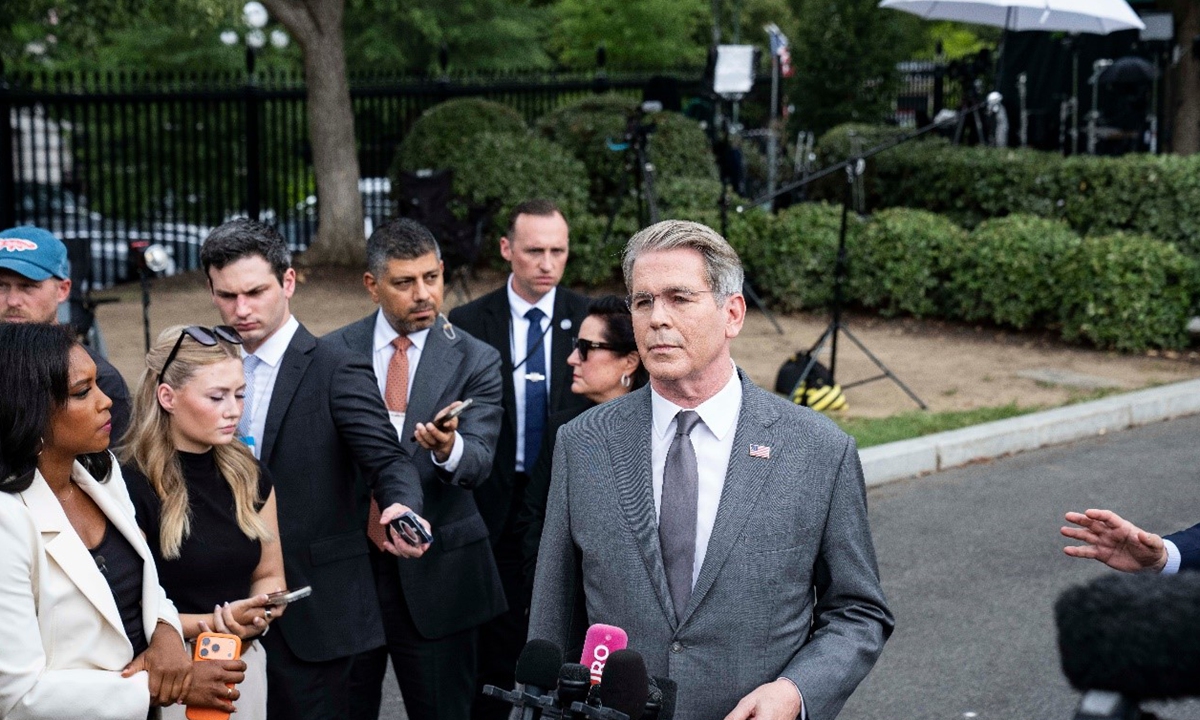
US Secretary of the Treasury Scott Bessent speaks to the media outside the West Wing of the White House in Washington, DC, US, on August 20 2026. Photo: VCG
Economic sanctions can concentrate pressure on a single country, but it is difficult to confine the costs to that country alone. War cannot solve problems, and sanctions only add fuel to the fire. Only by abandoning the Cold War mentality of confrontation, setting aside the tool of maximum pressure, and returning to the proper track of dialogue and negotiation can Washington cut its losses in time and make a dignified exit.US President Donald Trump announced on August 19 local time that he would launch a so-called "economic D-Day" operation against Iran. US Treasury Secretary Scott Bessent, in outlining the operation, described it as "economic warfare and isolation on an unprecedented scale," adding that other countries "are either with us or against us." When asked whether the new sanctions would involve China, Bessent urged China to "get with the program," claiming that would do China "a big service."
The US war against Iran has now entered its sixth month, with both sides now locked in a stalemate - unable to escalate the conflict further yet unable to reach a negotiated settlement. The so-called "economic D-Day" operation is less a new offensive launched by the US against Iran than it is yet another attempt by Washington to cut its losses as quickly as possible and extricate itself from the quagmire of the Middle East - a move to change tactics and keep gambling after military means have proven ineffective.
But it may well be heading in the wrong direction. Whether it is the ever-rising bills at US gas stations or the soaring energy and shipping costs in global markets, one thing is clear: Economic sanctions can concentrate pressure on a single country, but it is difficult to confine the costs to that country alone. War cannot solve problems, and sanctions only add fuel to the fire.
The so-called "either with us or against us" rhetoric, in a sense, exposes Washington's strategic predicament: it "can no longer handle this mess on its own." Ironically, while Washington has been spouting "bold rhetoric," its circle of allies has remained silent on the matter. In fact, since the US' war against Iran began, most US allies have been highly reluctant to go along with America's radical strategy out of concern for the spillover effects of the conflict and the energy crisis. The reason is simple: for these countries, the Iran issue affects energy supply, shipping security, and inflationary pressures.
The US has set its own house on fire, yet it wants the whole world to help fan the flames, making the blaze even bigger - and in the end, it expects everyone else to foot the bill. Who would want to be such a patsy? The US has repeatedly labeled European nations "cowards" for refusing to join the war, further provoking a strong backlash from its European allies and creating a rare, deep‑seated rift in the alliance system.
If the US cannot even rally its own allies, it certainly cannot expect to boss China around. China has consistently opposed unilateral bullying and long-arm jurisdiction - not because China is Iran's largest trading partner and maintains long-standing friendly relations with Iran, but because once this US logic is accepted, international trade would no longer be normal exchanges between nations. Instead, it would devolve into an absurd situation where the US unilaterally sets the rules and the flow of all goods must be approved by the US.
If the US can force China to cut ties with Iran today, will it be able to arbitrarily cut off all foreign trade with any country it regards as a "rival" tomorrow? If so, there is no doubt that the world would be reverting to the law of the jungle, where the basic rules of modern civilized society will cease to exist.
The Strait of Hormuz is a strait used for international navigation. Restoring safe and free passage through the strait as soon as possible serves the interests of all parties and is also the shared aspiration of the international community. But if the fact that "the Strait of Hormuz concerns a certain country's interests" is used as a pretext to demand that this country unconditionally comply with Washington's maximum pressure and trade bullying, that would not only put the cart before the horse, but also steadily deplete the US' international credibility while exacerbating global energy volatility, high inflation, and market disorder.
Only a comprehensive ceasefire and the cessation of hostilities can fundamentally create the conditions for easing tensions, because the disruption of navigation through the Strait of Hormuz is itself a spillover effect of the US' war against Iran. China has consistently supported all efforts conducive to a ceasefire and an end to hostilities. But ultimately, those who tied the knot must be the ones to untie it; this knot can and must be resolved by the parties directly involved.
The so-called "economic D-Day" operation i America's strategic predicament stems precisely from its obsession with the "big fist" and its inexplicable confidence that "there is always a way to force those who refuse to comply into submission." If the US continues applying pressure at will, it will only be kept trapped for longer and sink deeper.
Simply expanding economic pressure will only prolong the conflict and increase the losses for all sides. The entire world can see this clearly. Not only will China not play along with the US' "reckless games" on the Iran issue, but the international community will not stand with Washington either. From moral, legal, and practical perspectives, escalating unilateral sanctions has neither legitimacy nor feasibility.
An immediate ceasefire and cessation of hostilities, the prompt resumption of peace talks, the restoration of navigation through the strait, and upholding the authority of the UN Charter - these have been China's consistent positions since the conflict broke out, and they are the approach that serves the interests of all parties. Only by abandoning the Cold War mentality of confrontation, setting aside the tool of maximum pressure, and returning to the proper track of dialogue and negotiation can Washington cut its losses in time and make a dignified exit.
RELATED ARTICLES