China seeks input on revised draft of outbound investment management rules
New rules defend Chinese investors overseas, promote high-level opening-up: expert
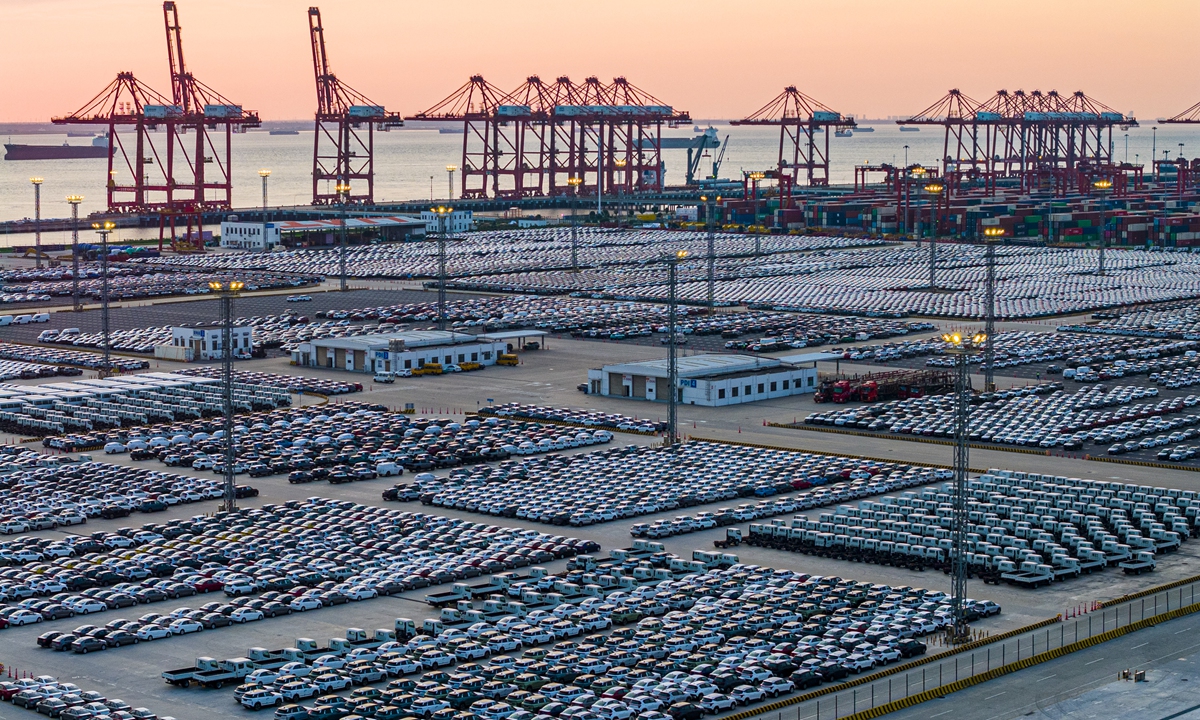
Domestically produced vehicles are ready for export overseas at the Taicang port zone of Suzhou Port, East China's Jiangsu Province on July 14, 2026. Photo: CNS Photo
China's top economic planner on Friday released a draft on the revised measures for managing outbound investment, which improves a reporting system for major adverse events and sets up an annual outbound investment mechanism to better protect the outbound investment rights and interests of Chinese companies, other organizations, and individuals.Overall, the provisions largely follow the existing legal framework, showcasing policy stability and transparency. Meanwhile, a series of new measures targeting discriminatory measures by a handful of countries and regions - for example requiring China to transfer technology, disclose data, or divest equity interests and assets - will further protect the legal rights and interests of Chinese investors and their outbound investments, and safeguard national sovereignty, security, and development interests, Chinese experts said.
Landmark law
The National Development and Reform Commission (NDRC) is seeking public comments until September 20. Consisting of 76 articles, the document stipulates that the regulation covers outbound investments made by companies, other organizations, and individuals.
The new rules stressed that the country supports investors in conducting outbound investment activities in accordance with market-based principles and actively participating in international cooperation and competition. Investors shall, in accordance with the law, enjoy autonomy in outbound investment, make their own decisions, assume their own risks, and be responsible for their own profits and losses, according to the document posted on the NDRC website.
The revised measures fully align with the new regulation on outbound investment released by the State Council, the country's cabinet, that took effect on July 1, Huo Jianguo, former head of the Chinese Academy of International Trade and Economic Cooperation under the Ministry of Commerce, told the Global Times on Friday.
"A key signal from the revision is that China is putting in place more mature institutional safeguards for Chinese investors to deepen their participation in global markets. As Chinese companies expand their global footprint, outbound investment management must shift from primarily encouraging firms to 'go global' toward helping them build a stable and sustainable overseas presence," Huo said.
Chinese outbound investment has expanded steadily and in an orderly way in recent years. By the end of 2025, Chinese investors had established over 50,000 overseas enterprises across 190 countries and regions, and China's cumulative outbound investment had ranked among the world's top three for nine consecutive years, according to data from the Ministry of Commerce.
However, despite this steady growth, there have been instances where the legitimate rights and interests of Chinese outbound investors have come under threat. Most notably, the UK government announced on July 16 that it had nationalized British Steel under the Steel Industry (Nationalisation) Act, taking over the firm previously controlled by China's Jingye Group - a move that has drawn strong opposition and dissatisfaction from Beijing.
Safeguard safety
The NDRC's new rules are essential to protecting the legitimate rights and interests of Chinese investors and their outbound investments, Huo said. They also help safeguard China's overseas interests against threats or infringement, while upholding national sovereignty, security, and development interests, the expert said.
According to the new regulation, investors should immediately report major adverse events to the NDRC during outbound investment under multiple circumstances, for example, if the foreign party requires the provision of technology, data, or the like, thereby threatening or harming China's national interests and national security; the foreign party requires the transfer or disposal of assets, rights and interests related to the outbound investment, or the like, thereby threatening or harming China's national interests and national security.
The improvement of a reporting system for major adverse events appears all the more relevant in light of a series of recent high-profile cases that tested the boundaries of China's outbound investment oversight, experts said.
A case in point is Nexperia, a Netherlands-based chipmaker owned by China's Wingtech. In September 2025, the Dutch Ministry of Economic Affairs and Climate Policy issued a ministerial order and the Amsterdam Enterprise Chamber of the Court of Appeal issued a ruling that restricted Chinese tech firm Wingtech's control over Nexperia's overseas entities. The root cause of the Nexperia issue lies in the Dutch government's improper administrative intervention in corporate operations.
Moreover, according to the regulation, the transfer or disposal of outbound investments and the related assets, rights and interests that affect or may affect national security shall be subject to outbound investment security review. Relevant organizations and individuals shall provide assistance and cooperation, shall not refuse or impede such review, and shall comply with the decisions.
In response to discriminatory measures, unreasonable deprivation and restriction by a foreign organization or individual, NDRC may, upon the request of the investor, adopt measures such as banning or restricting the relevant foreign organization or individual from investing within China, and banning or restricting organizations or individuals within China from conducting relevant transactions, cooperation, or other activities with such foreign organizations or individuals, it said.
Amid mounting geopolitical frictions, growing protectionism, and discriminatory barriers directed at Chinese enterprises, the global investment climate has become markedly more challenging, Hu Qimu, a professor at the Maritime Silk Road Institute of Huaqiao University, told the Global Times on Friday.
"Some of these non-commercial risks can be difficult for individual companies to handle on their own. Stronger information sharing and coordination between the government and businesses can help Chinese companies better identify and respond to such risks, while better supporting the high-quality development of China's outbound investment through high-level opening-up," Hu said.
As stipulated in the State Council's new regulation on outbound investment, the country proactively aligns with high-standard international economic and trade rules, advances high-quality Belt and Road cooperation, promotes the development of multilateral and bilateral investment cooperation mechanisms, actively participates in the formulation of international investment rules, fosters international cooperation on industrial and supply chains, opposes unilateralism and protectionism, and promotes the building of an open global economy.
RELATED ARTICLES