China unveils outbound investment rules; Move to bolster resilience of outbound investment, fight external discrimination: expert
Move expected to bolster resilience of outbound investment, fight against external discrimination: expert

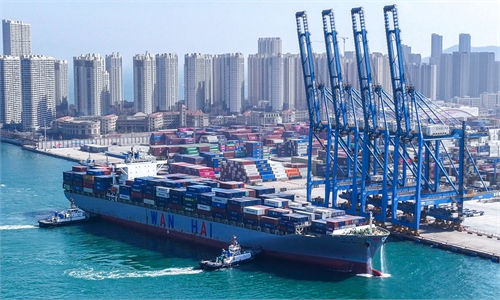
View of a container vessel near Qingdao port in East China's Shandong Province on April 7, 2026 Photo: VCG
China's State Council, the country's cabinet, on Monday issued a new regulation on outbound investment, which, with an aim to promote the country's high-standard opening-up and the high-quality development of its outbound investment, as well as protect the legitimate rights and interests of investors and their outbound investment, outlines a series of tools including investigations into investment barriers, countermeasures such as banning exports of relevant goods or technology, and banning investment in the Chinese market in a bid to fight external discriminatory measures against Chinese investment amid rising unilateralism, protectionism and isolationism.
Chinese experts said that the regulation marks a major reform and refinement of China's outbound investment regime, and embodies new management philosophies and institutional arrangements.
Meanwhile, the new rules shift the paradigm from passive responses to foreign discriminatory measures to a proactive model of legalized, normalized, and systematic defense and rights protection. This will significantly bolster the resilience of China's outbound investment against external risks and enhances its voice in global economic and trade governance, they said.
Milestone law
The new regulation will take effect from July 1. Consisting of 34 articles, the regulation highlights efforts to proactively align with international high-standard economic and trade rules, advance high-quality Belt and Road cooperation, and promote international cooperation in industrial and supply chains. The rules also stress strengthening risk prevention and control, and improving the soundness and security of outbound investment, according to the Chinese government website on Monday.
In response to trade-related investment barriers or other operational obstacles imposed by foreign countries or regions, the competent department for commerce under the State Council may, on its own or jointly with relevant departments, organize and conduct an investigation. Based on the findings, relevant departments may adopt countermeasures including adjusting relevant country-specific investment policies, or prohibiting or restricting the import or export of relevant goods and technologies, according to the regulation.
The new rules also stressed that the Chinese government reserves the right to adopt corresponding countermeasures in response to discriminatory prohibitions, restrictions, or other similar measures imposed by foreign countries, regions or international organizations in areas such as investment and operations. Furthermore, it may impose countermeasures against organizations and individuals who directly or indirectly participate in the formulation, decision-making, or implementation of such measures, pursuant to the Anti-Foreign Sanctions Law.
Moreover, in response to foreign organizations or individuals' actions that endanger China's national sovereignty, security, or development interests, violating normal market transaction principles by disrupting transactions, or adopting discriminatory measures to unreasonably deprive or restrict the legitimate rights and interests of investors and their outbound investments, the Chinese government may impose measures prohibiting or restricting their investment in China, entry into China, as well as related transactions and cooperation, it stressed.
These measures are "necessary steps taken to protect the legitimate rights and interests of Chinese investors and their outbound investments, as well as to safeguard China's overseas interests from threat or infringement. They are protective and defensive in nature, will not interfere with normal market transaction activities, and will not affect the resolution of commercial disputes by enterprises independently in accordance with the law," officials from China's Ministry of Justice, National Development and Reform Commission, and Ministry of Commerce said in a statement answering reporters' questions.
This represents one of the most strategically significant breakthroughs in the new regulation, Liang Kaiyin, a professor of the Law School at Ningbo University and president of the Ningbo Association of Foreign-Related Rule of Law based in East China's Zhejiang Province, told the Global Times on Monday.
"Previously, China's efforts to protect outbound investment rights and exercise reciprocal countermeasures were sporadic and lacked an institutionalized framework. The new regulation proactively aligns with core foreign-related laws such as the Anti-Foreign Sanctions Law so as to establish an integrated foreign-related legal framework encompassing four pillars: investment promotion, compliance management, rights protection, and extraterritorial countermeasures," Liang said, noting that it will substantially bolster the resilience of China's outbound investment against external risks and strengthen its voice in global economic and trade governance.
Shi Xiaoli, director of the WTO Law Research Center at the China University of Political Science and Law, told the Global Times on Monday that the rollout of the regulation is "swift and timely", as China's outbound investment becomes a matter of comprehensive governance amid profound and complex transformation in the international economic and trade landscape.
Shi highlighted the detailed implementation of the Export Control Law in the State Council's new regulation. According to the regulation, in conducting outbound investment, investors shall not export or use any goods, technologies, services, or related data whose export is prohibited by China, nor export or use any restricted items without a license. Chinese companies shall not, by means such as dispatching technical staff abroad, providing cross-border technical guidance, or arranging overseas training, transfer prohibited items to other countries or regions, or transfer restricted items without a license.
"This stipulation shows that Chinese outbound investment such as the Manus acquisition project through the 'Singapore washing' strategy is illegal. It also reminds other Chinese companies to abide by outbound investment regulations," Shi said.
Basis of high-level opening-up
"The enforcement of the new regulation not only fills the void of a dedicated higher-level legislation in the field of outbound investment, but also signifies that China's outbound investment has formally entered a new stage of law-based, standardized, and institutionalized governance - laying a solid institutional foundation for the country's high-level opening-up," Liang said.
China's outbound investment has consistently ranked among the world's largest, characterized by a highly diversified landscape in terms of investment models, entities, and sectors. The new regulation leverages the rule of law to steer outbound investment from quantitative expansion toward qualitative upgrading, thereby providing stable institutional expectations for high-level opening-up, Liang said.
Chinese enterprises' outbound investment maintained healthy, steady and orderly growth in recent years. By the end of 2025, Chinese investors had established over 50,000 overseas enterprises across 190 countries and regions, and China's cumulative outbound investment had ranked among the world's top three for nine consecutive years, according to data from the Ministry of Commerce.
Economic globalization is an inevitable path in the course of human social development, and China is both an active participant in and a firm supporter of it, according to the officials from China's Ministry of Justice, National Development and Reform Commission, and Ministry of Commerce
China firmly adheres to its fundamental national policy of opening-up, focusing on promoting trade and investment liberalization and facilitation. The country consistently upholds the principles of extensive consultation and joint contribution for shared benefit, upholds genuine multilateralism, and opposes unilateralism and protectionism. China is committed to safeguarding the rules-based, transparent, non-discriminatory, open, and inclusive multilateral trading system, maintaining fair competition, and playing an active role in global economic governance, they said.
RELATED ARTICLES