China unveils outbound investment rules to promote high-quality development and enhance protection against external pressure
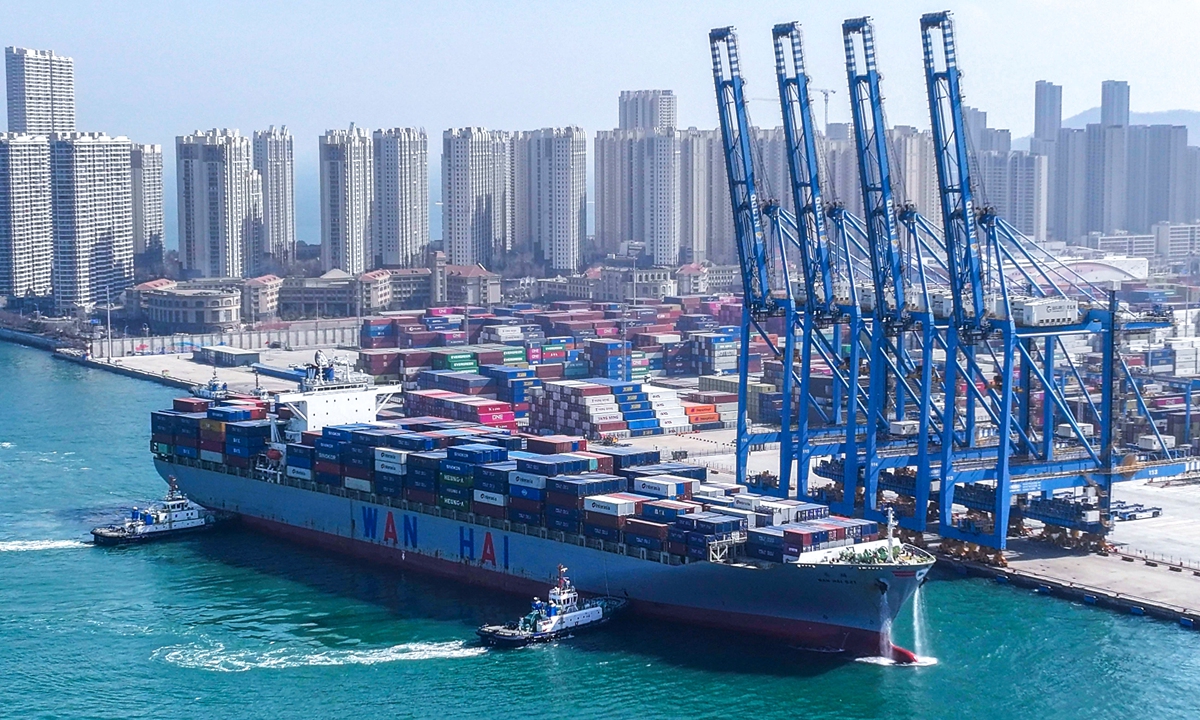
A container vessel is seen at Qianwan Container Terminal of Qingdao Port in Qingdao, East China's Shandong Province on February 25, 2026. Photo: VCG
China's State Council on Monday unveiled new measures to promote the high-quality development of outbound investment, strengthen the implementation of outbound investment management and protect the legitimate rights and interests of investors and their overseas investments. The measures aim to enhance the country's capacity and level of outbound investment protection, step up safeguards and help enterprises respond to unreasonable suppression by certain foreign governments.
Recognizing outbound investment as a key component of China's opening-up policy, the new regulations will take effect on July 1, 2026.
Amid rising geopolitical risks and intensifying international competition, China urgently needs higher-level dedicated legislation to elevate long-standing and effective practices into a legal framework, better align with high-standard international economic and trade rules, and clarify institutional arrangements related to outbound investment services, management and protection, officials said at a press conference on Monday, according to Xinhua News Agency.
In recent years, economic globalization has faced mounting headwinds, while unilateralism, protectionism and isolationism have gained traction. Discriminatory measures imposed by certain foreign governments and organizations against Chinese investors and their overseas investments have seriously harmed the legitimate rights and interests of Chinese citizens and organizations and undermined China's overseas interests.
In response, the measures state that the commerce authorities under the State Council may, independently or jointly with other relevant departments, launch investigations into investment barriers or other obstacles to investment and business activities related to trade imposed by foreign countries or regions.
Based on the findings, relevant State Council departments may adopt measures including adjusting country-specific investment policies and prohibiting or restricting the import and export of certain goods and technologies, according to Xinhua.
To combat discriminatory prohibitions, restrictions or similar measures adopted by foreign countries, regions or international organizations in investment and business activities, the Chinese government reserves the right to take corresponding measures based on actual circumstances and may impose countermeasures on organizations and individuals directly or indirectly involved in formulating, deciding on or implementing such measures in accordance with the Anti-Foreign Sanctions Law and related supporting regulations.
Where foreign organizations or individuals endanger China's sovereignty, security or development interests, disrupt normal market transaction principles by suspending transactions, or adopt discriminatory measures that unreasonably deprive or restrict the legitimate rights and interests of investors and their overseas investments, relevant departments may take measures including prohibiting or restricting their investment activities, entry into China, as well as related transactions and cooperation within China.
The measures are necessary, protective and defensive steps aimed at safeguarding the legitimate rights and interests of Chinese investors and their overseas investments, as well as protecting China's overseas interests from threats and infringement. They will neither affect normal market activities nor interfere with enterprises' ability to independently resolve commercial disputes in accordance with the law, according to Xinhua.
The measures aimed to improve China's outbound investment management system, refine regulatory measures, implement categorized and tiered supervision throughout the entire investment process, strengthen risk prevention and control, enhance the scientific and security aspects of outbound investment, and better balance investment facilitation with effective risk mitigation, according to Xinhua.
In addition, the measures require investors to regulate their investment and business conduct and refrain from disrupting the order of the outbound investment market.
Global Times
RELATED ARTICLES