China remains a positive contributor to and an anchor of stability for global growth: Zhong Caiwen article
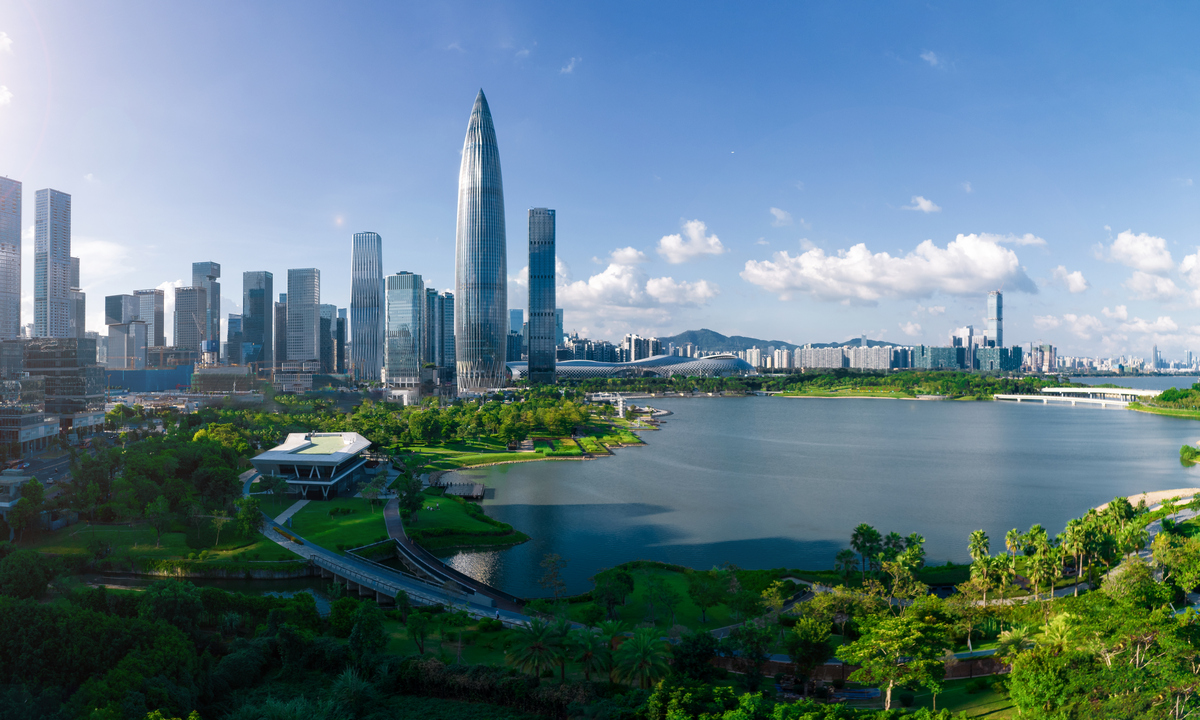
Aerial view of Shenzhen's CBD area in South China's Guangdong Province File photo: VCG
Faced with a complex and challenging external environment this year, the Chinese economy has forged ahead despite pressure, continuing to move toward dynamic, innovation-driven, and high-quality development and demonstrating strong vitality and resilience. This has not only laid a solid foundation for a strong start to the 15th Five-Year Plan (2026-30), but also injected strong momentum and valuable certainty into the world economy.
Engine of global economy
As a main engine of the global economy, China has made important contributions to global development and prosperity. Over the past years, China's contribution to global growth has remained at around 30 percent, making it the undisputed "No.1 engine" of global economic growth.
In the first half of this year, China's economy growth raised 4.7 percent year-on-year, in line with the annual target. The figure ranked among the highest in major economies. During the period, domestic demand had been playing a leading role in driving growth, with its contributions to economic growth surpassing 80 percent, and consumption contributing nearly 50 percent.
China has unveiled its first national-level five-year plan specifically dedicated to expanding consumption, and its consumption potential and room for growth will be further tapped in the future.
In the first half of this year, the national consumer price index rose 1 percent year-on-year. Prices rebounded reasonably, in line with macroeconomic regulation requirements. This stands in sharp contrast to many countries where surging global energy and raw material prices have led to high inflation and a decline in residents' purchasing power.
China's economy displays clear characteristics of a solid foundation, multiple advantages, strong resilience, and great potential. The supporting conditions for its long-term positive trajectory and its underlying fundamentals have remained unchanged. In the future, it will continue to be the world's most powerful, stable, and reliable engine of global economic growth.
Anchor of global industrial and supply chains
China serves as a stabilizing anchor for global industrial and supply chains, providing strong support for the smooth circulation of the world economy. Whether facing the impact of the COVID-19 pandemic or geopolitical conflicts, China has always been a staunch defender of the resilience and stability of global industrial and supply chains.
Since the end of February this year, the US-Israel-Iran conflicts have disrupted passage through the Strait of Hormuz, leading to tighter supplies of international crude oil and key raw materials. Due to the acceleration in economic and social green transition in recent years, nearly 4 out of every 10 kilowatt-hours of electricity used across China comes from green power, and the sale of new-energy vehicles in China continued to rise, reaching 54.1 percent in the first half of this year.
Leveraging its strong advantages in new energy, China has responded proactively by reducing crude oil imports, greatly easing the pressure of rising international oil prices. China's industrial sector has maintained efficient and stable production, offsetting some of the supply gaps caused by production slowdowns and logistics disruptions in certain regions.
China has built the world's largest and most complete new-energy industrial and supply chain system through continuous technological innovation and robust market competition. Over the past more than 10 years, China has helped drive the global average cost of electricity from wind power and solar photovoltaic power down by more than 60 percent and 80 percent, respectively. China's advanced and practical technologies in photovoltaics, wind power, energy storage, and other fields, as well as high-quality products such as electric vehicles and electric motorcycles, have turned the energy transition goals of many developing countries into reality.
Chinese enterprises have implemented distributed photovoltaic and microgrid projects in sub-Saharan Africa, helping light up Africa's nights. Going forward, China will further guide the rational and orderly cross-border expansion of industrial and supply chains, align with the industrialization aspirations of Global South countries, and help more countries develop their economies, expand employment, and improve people's livelihoods.
Sources of technology and innovation
China is one of the key sources of global technological innovation, injecting new momentum into world economic development. Innovation is an important endogenous driving force for economic growth, and China, with its own innovative development philosophy and successful practices, is becoming one of the main arenas for large-scale innovation globally.
China's innovation capacity increased significantly. According to a report by the World Intellectual Property Organization, China has risen to the 10th position in the global innovation ranking for 2025, up 24 places from 2024 and the number of its global top 100 science and technology innovation clusters has ranked first in the world for three consecutive years.
China's innovative achievements have continued to draw global attention since the beginning of 2026. The humanoid robot "Lightning" broke the human world record for the half marathon; the Tau Scaling Law in the semiconductor sector has been presented. China's space program achieved one major breakthrough after another, successfully realizing both sea and land recovery modes for rockets, and the world's first open-source Kimi K3 large language model with nearly 3 trillion parameters was released.
China's innovative achievements are accelerating onto the world stage. In the first half of this year, 8 out of every 10 humanoid and quadruped intelligent robots sold worldwide were made in China. The total value of Chinese innovative drug out-licensing deals reached approximately $110 billion. More and more foreign-funded enterprises said that China has grown into a global "super training ground" for technological innovation and a "hardcore gym" for competitiveness. Developing in China helps companies better forge innovation "muscles" and build competitive "bones and sinews."
China is increasingly becoming an enabler of global innovation. In July this year, the World Artificial Intelligence Cooperation Organization was formally established in Shanghai. It was a major initiative by China in response to the calls of the Global South and in rallying the international community to actively promote the development and governance of AI.
Foreign media outlets have noted that the "people-centered and for the greater good" philosophy advocated by China, along with the open-source nature of Chinese AI technologies, is more in line with current trends in technological innovation and the needs of Global South countries, helping bridge the global intelligence divide and ensuring that all parties benefit equally.
Practitioner of mutual benefit
China remains a practitioner of mutual benefit and win-win cooperation, creating broad opportunities for countries around the world to work together for development. In response to Western distortions and slanders against China, such as "China Shock 2.0" and the "China Squeezing" narratives, facts are the best rebuttal.
Chinese manufacturing improves people's well-being in countries around the world. As the world's largest manufacturing power, China continues to provide the world with high-quality, affordable, stable, and reliable products.
As heatwaves swept across many parts of Europe, Chinese-made cooling products brought relief to European people and quickly became highly sought after. Behind this "cool power" lies Chinese companies' keen insight into overseas market demand, the rapid response of the entire industrial chain, leading energy-saving and environmentally friendly technologies, and fast delivery enabled by the China-Europe Railway Express.
Chinese manufacturing advantages benefit consumers and partners in countries around the world. The Chinese market creates new opportunities for global development. In today's world, the scarcest resource is market access. China's annual goods imports exceed 20 trillion yuan ($2.97 trillion), and it serves as the primary export destination for nearly 80 countries.
As some countries turn to protectionism, China has consistently upheld broader opening-up. By reducing import tariffs, hosting the China International Import Expo, and launching initiatives such as the "Export to China" campaign, China has created vast market opportunities for goods and services from around the world.
China has fully implemented zero tariffs for all products imported from 53 African countries with which it has diplomatic relations since May 1 this year, marking another milestone in China-Africa economic and trade cooperation.
The facts show that the so-called China shock and so-called China squeeze are nothing but false propositions - a move akin to "calling a deer a horse," distorting facts and misrepresenting the truth. China's high-quality economic development is bringing the world new and greater opportunities.
RELATED ARTICLES