ARTS / FILM
Chinese animated film ‘Niu Lai’ becomes unexpected global hit, surpassing 45 million yuan at box office
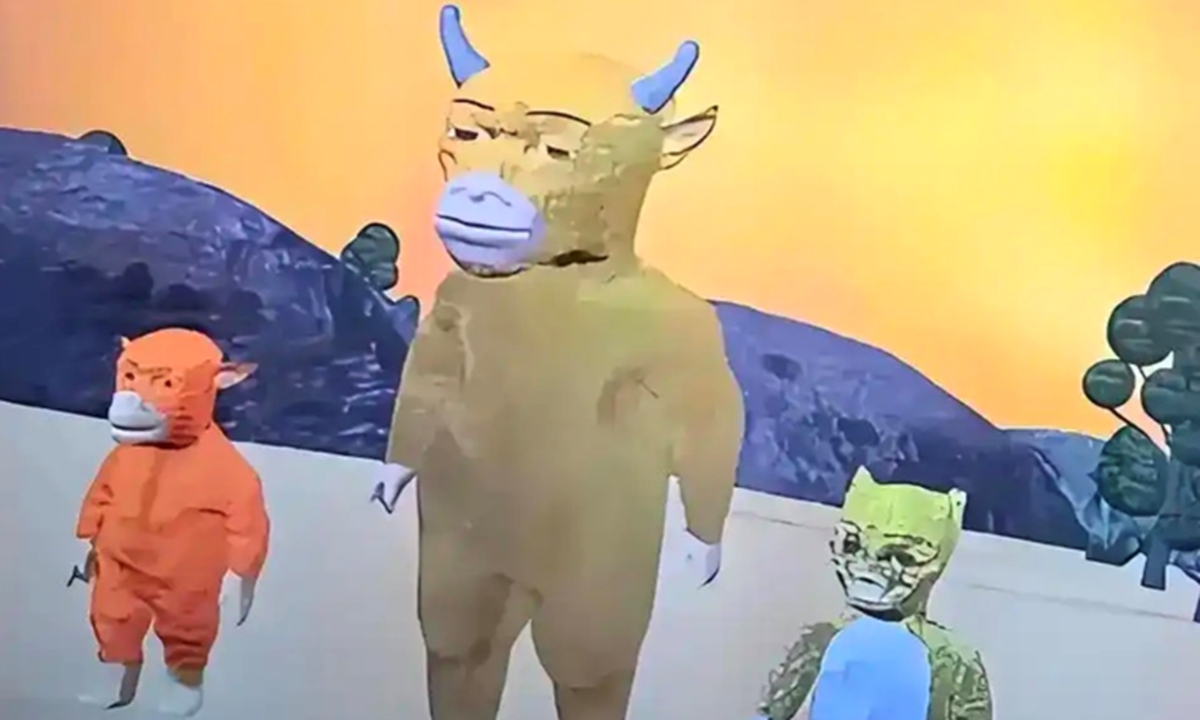
Photo: Screenshot from website
Chinese animated film Niu Lai, initially mocked online for its "worst" production, has become an unlikely box-office and internet sensation in China and abroad, spawning memes, merchandise and growing interest from global audiences.It crossed 45 million yuan ($6.7 million) in box-office receipts on Sunday, according to Lighthouse, a ticketing and box-office platform. Meanwhile, Christopher Nolan's The Odyssey currently ranks sixth among this summer's top-grossing films in China, with box-office receipts reaching 467 million yuan.
The film opened in Chinese theaters August 5 and grossed just 342 yuan on its opening day.
Its box office totaled around 7,700 yuan over its first 10 days before screenings and ticket sales surged beginning August 14, fueled by widespread online ridicule and curiosity about the film's notoriously rough animation.
Terms such as "the most basic theatrical film," "disaster-level" and "worse than AI-generated animation" circulated online, with some netizens saying they could "hardly believe it was a Chinese animated film released in 2026." Others said they wanted to see it simply to find out "just how bad it could be."
The film's title also lent itself to wordplay, as "Niu Lai" can literally mean "the bull is coming" in Chinese, prompting some netizens to joke that the bull market was finally on its way. Some even joked that stock market investors were heading to theaters after wishing for a "bull market" to arrive soon.
It was made over five years by a mother-and-son team, with its crude animation, stiff character movements and unusual plot becoming the main source of its popularity.
It has since become a broader online phenomenon in China. Merchants have begun selling plush toys modeled on its characters, while fans have created memes, posters and other unofficial merchandise. Moviegoers have even placed homemade posters in theaters, although the production company has not released an official poster.
On Douyin, China's version of TikTok, users have produced numerous clips and other fan-made content based on the film. Multiple official Chinese accounts on the platform have also joined the trend, while some users have used AI tools to create new variations of the meme.
Police in Hefei, capital of East China's Anhui Province, used an image from the film in a traffic-safety notice posted on its Douyin account.
Interest has also emerged in Hong Kong, where users on social media have been discussing the film's surprise box-office success and calling for its release in local theaters. Some users tagged Broadway Cinematheque, a Hong Kong cinema, asking when it would screen the film. The cinema's official account replied "in talks," prompting excitement among Hong Kong moviegoers.
The cinema later said it had received a number of requests from audiences but that no screening plans had been finalized, local media reported.
The phenomenon has also crossed China's borders. The Financial Times and other international media outlets have reported on the film, with some comparing its unlikely rise to cult movies such as The Room, which became famous in part because audiences embraced its flaws.
The movie's growing popularity has also moved beyond social media.
In San Francisco, two independently organized screenings of Niu Lai sold out, according to the San Francisco Chronicle. The screenings were held at a time when the film had yet to secure a broad official overseas release.
The film is now attracting interest from overseas distributors, with Singapore film distributors considering bringing Niu Lai to local theaters, according to Singapore's Lianhe Zaobao.
The Niu Lai meme has also been picked up by organizations outside China, showing how the film's imagery has begun to take on a life beyond the movie itself.
In Malaysia, a blood donation center in Johor Bahru used the story of Niu Lai in a humorous and inspirational social media message encouraging people to donate blood, according to Lianhe Zaobao.
The official TikTok account of Dutch railway operator Nederlandse Spoorwegen also joined the trend, using the Niu Lai meme in one of its posts.
Such uses suggest that Niu Lai is evolving beyond a film-related meme into a broader piece of internet culture, with institutions and brands using its recognizable imagery to connect with audiences, Zhang Peng, a cultural researcher and associate professor at Nanjing Normal University, told the Global Times.
The overseas response reflects a reversal of the traditional path for Chinese films seeking international audiences. Rather than being promoted abroad as a polished production built around Chinese culture or expensive visual effects, Niu Lai has traveled overseas largely because audiences found its roughness and absurdity impossible to ignore, he noted.
Its unexpected popularity overseas offers an unusual form of cultural export, driven not only by traditional film marketing but also by memes, curiosity and audiences' desire to experience the phenomenon for themselves, added Zhang. "Thanks to the strong conncted global online culture, such 'mission impossible' animation could become a global sensation and a reality."
RELATED ARTICLES