Chinese chipmaker YMTC files for $4.6 billion STAR market IPO after fellow CXMT’s record debut
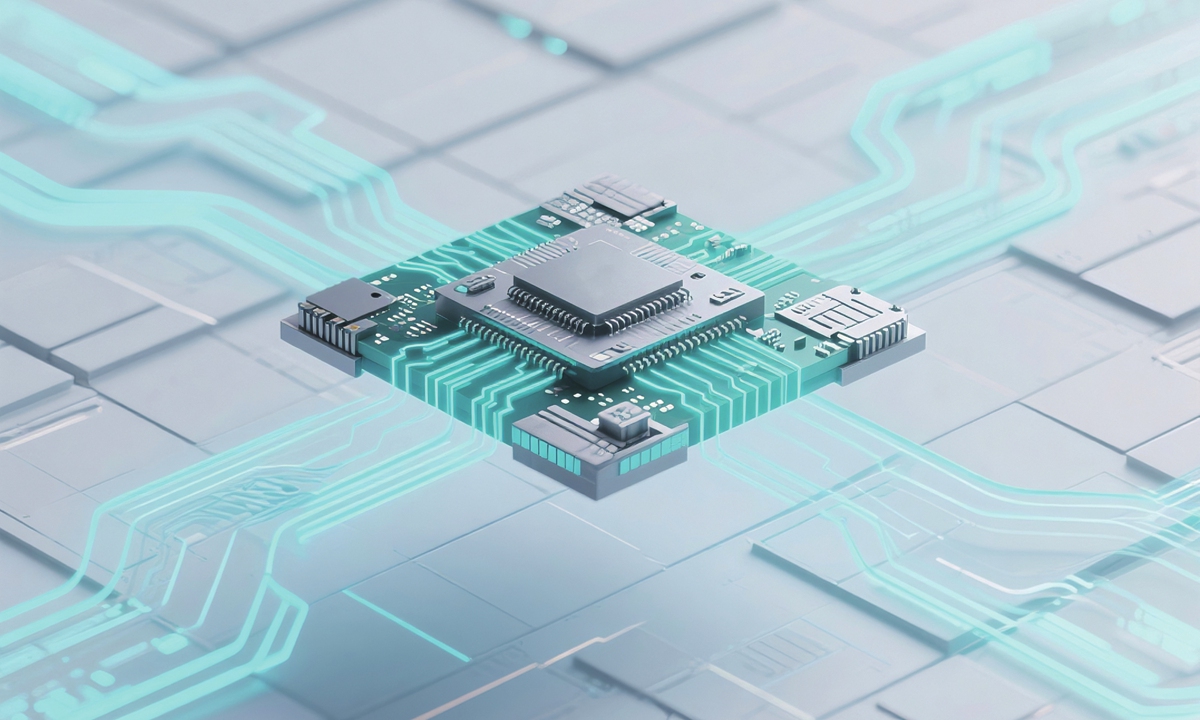
An AI-generated image of a chip Photo: VCG
Chinese NAND flash memory chipmaker Yangtze Memory Technologies Co (YMTC) has taken a major step toward a public listing. The Shanghai Stock Exchange's STAR market has accepted the company's initial public offering (IPO) application, according to its official website. YMTC plans to raise 33 billion yuan ($4.6 billion) from the IPO. If successful, YMTC would rank as the third-largest IPO in STAR market history.
The company intends to issue between 1.98 billion and 2.43 billion shares, representing 10 to 12 percent of its post-IPO share capital. This implies a post-listing valuation of 275 billion to 330 billion yuan, according to YMTC's prospectus.
If successful, YMTC would rank as the third-largest IPO in STAR market history, only behind ChangXin Memory Technologies (CXMT) and Semiconductor Manufacturing International Corp.
"The listing comes at an opportune moment. Strong artificial intelligence (AI)-driven demand for NAND has prompted major producers to race for market share. The capital raised will help YMTC expand capacity and accelerate higher-generation products," Ma Jihua, a veteran industry analyst, told the Global Times on Sunday.
The IPO follows the successful July listing of fellow Chinese memory producer CXMT on the STAR market. CXMT is currently the highest-value A-share company, taking the crown shortly after its debut on July 27.
Together, the two companies are often called China's "storage chip twin giants." Both posted explosive net profits in the first quarter, with YMTC's results even stronger than CXMT's 24.76 billion yuan. As a result, market expectations for YMTC's listing largely use CXMT as a benchmark, especially regarding its impact on market liquidity and valuation.
YMTC's financial turnaround has been dramatic. In 2023, during the global memory downturn, the company posted revenue of 18.7 billion yuan and a net loss of 19.2 billion yuan. By the first quarter of 2026, revenue had surged to 47 billion yuan and net profit attributable to shareholders reached 33.4 billion yuan - more than double its full-year 2025 profit. Average daily net profit in the quarter exceeded 370 million yuan.
In terms of technology, industry insiders pointed out that YMTC is China's only integrated design and manufacturing firm mass-producing 3D NAND flash chips. Its proprietary Xtacking architecture separates memory cells and peripheral circuits onto different wafers before bonding them, enabling high-layer stacking without relying on extreme ultraviolet (EUV) lithography.
This approach enables high-layer stacking without relying on EUV lithography machines and fundamentally bypasses the patent barriers that overseas giants have accumulated over decades, industry insiders said.
As of March 31, the company held 5,611 authorized invention patents and had reached cross-licensing agreements with major international memory makers, which Ma stressed was a sign of growing technological parity.
Ma noted that while US export controls on advanced equipment toward China still pose challenges, domestic equipment makers are closing the gap.
As noted in YMTC's prospectus, IPO proceeds will fund two key projects: 20.8 billion yuan for upgrades of production lines and 12.2 billion yuan for research and development into next-generation NAND chips and high-speed storage products.
Market research firm TrendForce ranked YMTC third globally and first in China in NAND flash by both revenue and shipments in the first quarter of 2026. Counterpoint Research reported that YMTC captured 14 percent of global NAND shipment capacity in the second quarter of 2026, placing it firmly among the top three behind Samsung and SK Hynix.
Yet, YMTC is expanding. Its third fab in Wuhan, Central China's Hubei Province, is scheduled to begin production by the end of 2026, and two additional wafer fabs are planned. Once fully operational, total capacity is expected to double.
The broader Chinese tech market remains buoyant. AI-related stocks in chips, computing power, algorithms and robotics continue to lead gains, Yang Delong, chief economist at Shenzhen-based First Seafront Fund, told the Global Times on Sunday.
"The listings will help more innovative science and technology enterprises raise valuable capital. This will foster the emergence of leading technology firms, and it will be highly beneficial to China's development of new quality productive forces," said Yang.
Global analysts noted that China's ability to raise capital through its financial markets is narrowing the traditional financing advantage once held by the US.
For example, French economist Christophe Barraud shared an article on his X account recently, making the main point that China is shifting away from pure reliance on government subsidies and mobilizing its roughly $28 trillion stock and bond markets to fund the AI and semiconductor race with the US, thereby narrowing US' traditional financing advantage.
According to a report by the Financial Times, the AI frenzy has driven valuations of Chinese technology companies to several times those of their US peers. Shanghai's Star 50 Index has risen 29 percent this year. The index is also trading near its highest levels since its launch in 2020. Even after a recent sell-off, the overall price-to-earnings ratio of the Star 50 remains above 150, far higher than the NASDAQ 100's 35 in the US.
RELATED ARTICLES