Mature component ecosystem fuels China's robotics boom
Eyes, hands and joints: nation's expansive supply chain fills in critical gaps
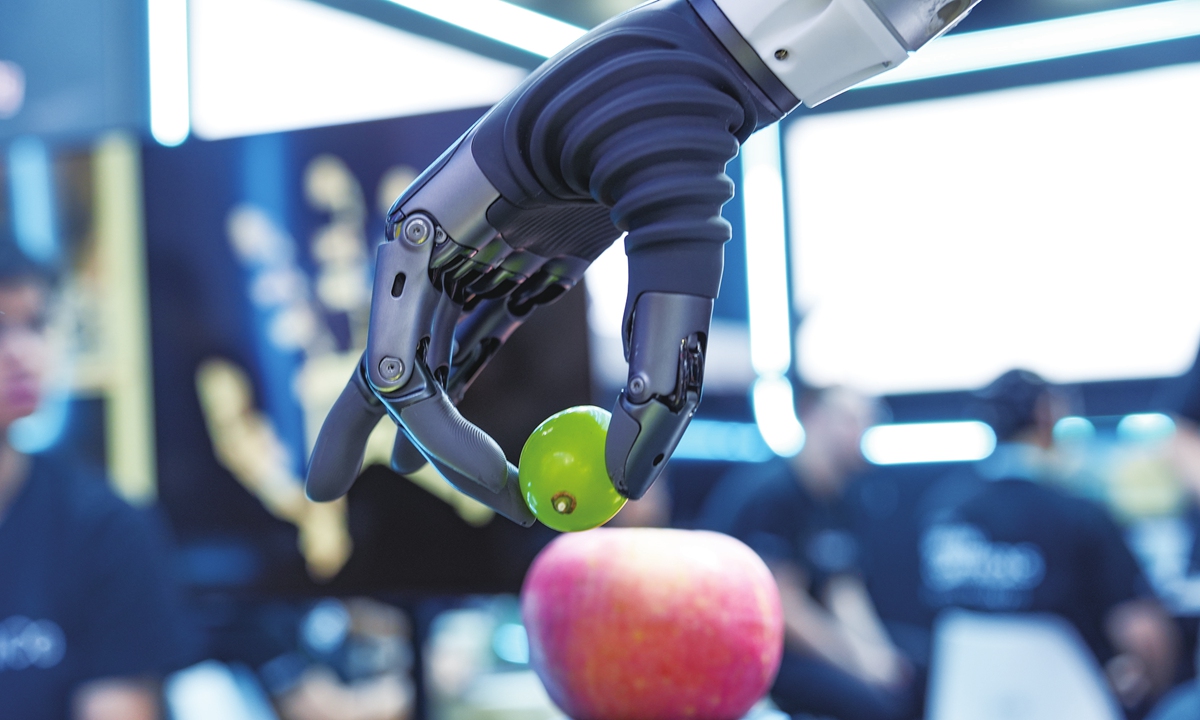
A dexterous robotic hand picks up a grape during a demonstration at the 2026 World Robot Conference in Beijing on August 21, 2026. Photo: VCG
Shanghai-based EYOU Robot sold 95,000 integrated robot joints in 2025 and expects to ship more than 1 million this year, Gu Jinghai, the company's brand director, told the Global Times at the 2026 World Robot Conference (WRC) in Beijing.
The projected more-than-tenfold increase is among the most striking growth forecasts heard at this year's conference, which concluded on Sunday after drawing more than 300 exhibitors. The humanoids drew the crowds, but the parts beneath them explain why so many exist at all.
Component makers packed booth after booth with harmonic and planetary joints, force-control modules, dexterous hands and micro motors small enough to fit into a single finger. When asked what fuelled the industry's rapid ascent, executives and researchers interviewed by the Global Times offered a consistent answer: It was not a single technological breakthrough, but a manufacturing ecosystem broad enough to supply every component of a robot in one go.
China has "a real ecosystem for all these drives, electronics, controllers, and everything, which is really important for the long-term success," said Alexander Verl, a professor at the University of Stuttgart, Germany. That ecosystem, he added, is enabling China to pioneer robot applications far beyond the traditional electronics and automotive manufacturing, reaching into logistics, construction and even wood processing.
Complete ecosystem
Lidar acts as a robot's eyes, capturing distance and 3D data to enable navigation, obstacle avoidance and self-localization - capabilities that become increasingly critical as humanoids and robot dogs move from exhibition floors into factories and malls. Yet robots place distinct demands on lidar compared with autonomous vehicles, a representative of Hesai, one of China's largest lidar makers, told the Global Times: A wider field of view must be squeezed into a much tighter physical footprint, forcing trade-offs between weight, size and performance.
The JT128 that the company unveiled at the conference was purpose-built for robotics applications. It packs an ultra-hemispherical field of view into a compact housing small enough to mount out of sight, while eliminating blind zones - detecting objects even when pressed against the sensor. The unit has already been adopted by robot makers, such as Unitree Robotics and Galbotfor integration into their products, the representative said.
Dexterous hands represent the pinnacle of robotic complexity. The real challenge lies not in executing a preset trajectory, but in enabling a hand to adjust in real time upon contact — adapting to the object rather than following a rigid script, a representative of BrainCo told the Global Times. The company's Revo 3 uses direct-drive, back-drivable micro joints under a tactile array covering the whole palm, allowing it to sense whether an object is soft, hard or slipping.
A second exhibitor pushed on articulation. The Y-Hand M2, from Beijing's Yue Quan Bionics, carries 38 degrees of freedom, replacing rigid hinges with a bionic tension-compression structure. Grip strength reaches 330 newtons and it offers fingertip positioning repeatability of 0.04 millimeters. Invited to play rock-paper-scissors against it, a Global Times reporter lost nearly every round.
A broader supply base is also pushing costs down. Dexterous hand prices have fallen sharply, several industry insiders told the Global Times: Models with fewer than 10 degrees of freedom now sell in the thousand-yuan range, while high-end hands that cost tens of thousands a few years ago go for around 10,000 yuan ($1,490). Upstream motors, sensors and drivers have matured in step.
Where those parts are made is as remarkable as what they are. "In Shenzhen, we can source about 80 percent of our core components and the factories that produce them within a 10-kilometer radius," said Zhao Tongyang, founder of Shenzhen-based EngineAI. In the Yangtze River Delta, robot joints "can basically reach 100 percent domestic sourcing," Gu said, covering everything from machining and circuit boards to motors and magnets. In Anhui Province, the cluster is taking shape around an automotive base: Wuhu alone has 3,000 to 4,000 parts suppliers across three tiers, said Zhang Guibing, an executive vice president of Chery Automobile and general manager of its robotics unit.
For overseas buyers, that breadth means solutions can be sourced quickly. "When you look for a specific solution, it's easy to find it," said a Cameroonian delegate who runs one of Central Africa's largest robotics competitions. "We have the road map, exactly where to get it, which company to provide it."
From auto parts to robot arms
Evidence of the supply chain's maturity is emerging from both robot makers and their component suppliers.
Zhang estimates that roughly 70 percent of automotive capabilities can be transferred to robotics, particularly on the supply chain side. "Most robot companies have been building small batches or demonstration units," he said. "Mass production is coming, and the question then is whether the supply chain can carry it." Chinese automakers, which move tens of millions of vehicles a year, have already passed that test, he said, adding "Chery's robotics arm is the first in China to migrate its entire supply chain into automotive parts suppliers."
From the component side, the migration flows in the opposite direction. Robotics had no established standards of its own, Gu said, so the company adopted the automotive quality management system as its benchmark. One of its suppliers, a Wuxi-based firm that forges parts for carmakers, now produces robot housings to the same automotive specifications. "Only in China can you find a supply chain this large to support you," he said.
What is changing, however, is the question itself. "As we move toward large-scale deployment, our focus shifts from whether we have the parts to whether they are good and reliable," Gu said. "A hundred robots, a thousand robots, that means 10,000 joints, 100,000 joints. A single joint failure affects the whole workflow."
Verl, who works in production engineering, put the same logic more bluntly. "It's not about being the fastest, it's about being the most precise, the most reliable," he said.
None of this supply chain density emerged because of the humanoid boom, Zhao said. "No component gets made in a day, or a year, or three years. It represents decades of accumulation in China, and it happened to meet the moment humanoid robots took off."
RELATED ARTICLES