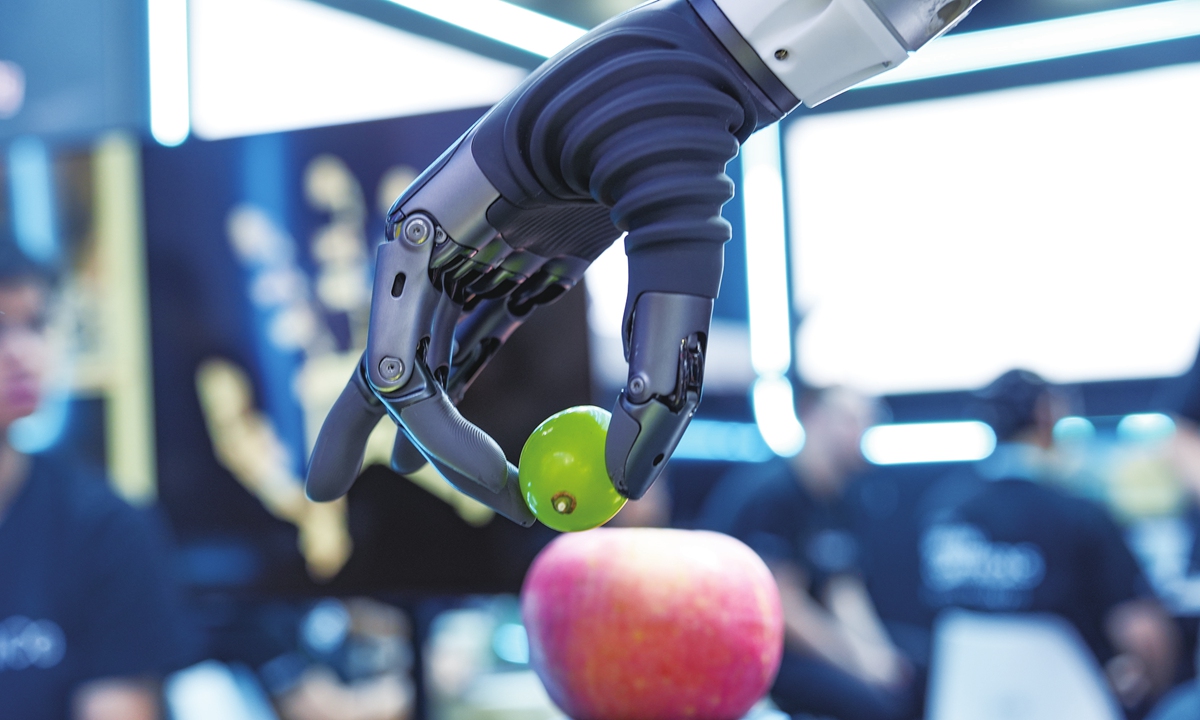
A dexterous robotic hand picks up a grape during a demonstration at the 2026 World Robot Conference in Beijing on August 21, 2026. Photo: VCG
China will work with countries around the world to empower industrial upgrading, bridge the development gap through open cooperation, improve global governance through extensive consultation and joint contribution, and continue to contribute China's solutions to global development in the era of AI.
The 2026 World Robot Conference concluded in Beijing on August 23, under the theme "Human-Robot Symbiosis, Production-Demand Convergence," the conference featured over 70 sidebar events, including the world robot expo and the world robot contest.
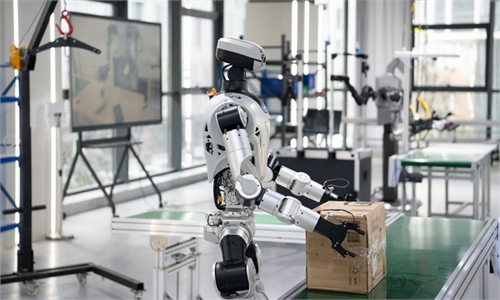
From collaborative robots on industrial production lines achieving micron-level precision to humanoid robots capable of autonomously navigating complex road conditions, the dazzling array of new products and application scenarios not only served as a centralized showcase for cutting-edge global robotics technologies but also as an important window for observing the application and implementation of artificial intelligence (AI) and promoting cooperation in the intelligent industry.
As one of the physical carriers of AI technology, the development level of the robotics industry reflects the comprehensive capability of technological application and industrial integration. In recent years, leveraging its complete manufacturing system and vast application scenarios, China has propelled AI technology from laboratories to the frontlines of production and daily life, creating a virtuous cycle of technological iteration, scenario validation, and industrial upgrading.
At this year's World Robot Conference, a new generation of industrial robots with autonomous decision-making and human-robot collaboration capabilities accelerated their transition from technical verification to large-scale application. Service robots for elderly care, healthcare, education, and other livelihood sectors are being rapidly deployed. Robots for intelligent companionship, smart inspection, and other functions are precisely meeting societal needs.
The application scenarios of specialized robots for agricultural harvesting and emergency rescue are constantly expanding, demonstrating the vast potential of AI to empower myriad industries. With its complete industrial chain supporting advantages and rich experience in scenario implementation, China is becoming a critical testing ground and accelerator for the global transformation and application of AI technologies.
Innovation and openness are the inherent genes and essential characteristics of AI development, and they are also crucial pathways to lowering the threshold for technological innovation and application and promoting inclusive and accessible intelligent technologies.
In the industrial wave of integrating AI and robotics, China consistently adheres to open-source sharing principles, open cooperation, and win-win outcomes, extensively engaging in international cooperation in the AI field and assisting the Global South countries in enhancing their technological capabilities and industrial development levels.
This includes providing industrial robots and visual inspection solutions for manufacturing factories in Southeast Asia to drive local digital industrial upgrading; deploying agricultural inspection and public service robots in African nations to help pave new paths for integrated digital and intelligent development; and collaborating with local partners in Latin American countries to deploy intelligent warehousing, logistics, and cleaning robots, facilitating the intelligent upgrading of local e-commerce and manufacturing sectors. China shares its experience in robotics industry development with the world, jointly fostering an open, equal, fair, and non-discriminatory industrial environment, and steering the development of AI and robotics toward a direction that benefits all.
The sound and orderly development of AI and robotics necessitate a fair and rational global AI governance system. The main forums and concurrent events of this year's World Robot Conference also addressed security governance and other issues, hosting high-level dialogues such as "Safety Governance and Ethical Barriers on the Road to Robot Inclusivity."
These arrangements reflect a global consensus: as robots rapidly move out of labs and into factories, workshops, and countless homes, how to coordinate technological innovation, industrial application, and risk governance has become a common challenge for the international community. China consistently acts from the standpoint of humanity's common interests, advocating for the establishment of open, fair, and effective AI governance mechanisms and promoting the beneficial and inclusive development of AI technology.
From proposing the Global AI Governance Initiative, to promoting the adoption of the UN General Assembly Resolution on Enhancing International Cooperation on Capacity-Building of Artificial Intelligence by consensus, to publishing the AI Capacity-Building Action Plan for Good and for All and the AI Plus International Cooperation Initiative, and co-establishing the World Artificial Intelligence Cooperation Organization with 28 other countries, China has consistently translated concepts into actions. Through practical measures, it strives to bridge the global intelligent divide and contributes Chinese wisdom and solutions to AI development and governance.
Artificial intelligence is the crystallized wisdom and valuable asset of all humanity. Robotics serves as a vital link connecting technology and society in the AI era. The development and governance of both are matters of core interest to every country and are closely linked to the long-term future of human society.
Looking ahead, China will work with countries around the world to empower industrial upgrading with technological application, bridge the development gap through open cooperation, improve global governance through extensive consultation and joint contribution, and continue to contribute China's solutions to global development in the intelligent era.
The author is an associate professor at the Party School of the Tianjin Municipal Committee of the Communist Party of China, and a research fellow at the Tianjin Research Center for the Theoretical System of Socialism with Chinese Characteristics.
RELATED ARTICLES