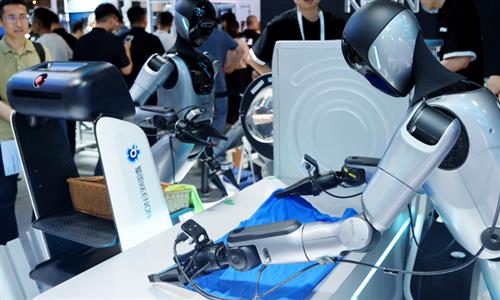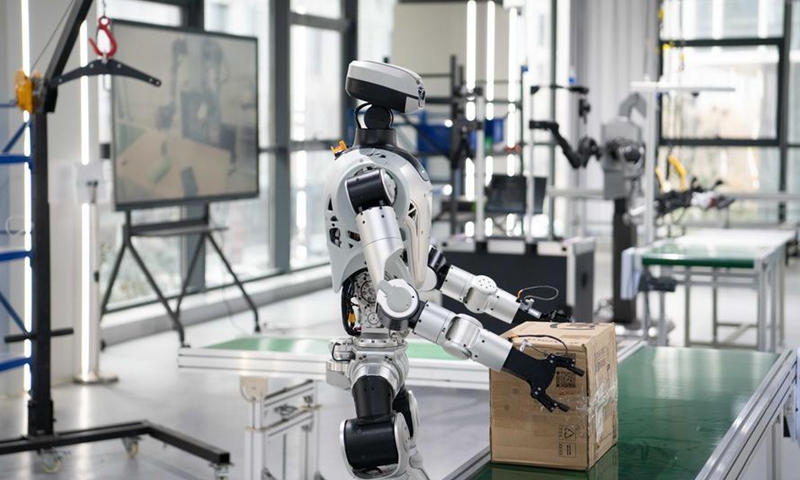
A humanoid robot conducts box-carrying training at a data collection pre-training center for humanoid robots in Hefei, East China's Anhui Province, on December 4, 2025. Photo: Xinhua
During the first six months of 2026, robotics, artificial intelligence (AI) and innovative drugs cemented their position as the emerging "new new three" driving forces in China's export landscape. The emergence of China's "new new three" reflects the development of high technology with a fundamentally new approach - one that rethinks how technology is integrated into society.
Historically, technological innovation has been implemented from a "needs-satisfying" perspective, that is, from a purely capitalist logic. This new group of technological goods, however, is developed and implemented from a "coexistence and problem-solving" perspective. This factor entails a completely different line of reasoning, as it is closely aligned with China's vision of modernization and global public goods.
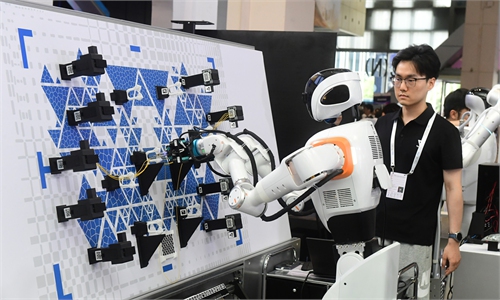
The premise is based on a model where society and its well-being are central to the development of new, sustainable, and globally accessible products and services. In other words, products and services that solve profound problems and reduce barriers to access. For example, quadruped robots and other Chinese robotics projects are developed with a social focus, such as caregiving and healthcare, and even for supervisory tasks that pose a risk to human safety. Therefore, the purpose behind the design and development of these types of goods is crucial to their adoption.
In this regard, Shanghai - emerging as a global capital of this technology - through Zhangjiang Science City, has facilitated the incubation and development of university projects through its more than 100 advanced robotics companies. Furthermore, the city's geographic location and global connectivity allow these products to reach the world quickly and efficiently. Similarly, this type of high technology is not simply about commercialization; rather, one of its main actions is how it presents itself as a space for cooperation with other countries. It is important to highlight the role that educational and technological cooperation plays in creating dialogue with counterparts in other countries.
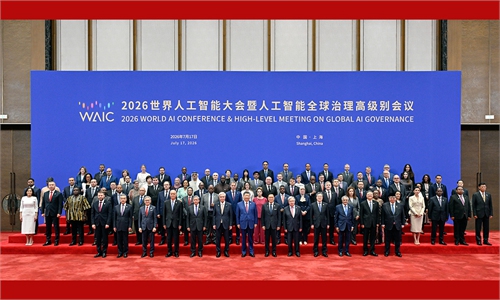
The issue of AI is positioned in this same way, as it is precisely the spearhead in the materialization of global technological public goods within the community with a shared future for mankind. All of this aligns with the idea that AI should not be the monopoly of a single power, and the need for "fair, equitable, and people-centered international governance to avoid greater global inequalities."

Raquel Isamara León de la Rosa Photo: Courtesy of León de la Rosa
For AI, 2026 represents a key year, as the performance gap with leading US models has almost completely narrowed. One of the most important projects is Kimi K3, the world's largest open-weight model with 2.8 trillion parameters. At an operational level, this AI platform reinforces the value proposition of this type of asset, since its main differentiator is its distribution philosophy and the control of the infrastructure, which allows any company or organization to download the AI and run it locally on its own servers.
The concept of the "new new three" reflects the continuous evolution of the Chinese economy through its five-year plans: China's industrial development has moved beyond simply satisfying international demand to creating a sustainable ecosystem of next-generation industries. On an economic level, the "new new three" sectors promote high value-added goods as a competitive factor within China's economic framework. On a social level, this evolution highlights Chinese human talent as a leader in technological development worldwide and marks a pivotal moment for China's leading global high-tech companies.
All of this is reflected in China's high-quality development model. In the case of the "new new three," this set of goods is driven by the imperatives of energy security, self-sufficiency, and sustainability. At the same time, the "new new three" places the knowledge economy at the forefront, with a distinctly social orientation. Specifically, they are closely tied to the concept of socialism with Chinese characteristics for the new era - a modernization paradigm in which research is not confined to theoretical abstraction but actively applied to real-world challenges. Taken together, these factors explain why the "new new three" marks a watershed moment for industries that underpin global public goods aimed at human well-being.
By anchoring technological advancement in social well-being and global accessibility, the "new new three" demonstrate how China's innovations can serve as a public good for all of humanity.
First, the implementation of this vision through public policy has a significant social impact both within and outside China, as it presents the world with an alternative model based on a greater commitment to humanity. Second, this situation is a call for countries around the world to open more avenues for technological and scientific cooperation with China, through their universities and companies. And third, and perhaps most importantly, it calls for a rethinking of technology with a social purpose that enables a sustainable model for future generations.
The author is an expert on China at the Meritorious Autonomous University of Puebla, Mexico. bizopinion@globaltimes.com.cn
RELATED ARTICLES