China issues action plan for AI cooperation, development
Move underscores nation’s commitment to inclusive sharing: expert
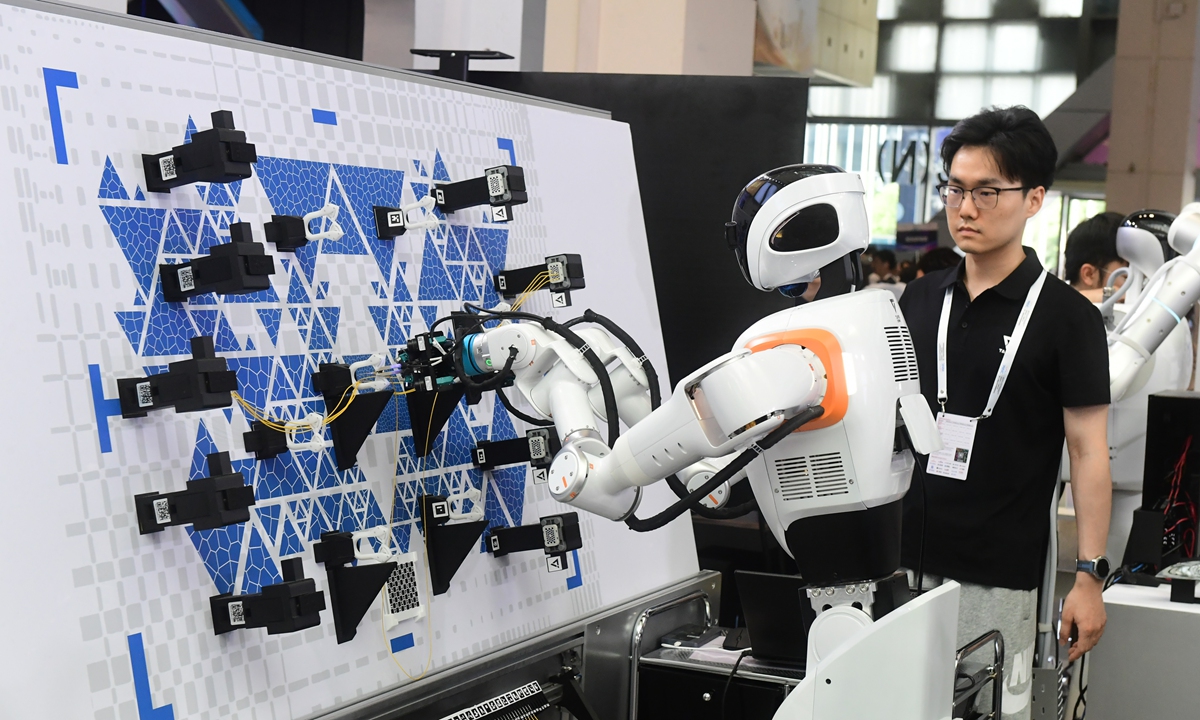
A high-precision robot performs a wiring task at the 2026 World Artificial Intelligence Conference in Shanghai on July 17, 2026. Photo: VCG
China on Friday released an action plan on artificial intelligence (AI) cooperation and development, as part of broader efforts to strengthen international AI collaboration and bridge the digital divide.
Chinese experts said the release of the action plan features clear-cut orientation and carries profound significance, marking China's commitment to advancing international AI cooperation and improving global intelligent governance.
The action plan was jointly issued by the National Development and Reform Commission and other government departments during the 2026 World AI Conference (WAIC) and High-Level Meeting on Global AI Governance, which opened in Shanghai on Friday.
The document outlines actions in eight areas covering data, computing power, ecosystems, industrial empowerment, talent development, rules and standards, governance and AI ethics.
According to the document, efforts should be made to advance cross-border data flows and to construct and operate trustworthy cross-border data spaces in selected sectors to promote efficient, convenient, and secure cross-border data flows. It calls for greater access to high-quality data, more inclusive intelligent computing services, and broader sharing of open-source AI ecosystems.
The plan also seeks to promote deeper AI application across industries, joint cultivation of digital talent, coordinated development of rules and standards, stronger cooperation on AI security and governance, and the development and use of AI for the benefit of humanity.
It noted that efforts will be made to deepen "AI+" cooperation, build transnational industrial cooperation platforms, and support digital-intelligence capacity building for developing countries.
Efforts will be made to promote the standardized application and innovative development of intelligent agents, drive AI empowerment in fields such as science, manufacturing, healthcare, education, agriculture, and governance, and leverage AI to boost economic development, improve social governance, and enhance public well-being, according to the document.
This action plan represents the substantive implementation of the four-point proposal China put forward at the 2026 WAIC, Zhou Mi, a senior researcher at the Chinese Academy of International Trade and Economic Cooperation, told the Global Times on Friday.
Ultimately, the plan aims to establish a cooperation model and philosophy of AI for good, serving as the fundamental principle and key objective of China's international AI initiatives, Zhou said, noting that this approach underscores China's commitment to fulfilling its responsibilities in inclusive sharing and global governance, ensuring that technological advancement benefits humanity without being driven solely by commercial interests.
Pan Helin, a member of the Information and Communication Economy Expert Committee of the Ministry of Industry and Information Technology, told the Global Times on Friday that the joint release of the action plan sends three signals.
First, it signals that AI is positioned as a global public good, with a key focus on providing inclusive intelligent computing services to developing countries. Second, it signals the release of China's governance paradigm that balances development and security, achieving equilibrium between security governance and AI development. Third, it offers a path to resolving the predicament of fragmented global governance through multilateralism and advancing the construction of the global AI governance system, Pan said.
This action plan shows that while AI development remains technology-driven, it must also uphold openness and sharing, and promote technological innovation and industrial cooperation on a global scale, Yan Yijun, vice president of Shanghai-based AI firm MiniMax, told the Global Times on Friday.
"We will continue to work hand in hand with global ecosystem partners in an open spirit, turning cutting-edge technology into real productivity, promoting deep integration between AI and global industries, and enabling the benefits of intelligence to reach more countries, industries, and communities," Yan said.
RELATED ARTICLES