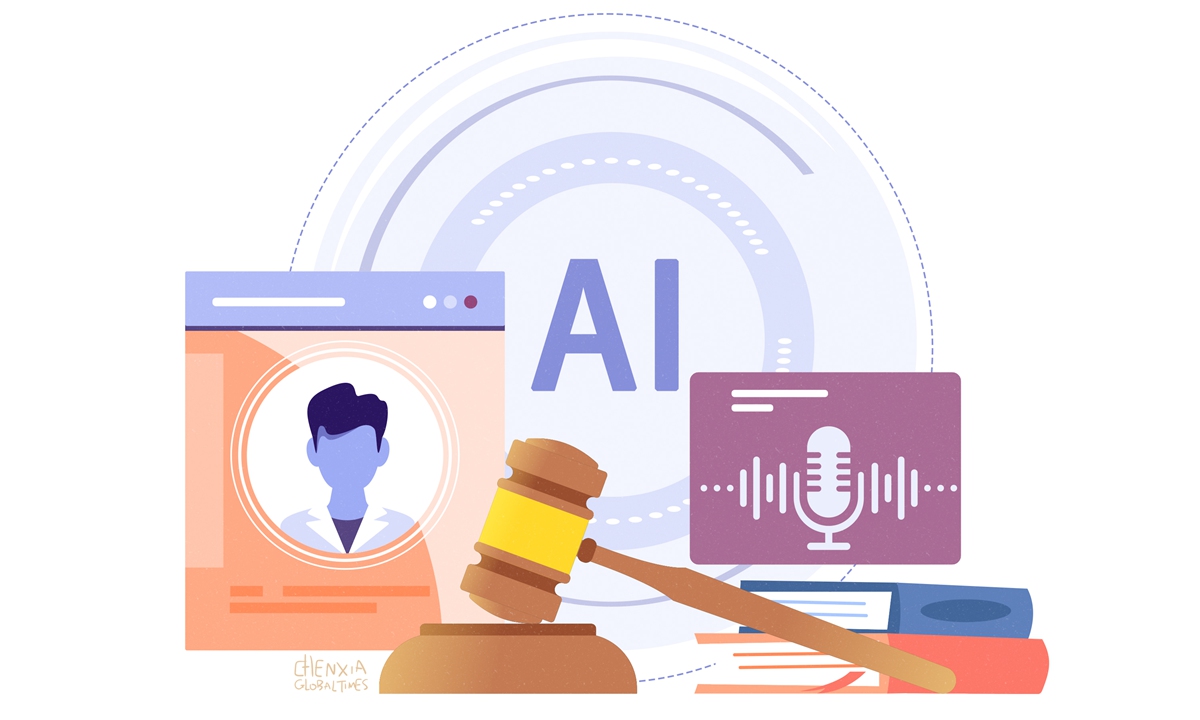
Illustration: Chen Xia/GT
China's fast-growing artificial intelligence (AI) industry is extending across sectors and daily life, while legal and regulatory frameworks and application advance in step. A balanced approach to innovation and regulated oversight is driving the healthy and sustainable development of the AI sector.The Beijing Internet Court recently handed down a ruling in a case, which said that using AI software to distort another person's likeness constitutes an infringement, CCTV News reported on Wednesday. This case exemplifies China's equal emphasis on innovation and security in the development of AI, with tangible progress in judicial applications.
As AI advances rapidly across the globe, nations are striving to balance innovation with stronger regulation. China, while accelerating the development of its domestic AI regulatory system, also adopts an open and cooperative stance in global AI governance. Its balanced approach to innovation and regulation offers a Chinese solution to shaping global AI governance.
In recent years, China has gradually clarified likeness rights and generative AI responsibilities through legislation and judicial practice, working to provide a predictable regulatory environment for the industry.
In August, the State Council released the Opinions on Advancing the "AI Plus" Initiative, aiming to deepen the integration of AI across sectors while reinforcing policy and legal frameworks and improving national AI security capacity.
Since September 1, the Measures for the Labeling of AI-Generated Content introduced by the Cyberspace Administration of China and three other agencies have taken effect. The new rules mandate labeling of all AI-generated text, images, audio, and video materials. This initiative seeks to curb fakes and disinformation, strengthen transparency, and advance the development of reliable and responsible AI.
In China, as AI regulation gradually expands to cover the entire application process and a full cycle oversight mechanism takes shape, judicial applications of AI are also accelerating. As early as 2022, the Supreme People's Court issued the Opinions on Regulating and Strengthening the Judicial Application of Artificial Intelligence, aiming to establish a relatively complete judicial AI system by 2025. Courts are increasingly handling AI-related legal disputes, signaling a shift of AI oversight from administrative regulation toward judicial application.
China's gradually comprehensive regulatory oversight of the AI sector, and judicial rulings in related cases, play a significant role in promoting the healthy and orderly development of this emerging technology. By managing risks and strengthening regulatory guidance, a safe, controllable, and sustainable environment can be established. This represents a critical step in ensuring that the AI industry moves toward high-quality development.
China not only maintains an open and cooperative attitude toward global AI governance but also takes proactive steps. In recent years, the country has quickly translated its domestic regulatory experience into international public goods, promoting a more inclusive and equitable global AI governance framework.
Chinese Vice Foreign Minister Ma Zhaoxu recently attended and addressed the United Nations High-level Meeting to Launch the Global Dialogue on Artificial Intelligence Governance in New York, noting that it is imperative to advocate a people-centered approach and enable people of all countries to share the benefits of AI development. Countries should also focus on taking real actions and be proactive in promoting AI development for good and for all.
China is actively promoting global AI governance through UN multilateral channels, opposing legislation by "small circles" and the use of AI to maintain hegemony. The 78th session of the UN General Assembly in July 2024 unanimously adopted a resolution proposed by China and co-sponsored by more than 140 countries, on strengthening international cooperation in building AI capacity.
From proposing initiatives to setting standards, China has transformed its domestic experience of simultaneous development and regulation into global public goods. This approach helps developing countries bridge the technological gap while mitigating the risks of technical monopolies and rules-based discrimination by some nations, substantially advancing global AI governance.
The author is a reporter with the Global Times. bizopinion@globaltimes.com.cn
RELATED ARTICLES