Accounting for 97% of global shipments, China-made humanoid robots start to enter homes, factories, pharmacies
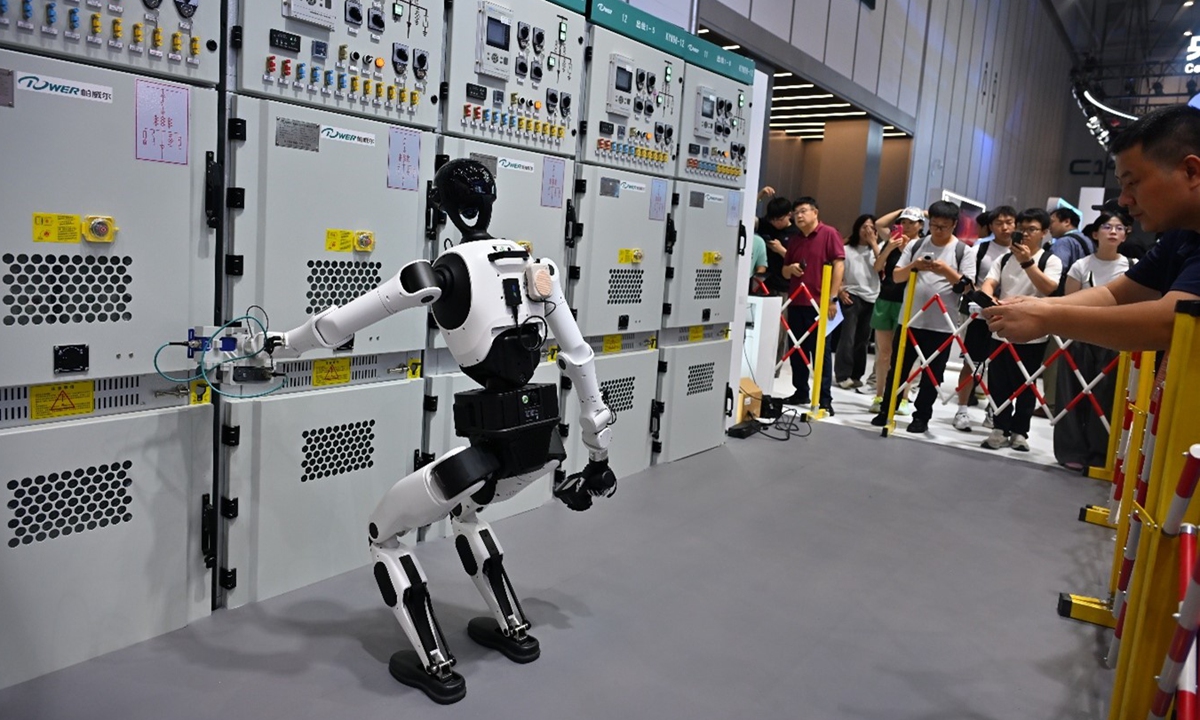
The Tien Kung 3.0 humanoid robot demonstrates a power facility inspection task at the 2026 World Robot Conference on August 20, 2026. Photo: Tao Mingyang/GT
For years, humanoid robot showcases were defined by flashy athletic feats: running, jumping, agile stunts designed to wow onlookers. This year's World Robot Conference held in Beijing told a very different story.
With 373 exhibitors, over 3,000 robotic products and 311new models on display, robots came ready for real jobs, carrying out tasks like equipment inspection, goods sorting, laundry folding and pasta cooking.
According to Zhang Feng, chairman of the China Humanoid Robotics and Embodied Intelligence Committee of 100, domestic humanoid robot shipments topped 40,000 units in the first half of 2026, accounting for a staggering 97 percent of the world's output. What started as a handful of pilot projects has become a full-blown work-force revolution.
Full-blown tech revolution
At Ant Lingbo Technology Co's booth, journalists observed a streamlined pharmacy workflow in action. An online drug order comes in. The robot springs into action. Its mechanical arm reaches out with surgical precision and plucks a medicine package from a tall shelf. The movement is smooth, efficient, and professional.
The system is already operational in selected Shanghai pharmacies. Its standout feature is plug-and-play functionality. No store-wide renovations. No expensive hardware upgrades. It integrates into existing retail layouts and takes over the repetitive fetch-and-carry labor — freeing pharmacists to spend more time with patients, offering critical medication guidance rather than simply playing warehouse worker.
Dangerous jobs? Send the robot.
Elsewhere on the show floor, the Tien Kung robot, engineered by the Beijing Humanoid Robot Innovation Center, was sweeping a thermal-imaging scanner across electrical cabinets, hunting for hidden faults.
Powered by a dedicated embodied‑intelligence platform and State Grid's large AI model, the robot has completed rigorous field validation tests at multiple substations across Beijing, Southwest China's Sichuan Province and East China's Zhejiang Province.
And, UBTECH Robotics Co took industrial deployment a step further. Its booth featured nearly a dozen humanoid robots working in seamless coordination along a simulated production line — lifting heavy auto sheet-metal components, handling machined parts, and stacking boxes, all without human oversight.
"If one robot stalls, others automatically step in to fill the gap," Jiao Jichao, vice president of UBTECH Robotics, told the Global Times.
Robotic home assistants
At Haier's booth, one robot bent down, gathered scattered T-shirts, placed them into a washing machine, and pressed the start button. Another robt stood nearby, sorting fresh groceries and sliding them into the refrigerator one by one.
"Laundry and food storage — two of the most repetitive household chores — have found a challenger," a staff worker from Haier told the Global Times.
Over at Futuring Robot's booth, its F2 humanoid robot drew crowds of onlookers as it prepared an Italian‑style meat‑sauce pasta. Without any human assistance, the robot completed seven sequential tasks on its own: pouring noodles into a bowl, draining water with a strainer, lifting the boiling pot off the induction cooker with two arms, switching to a frying pan, adding ingredients, stir‑frying and plating the finished dish.
Shen Luyi, co-founder of Futuring Robot, said that the robot is available for rent at 3,000 yuan ($446) per month. It has been trialed in more than 500 households, accumulating over 50,000 service hours.
UBTECH's U1 robot, meanwhile, showcased a different frontier: emotional interaction. With lifelike silicone skin and a face capable of hundreds of micro-expressions — blinking, frowning, even reading human moods — it can detect joy, sorrow, or exhaustion and respond with supportive interactions.
It is built to serve not merely as a machine, but also as a companion for emotional‑support services and elderly care, the Global Times learned from the company.
As robots move out of exhibition halls and into real-world scenarios, after-sales infrastructure is beginning to catch up. At JD's booth, technicians tended to a humanoid robot laid on a repair "operating table." Customers once had to ship broken robots back to manufacturers, but JD now offers in-home fixes for minor faults through partnerships with leading robot makers. The company runs eight service centers nationwide and plans to roll out on-site repairs across more than 50 major cities in the next three years.
Despite the encouraging momentum, industry leaders caution that significant hurdles remain.
Wang Xingxing, founder of Unitree Robotics, said that humanoid robots still lag far behind human workers in raw efficiency. Remove them from their carefully controlled training environments, and their performance will deteriorate sharply, he said.
Wang believed that the sector will reach a tipping point only when a humanoid robot can hear a simple spoken instruction and successfully complete roughly 80 percent of the untrained tasks.
That day has not yet arrived. But it is approaching.
This was compiled and translated by the Global Times English edition based on an article published by the People's Daily Overseas Edition on August 25, 2026.
RELATED ARTICLES