Chinese lawmakers review amendments to Road Traffic Safety Law, adding special stipulations on self-driving cars
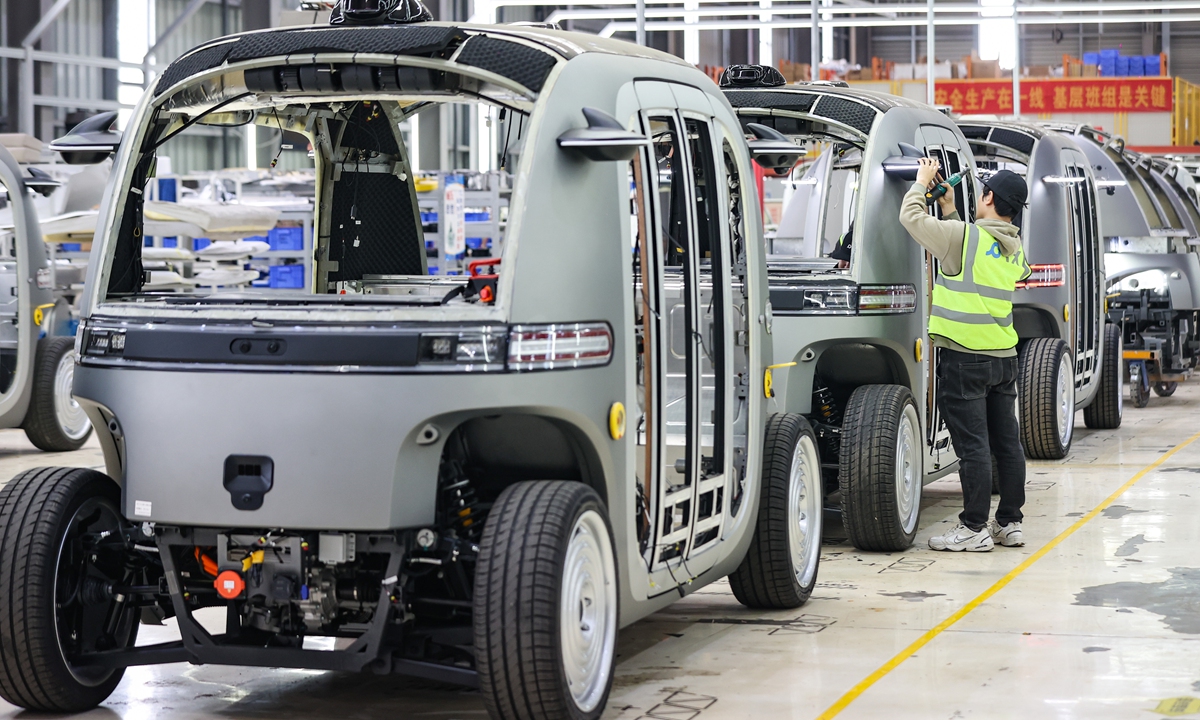
A worker assembles driverless minibuses at a plant in Guiyang, Southwest China's Guizhou Province on April 2, 2026. According to predictions from industry organizations, the total value of China's shared mobility market will reach 2.25 trillion yuan ($327.4 billion) by 2030. Photo: VCG
China will propose new rules on autonomous vehicles, as national lawmakers on Tuesday began reviewing draft amendments to the country's Road Traffic Safety Law that creates a special chapter focusing on self-driving cars.
The legislation reflects the country's support for safe, orderly and standardized testing, demonstration and road use of autonomous vehicles, the Xinhua News Agency reported.
The draft, submitted to the 24th Session of the Standing Committee of the 14th National People's Congress, the country's top legislature, for first reading, defines autonomous vehicles and driver-assistance functions for the first time, according to Xinhua.
According to Xinhua, the new rules outline specific conditions for autonomous vehicles to be allowed on roads, principles for handling traffic violations, and car insurance, seeking to strengthen the legal framework for China's rapidly developing autonomous-driving sector.
Under the proposed rules, if a traffic violation occurs while a self-driving function is activated, the car producer, or importer of the vehicle should be responsible for handling the case.
Autonomous vehicles operating without autonomous-driving functions being activated, and vehicles equipped only with driver-assistance functions, will be managed under rules applying to conventional vehicles.
The draft also proposes a compulsory vehicle accident liability insurance arrangement for all autonomous vehicles. In addition, the draft strengthens corporate responsibility by requiring car manufacturers and importers to ensure road safety, cyber-security, and data security, and by prohibiting false or exaggerated advertising of autonomous-driving functions, chinanews.com reported.
The amendment is based on the practical needs of China's automotive sector development and industry regulation, Wu Shuocheng, a veteran car industry analyst, told the Global Times on Tuesday, noting that it reflects China's efforts to balance rapid technological development with road safety.
Wu said that the draft amendment would mark a significant change from the traditional model in which human drivers bear full responsibility. In the future, companies selling advanced autonomous vehicles may need to continuously prove their safety, monitor vehicles in operation in real time, and assume long-term responsibility for safety.
As the penetration rate of Level-2 assisted driving rises rapidly, the problem of lagging legislation has become increasingly prominent. The amendment marks China's autonomous driving legal framework's shift from "piecemeal fixes" to a "special-chapter reconstruction," Cui Dongshu, secretary-general of the China Passenger Car Association, told the Global Times on Tuesday.
"The amendment's significance is that it clearly defines the line of responsibility," Cui said.
Cui further noted that the new legislation effort will elevate the liability logic from an industry standard to the national legal level, providing a legal basis for determining traffic accidents and handling traffic-related disputes.
The new move is expected to raise the entry threshold for autonomous-driving products and push companies to strengthen safety verification. The move could help reduce risks caused by system failures and mis-use, while supporting the transition of Level-3 and Level-4 autonomous driving from pilot projects to larger-scale commercial deployment, Wu said.
China's Road Traffic Safety Law took effect in 2004 and was amended in 2007, 2011 and 2021.
The latest draft contains nine chapters and 170 articles, aiming to keep pace with ongoing economic and social development, address people's needs and enhance road safety, according to Xinhua.
Global Times
RELATED ARTICLES