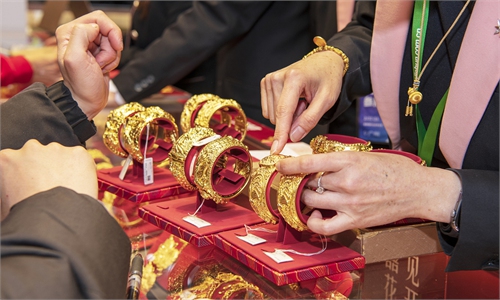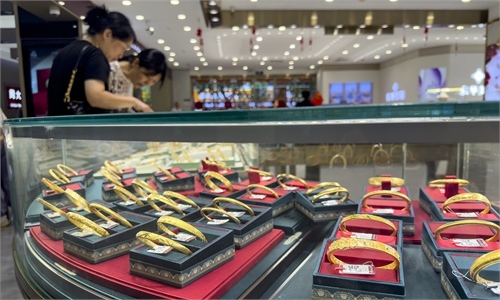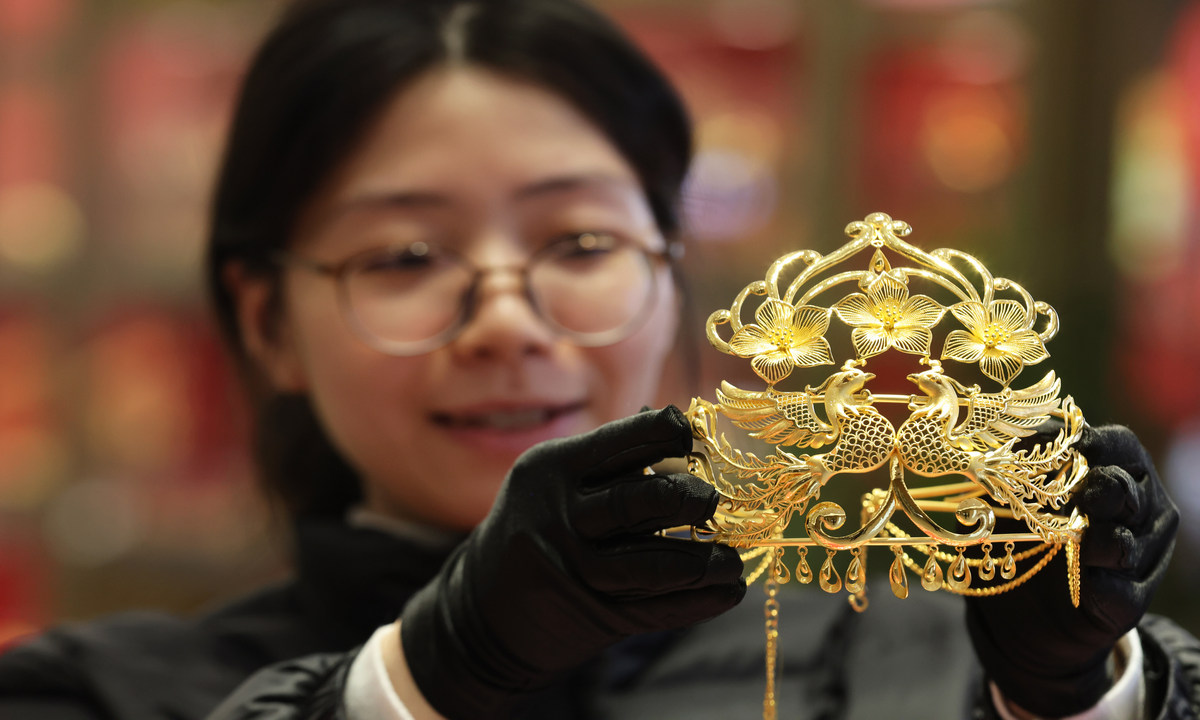
An employee displays gold ornaments at a shop in Hangzhou, East China's Zhejiang Province, on January 28, 2026. The approaching 2026 Spring Festival holiday has sparked a rush to buy gold among consumers despite global price rises. Photo: VCG
China is developing a global network of gold vaults and accelerating central bank gold purchases as part of efforts to strengthen the yuan's role in international trade and enhance the nation's economic resilience, according to a report by S&P Global Ratings on Tuesday.
Chinese analysts stressed that the yuan's internationalization does not rely solely on gold reserves. Progress is advancing across multiple fronts - payments, trade settlement, digital finance, offshore markets, bond financing and monetary cooperation - moving the currency from a transactional medium toward a more widely held reserve asset.
The S&P report said that China's efforts in gold are "more comprehensive and lasting in nature," motivated by long-term aims such as raising economic resilience and broadening global use of the yuan.
The report also pointed out that the gold purchase strategy is multi-pronged. The People's Bank of China (PBC), China's central bank, has carried out steady official purchases to diversify reserves and reduce reliance on the US dollar. Chinese companies are expanding overseas mining interests, while retail and institutional demand for gold bars, coins and exchange-traded funds remains robust.
Official data confirmed the steady build-up. As of the end of July, China's gold reserves stood at 76.08 million ounces (about 2,366 tons), up 640,000 ounces from June. This marked the 21st consecutive month of increases and the largest single-month addition in nearly three years, according to PBC statistics.
Despite the growth, China's gold holdings remain relatively modest. The metal accounts for roughly 8.8 percent of the country's official international reserves, compared with a global average of 27 percent among central banks as of the end of 2025, according to the European Central Bank. S&P noted that China ranks only sixth worldwide by absolute holdings, leaving room for further accumulation.
"Higher gold reserves can strengthen confidence in the yuan as a sovereign currency and support its gradual internationalization," Wang Qing, chief macroeconomic analyst at Golden Credit Rating International, told the Global Times, adding that the necessity of increasing gold holdings is rising from the perspective of optimizing the country's international reserve structure.
The yuan's global standing has continued to rise. It ranked as the world's fifth-most-traded currency, with its share climbing to 8.6 percent as of the end of 2025. In international payments, it held a 4.61 percent share in June 2026, remaining the fourth-largest payment currency for the eighth consecutive month. Its share of global foreign-exchange reserves reached 2.88 percent at the end of the first quarter, and more than 80 central banks now include yuan in their reserves.
Noting these figures, analysts stressed that gold alone is not sufficient. Progress also depends on improving cross-border payment infrastructure, advancing digital currency initiatives and deepening offshore markets.
The Cross-Border Interbank Payment System (CIPS) is a key pillar. It serves as a financial market infrastructure authorized by the PBC, providing clearing and settlement services for cross-border yuan transactions.
In June, the CIPS linked more than 5,200 banks across 191 countries and regions. Average daily transactions reached about 920.5 billion yuan ($137 billion) in March, with single-day peaks exceeding 1 trillion yuan. In the first quarter of 2026, cross-border yuan payments totaled 20.2 trillion yuan, up 17.2 percent year-on-year.
Digital currency initiatives are advancing. As of mid-2026, China's international operation center for the digital yuan had signed agreements with 26 financial institutions covering markets including Singapore, Thailand, the United Arab Emirates and Brazil, according to media reports.
Offshore markets are deepening. Panda bond issuance, in particular, has surged, exceeding 200 billion yuan in 2026 so far - already surpassing the full-year total for 2025 and reaching a historic high, according to media reports.
"The yuan's offshore market performance reflected the continuous increase in the demand for yuan asset allocation from the international community," Yang Delong, chief economist at Shenzhen-based First Seafront Fund, told the Global Times.
The PBC has also expanded its network of bilateral currency-swap agreements this year, renewing or signing deals with Canada, Serbia, Egypt, Australia and Malaysia.
Taken together, these developments show that the yuan's internationalization is advancing across multiple fronts, analysts said.
Global Times
RELATED ARTICLES