Humanoid robots take on table tennis challenge at WHRG, pushing perception and decision-making to new limits
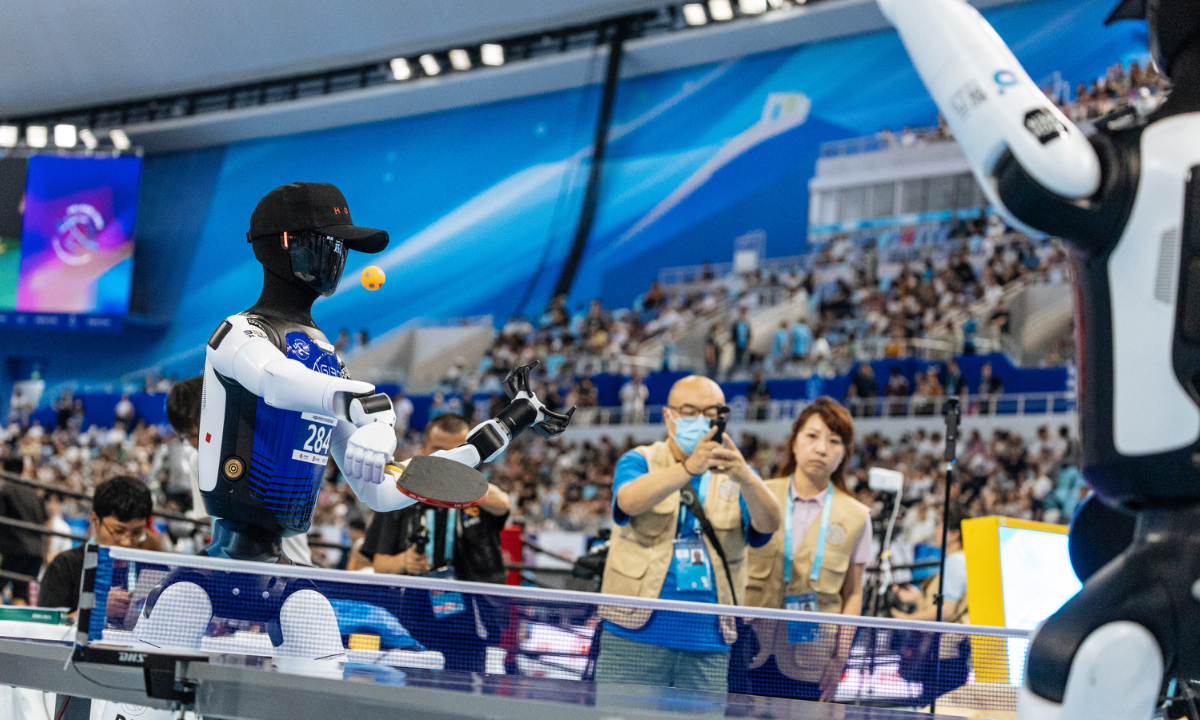
A humanoid robot returns the ball during a table tennis match at the 2nd World Humanoid Robot Games (WHRG) in Beijing on August 23, 2026. Photo: Li Hao/GT
A humanoid robot moves quickly across the court, swings its racket, and returns the ball with control. It then adjusts its footing for the next shot, showing a level of balance and coordination increasingly reminiscent of a human player.
Once confined to science fiction, these scenarios are now becoming reality. At this year's World Humanoid Robot Games (WHRG), table tennis made its debut as an official competition event.
In the table tennis final at the 2nd WHRG on Tuesday, the Peking University-Beijing Academy of Artificial Intelligence (PKU-BAAI) Team defeated the University of Hong Kong SMASH Team 2-0 to claim the championship. The Shanghai Jiao Tong University/Shanghai Innovation Institute (SJTU/SII) Joint Team finished third.
Twelve teams from China and abroad competed in the event. Unlike robot demonstrations based on pre-programmed movements, the table tennis matches required robots rely on AI-powered autonomous decision-making throughout the game to return shots. Organizers described it as one of the most challenging events of the Games.
Behind such seemingly simple exchanges lies one of the toughest tests yet for humanoid robots: seeing, predicting and responding to a fast-moving ball in a fraction of a second, while keeping their balance and coordinating their entire bodies.
For the University of Hong Kong team, the goal from the start was not simply to teach a machine to return a ball, but to make it play more like a human.
Ping Luo, the leader of team SMASH, told the Global Times that the project began around the end of last year, months before the team knew the event would become part of the competition.
The system was originally designed to rely on cameras mounted on the robot itself, rather than a ring of external cameras around the court. The robot uses its own vision to judge the ball's trajectory and decide how to respond.
For the competition, however, the team also connected the robot to a motion-capture system, which can provide more precise information about the ball's position in three-dimensional space and its spin, helping researchers refine hitting strategies.
A key feature of the team's approach is an action-generation model trained on data collected from human players.
"Because the robot is close to the height of an adult, human motion data can be transferred much more naturally," Luo said. Compared with smaller humanoid robots, a full-size platform requires far less adjustment to reproduce human movements.
Twelve teams from China and abroad competed in the event. Unlike robot demonstrations based on pre-programmed movements, the table tennis matches required robots rely on AI-powered autonomous decision-making throughout the game to return shots. Organizers described it as one of the most challenging events of the Games.
Behind such seemingly simple exchanges lies one of the toughest tests yet for humanoid robots: seeing, predicting and responding to a fast-moving ball in a fraction of a second, while keeping their balance and coordinating their entire bodies.
For the University of Hong Kong team, the goal from the start was not simply to teach a machine to return a ball, but to make it play more like a human.
Ping Luo, the leader of team SMASH, told the Global Times that the project began around the end of last year, months before the team knew the event would become part of the competition.
The system was originally designed to rely on cameras mounted on the robot itself, rather than a ring of external cameras around the court. The robot uses its own vision to judge the ball's trajectory and decide how to respond.
For the competition, however, the team also connected the robot to a motion-capture system, which can provide more precise information about the ball's position in three-dimensional space and its spin, helping researchers refine hitting strategies.
A key feature of the team's approach is an action-generation model trained on data collected from human players.
"Because the robot is close to the height of an adult, human motion data can be transferred much more naturally," Luo said. Compared with smaller humanoid robots, a full-size platform requires far less adjustment to reproduce human movements.
A member of the University of Science and Technology of China team told the Global Times that the robot's table tennis skills have been improved through extensive simulation training. The team simulated real-world factors such as friction and perception errors, allowing the robot to better adapt to disturbances and perform more reliably in actual matches.
He added that serving and returning require different strategies. While serving relies more on pre-planned trajectories and parameter adjustments, returning requires real-time perception, decision-making and motion control based on changing game situations.
The challenge goes far beyond keeping a rally alive.
Tang Minqin, an organizer involved in the table tennis event, said the robots may have only about 0.3 seconds to complete perception, prediction, decision-making and the swing itself. The event uses the same full-size humanoid platform for all 12 teams, meaning much of the competition comes down to differences in algorithms, models and system design rather than hardware.
Tang said the event is fully autonomous, with no remote control, scripts or preset movements, turning the competition into a test of how well different teams can make the same body "think."
Professional table tennis players have told the team that the sport is, in essence, "a game of the brain and the fingers," Luo said, as elite players make extremely fine adjustments to racket angles with their hands while constantly reading an opponent's intentions.
For robots, reproducing even part of that chain is difficult. Balls that land very close to the net are among the hardest to handle because the robot's reach is ultimately constrained by its height, arm span and balance. If it stretches too far, it risks hitting the table or falling.
Those limitations, however, may be precisely what gives the competition value beyond sport.
"You can think of the table simply as a work surface," Luo said. If a robot can execute complex actions in such a fast and dynamic environment, similar capabilities could eventually be applied to sorting, cleaning, industrial handling or other fine operations on ordinary work surfaces, where objects often move far more slowly than a table tennis ball.
This makes the competition less a showcase of whether robots can beat humans at sport than a high-intensity "stress test" for embodied intelligence.
Liu Shaoshan, executive director of the Embodied Intelligence Center at the Shenzhen Institute of Artificial Intelligence and Robotics for Society, told the Global Times that sports such as tennis and table tennis are particularly worth watching.
In these dynamic settings, robots need to perceive their opponents and the ball in real time, predict future states, make decisions and coordinate their entire bodies to respond. Liu said this represents a shift from motion control toward greater intelligence, with three major trends emerging: rapidly advancing robot hardware, improved autonomy, and the transition from single-task execution to continuous decision-making in complex environments.
China's rapid development of humanoid robots is increasingly moving from demonstrations of isolated skills toward training systems that can sense, decide and act in more complicated real-world environments. Competitive sports provide a controlled but demanding laboratory for that transition, a Chinese expert said.
In that sense, every successful return across a table may be training for something much larger: a robot that can better understand and serve the physical world around it, industry observers said.
He added that serving and returning require different strategies. While serving relies more on pre-planned trajectories and parameter adjustments, returning requires real-time perception, decision-making and motion control based on changing game situations.
The challenge goes far beyond keeping a rally alive.
Tang Minqin, an organizer involved in the table tennis event, said the robots may have only about 0.3 seconds to complete perception, prediction, decision-making and the swing itself. The event uses the same full-size humanoid platform for all 12 teams, meaning much of the competition comes down to differences in algorithms, models and system design rather than hardware.
Tang said the event is fully autonomous, with no remote control, scripts or preset movements, turning the competition into a test of how well different teams can make the same body "think."
Professional table tennis players have told the team that the sport is, in essence, "a game of the brain and the fingers," Luo said, as elite players make extremely fine adjustments to racket angles with their hands while constantly reading an opponent's intentions.
For robots, reproducing even part of that chain is difficult. Balls that land very close to the net are among the hardest to handle because the robot's reach is ultimately constrained by its height, arm span and balance. If it stretches too far, it risks hitting the table or falling.
Those limitations, however, may be precisely what gives the competition value beyond sport.
"You can think of the table simply as a work surface," Luo said. If a robot can execute complex actions in such a fast and dynamic environment, similar capabilities could eventually be applied to sorting, cleaning, industrial handling or other fine operations on ordinary work surfaces, where objects often move far more slowly than a table tennis ball.
This makes the competition less a showcase of whether robots can beat humans at sport than a high-intensity "stress test" for embodied intelligence.
Liu Shaoshan, executive director of the Embodied Intelligence Center at the Shenzhen Institute of Artificial Intelligence and Robotics for Society, told the Global Times that sports such as tennis and table tennis are particularly worth watching.
In these dynamic settings, robots need to perceive their opponents and the ball in real time, predict future states, make decisions and coordinate their entire bodies to respond. Liu said this represents a shift from motion control toward greater intelligence, with three major trends emerging: rapidly advancing robot hardware, improved autonomy, and the transition from single-task execution to continuous decision-making in complex environments.
China's rapid development of humanoid robots is increasingly moving from demonstrations of isolated skills toward training systems that can sense, decide and act in more complicated real-world environments. Competitive sports provide a controlled but demanding laboratory for that transition, a Chinese expert said.
In that sense, every successful return across a table may be training for something much larger: a robot that can better understand and serve the physical world around it, industry observers said.
RELATED ARTICLES