ARTS / CULTURE & LEISURE
Chinese anti-war hit about chef’s restaurant refuge to go global after $253 million mainland run
Solid performance expected in Asian markets
By Published: Aug 26, 2026 08:57 PM

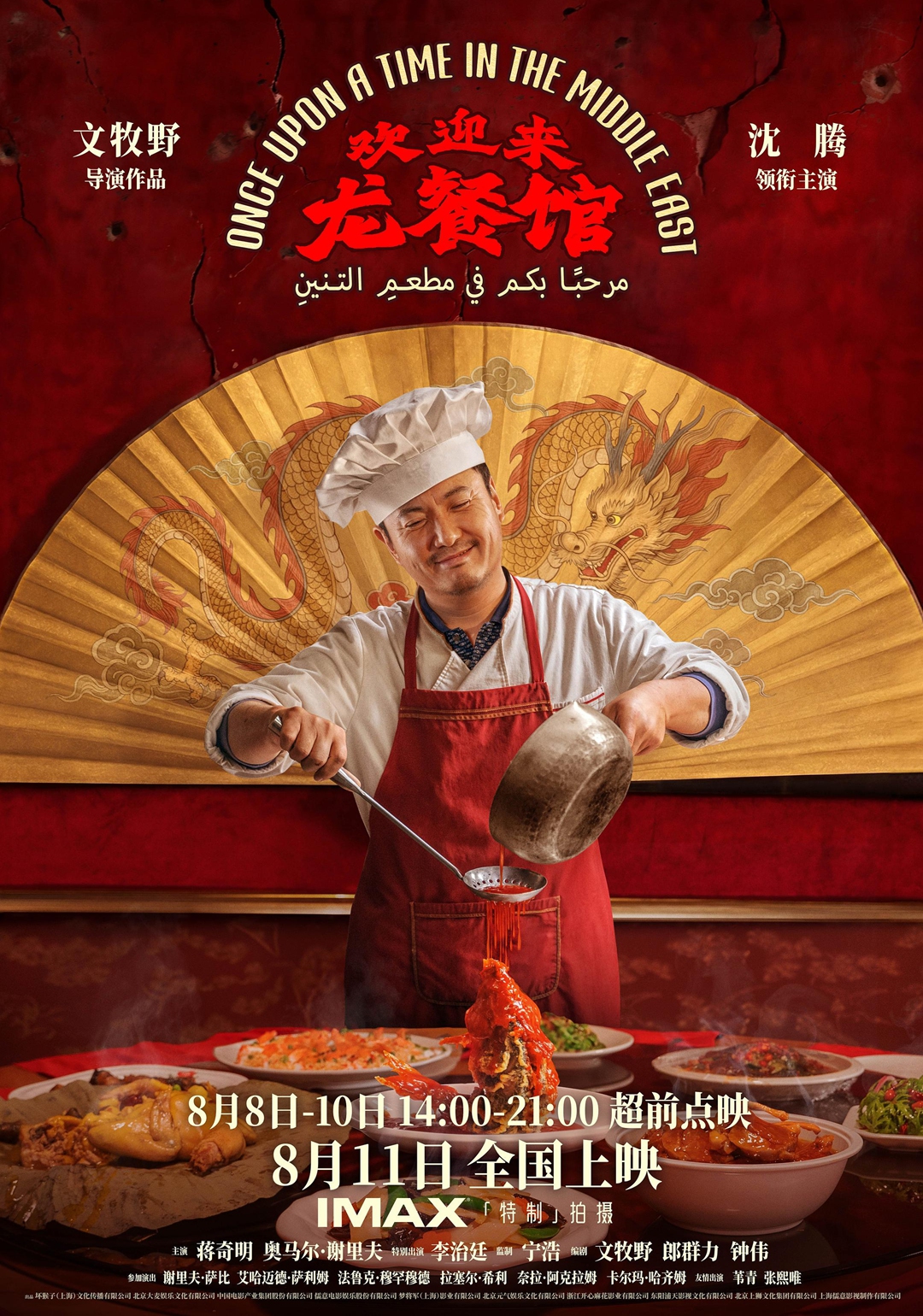
Promotional material for Once Upon a Time in the Middle East Photo: Courtesy of Douban
Chinese blockbuster Once Upon a Time in the Middle East, which has so far earned over 1.7 billion yuan ($253 million) at the Chinese box office, is set for a global rollout across Asia, North America, Europe, the Middle East and North Africa, its official social media team confirmed on Tuesday.The film, released at home on August 11, stars comedian Shen Teng as a Chinese chef who travels to the Middle East and turns his restaurant into a refuge from conflict. Its official Sina Weibo account announced that screenings will start on September 11 in China's Hong Kong and Macao, Australia, New Zealand and Malaysia, followed by Singapore on September 17, Japan on September 18 and several Southeast Asian countries in October. Releases in North America, Europe, the Middle East and North Africa are planned for later.
The movie has become one of China's biggest summer hits, with ticketing platform Maoyan forecasting a final domestic gross of about 2.5 billion yuan and a shot at the summer box-office crown. Its score on Chinese review site Douban has climbed from 8.5 to 8.7 out of 10.
Once Upon a Time in the Middle East follows chef Xu Fu as he struggles to pay off debt in a war-torn country. A Chinese restaurant becomes a small sanctuary where people seek shelter from bombardments. "The Dragon Restaurant has only peace and food," a plain-spoken line repeated in the film captures its core message: food, not war.
Chinese media and industry commentators have presented the picture as a challenge to Hollywood's long-dominant narrative way of war stories, which they argue often adopts a strong, heroic savior perspective. By contrast, the film sees war, suffering and peace through what its backers call an Eastern peace-oriented lens, "gently empathizing with the world and dissolving barriers with goodwill."
That framing has drawn both praise and caution among Chinese analysts as the film heads abroad.
"Once Upon a Time in the Middle East is strikingly different from most Chinese blockbusters because it does not put China at the center and largely avoids obvious Chinese cultural symbols, making its anti-war theme broadly universal and less prone to being misread," veteran film critic Liu Nandou told the Global Times on Wednesday.
However, he said it is not a popcorn film and needs "patience." Its domestic success depended heavily on actor Shen Teng's box-office pull, which will not help overseas. "The ticket sales will hinge on whether strong word-of-mouth can spread widely, but the film may have stronger prospects at international festivals and awards than at the box office," Liu said.
Zhang Peng, a cultural researcher and associate professor at Nanjing Normal University, told the Global Times that pairing anti-war themes with food is "a double-edged sword" for global communication.
"Food can bridge cultural gaps, and a Middle East setting gives the story universal resonance," he said. However, he warned that the family and collective memories embedded in Chinese food culture may be lost on non-Chinese viewers. Zhang said he expects a solid performance in Chinese-speaking and Asian markets but only limited penetration in mainstream European and North American markets.
The overseas rollout is the latest sign of Chinese filmmakers trying to export stories with universal themes. Chinese animated feature All Wishes Come True! has already opened in Australia, New Zealand, North America and the UK, earning positive reviews and increasing foreign interest in Chinese cinema and culture, CCTV reported. The film has surpassed 1.7 billion yuan at home, entering the top 10 all-time Chinese animated movies.
The global release of domestic titles coincides with a robust summer box-office season in China, with total market revenue surpassing 11.8 billion yuan and 44 consecutive days of the daily box office exceeding 100 million yuan, according to Chinese ticketing platform Maoyan.
Film analyst Lai Li told the Global Times that four films have crossed the 1 billion yuan mark, the most in three years. Three of them are domestic titles - Kung Fu Soccer, All Wishes Come True! and Once Upon a Time in the Middle East - while imported film Spider-Man: Brand New Day also outperformed expectations.
"The number of films above 1 billion yuan showed a healthy spread of hits, but the absence of a film above 3 billion yuan indicates weaker staying power at the very top of the market," Lai noted.
"This summer, Chinese audiences are increasingly willing to pay only for strongly entertaining films, like the unexpected performance of the low-budget film Niu Lai, limiting the ceiling for slower dramas such as Once Upon a Time in the Middle East," Liu commented.

Niu Lai
The "so bad it's good" film Niu Lai had grossed over 50 million yuan as of Wednesday afternoon, with posters showing a total of 1.798 million admissions to date. Its projected final box office now stands at over 64 million yuan. Additionally, the film's Douban rating has risen from an initial score of 5.9 to 6.0/10.RELATED ARTICLES