ARTS / CULTURE & LEISURE
84-year-old Cambridge professor becomes ‘Grandpa’ of millions of Chinese youth, reframes ‘lying flat’ as strength
84-yr-old Cambridge professor becomes ‘Grandpa’ of Chinese youth
By Published: Aug 26, 2026 09:08 PM

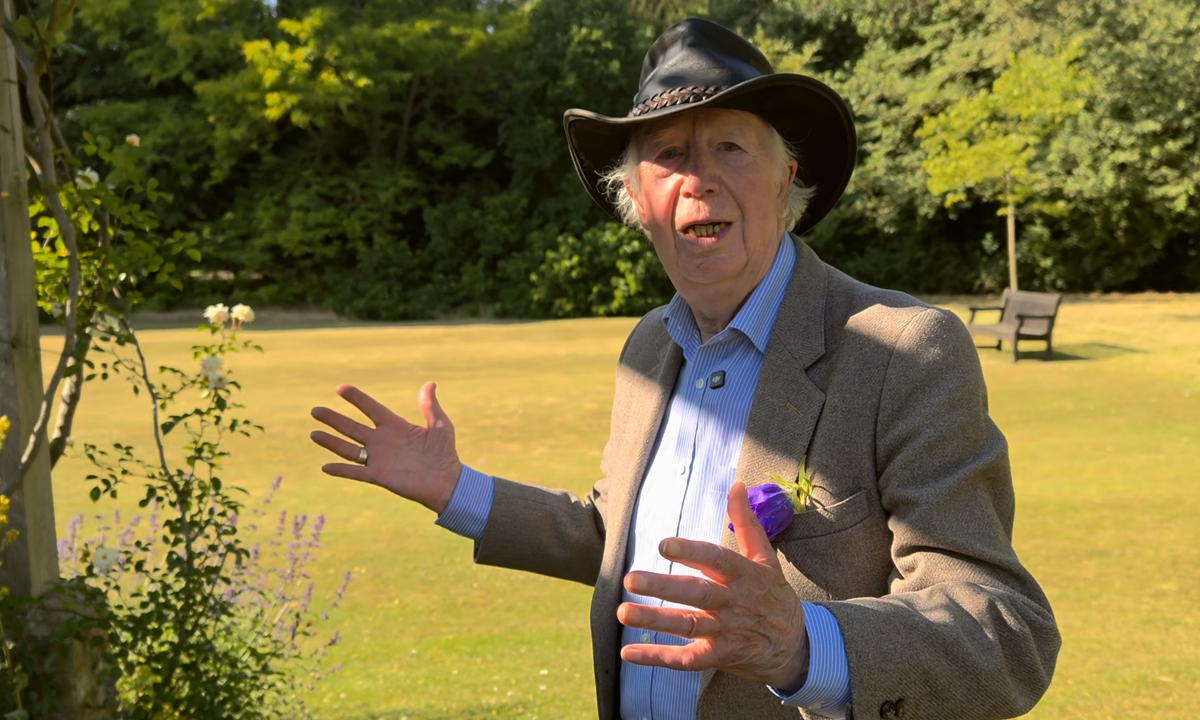
University of Cambridge Professor Alan Macfarlane Photo: Courtesy of Cam Rivers Publishing
In a small, book-lined room in Cambridge, Alan Macfarlane adjusts a black mariner's cap and looks into a camera. "Ni hao," he says softly. Then he reads a question from a young person on Chinese social platform RedNote: "Why is it so hard to make real friends? How do you stay steady when everything feels heavy?"Macfarlane, 84, an emeritus professor of anthropological science at the University of Cambridge and a fellow of the British Academy, has become an unexpected source of calm for millions of young Chinese.
In about a year, his account has drawn more than 2.4 million followers; videos regularly reach millions of views. Followers call him "Grandpa Cute" or "the British Dumbledore." He has also been given the nickname "Tree Hole," a quiet place where people leave worries about work, relationships and the future.
"Even the platform team said they found Macfarlane's growth unbelievable," Qin Yuchen of Cam Rivers Publishing, who oversees his Chinese accounts, told the Global Times.
Lasting friendship
This improbable second act began late. "I was already 55 when I first thought that it would be wonderful to go to China," Macfarlane recalled in an interview with the Global Times.
The path started earlier, in Nepal, where he first saw Chinese faces, then in Japan, and later through Chinese doctoral students at Cambridge.
In the first 35 years of his actual teaching experience, he had never taught anyone from the Chinese mainland.
It was only in 2002 or 2003 that he received his first group of PhD students from Chinese mainland, he said.
Since then he has visited China nearly every year.
"I've been to China many times, and every time it feels as if I'm going to a new country," he said.
He said the only real way to understand another civilization is friendship. "The only way really to get quickly down deep is through friendship and through honesty," he said.
What draws him back is both China's diversity and its people.
"China is so diverse. This is one of the things I love about it," he said. "The parts of China are the size of European countries and their cultures and languages and everything is so different that you never get tired of it."
Above all, "my Chinese friends are very warm, very caring, very loyal. Many of my Chinese friends go back over 20 years now. It becomes real friendship," he said.
Macfarlane has noticed a distinct quality in those relationships. But with students from elsewhere, the friendship reaches a certain level and stops.
With young Chinese, he said, "The friendship continues and deepens and becomes something very akin to a family relationship. I become a grandfather or an uncle or an older brother. And this breeds a depth of emotion, loyalty."
His young Chinese followers write that they miss him and want to visit him, something Macfarlane said his students from Britain and other places rarely do.
"The relationship is both emotional and very trusting. They reveal a lot about themselves in a way that the buttoned-up British or Americans wouldn't," he said.

A view of the King's College, University of Cambridge Photo: VCG
Different kind of resilienceOn China's Youth Day, he offered a favorite image for the pressure many young people feel, including the sentiment known as "tang ping," or lying flat.
"China often reminds me of a feature of its agriculture… which is that it's a bamboo civilization," he said. "When a great gust of wind comes to a bamboo, it absorbs the shock, lies flat almost. And then when the gust has gone it goes back up. This is of course a big feature of Chinese philosophy, and particularly of Chinese martial arts. When you are assaulted by really overpowering force, you don't stand brittle and get broken. You lie flat, and then you bend and come back again."
He sees the current pause among some young Chinese in the same light.
"The people who are half giving up, or apparently not pushing themselves in the way that Chinese are accustomed to do, are just resting, pausing before launching forth. And this is the right attitude."
He has also reflected on cultural differences in education and family. Chinese students, he said, show striking curiosity about the wider world.
"They're not confined — when they come to England, they want to learn about England… they know a great deal about it." In contrast, he finds many Western students "quite insular."
Another difference lies in the weight of family expectations. In the individualistic West, failure mainly affects the person. In China's more familistic tradition, success or failure can touch a wider group. His advice is to understand that background, take necessary risks, and still try to keep family in the conversation.
With his colleague Wang Zilan, he set up Cam Rivers Publishing as a cultural bridge. He has lectured widely to Chinese students and was named an honorary professor at Shenzhen University.
Almost three-quarters of his closest friends, he said, are now the young Chinese.
"I've talked to hundreds of thousands of young Chinese on RedNote over the last year," he noted, "and now almost all my best friends are young Chinese."
Reflecting on the unexpected popularity, he said, "This may not be because I am particularly clever, but because I see that young Chinese people are truly interested in understanding the world. I speak to them as equals, and they return the same equality, openness and trust."
The comments he receives, he added, are "uniformly cautious, respectful… philosophical and thoughtful… very personal."
He also has a short piece of advice he sometimes shares.
"When you think you are old, then you are old; when you think you are young, then you are young. Keep thinking young, and you grow stronger and stronger," he said.
RELATED ARTICLES