Precision and power: China's humanoid robots prove their versatility at both extremes
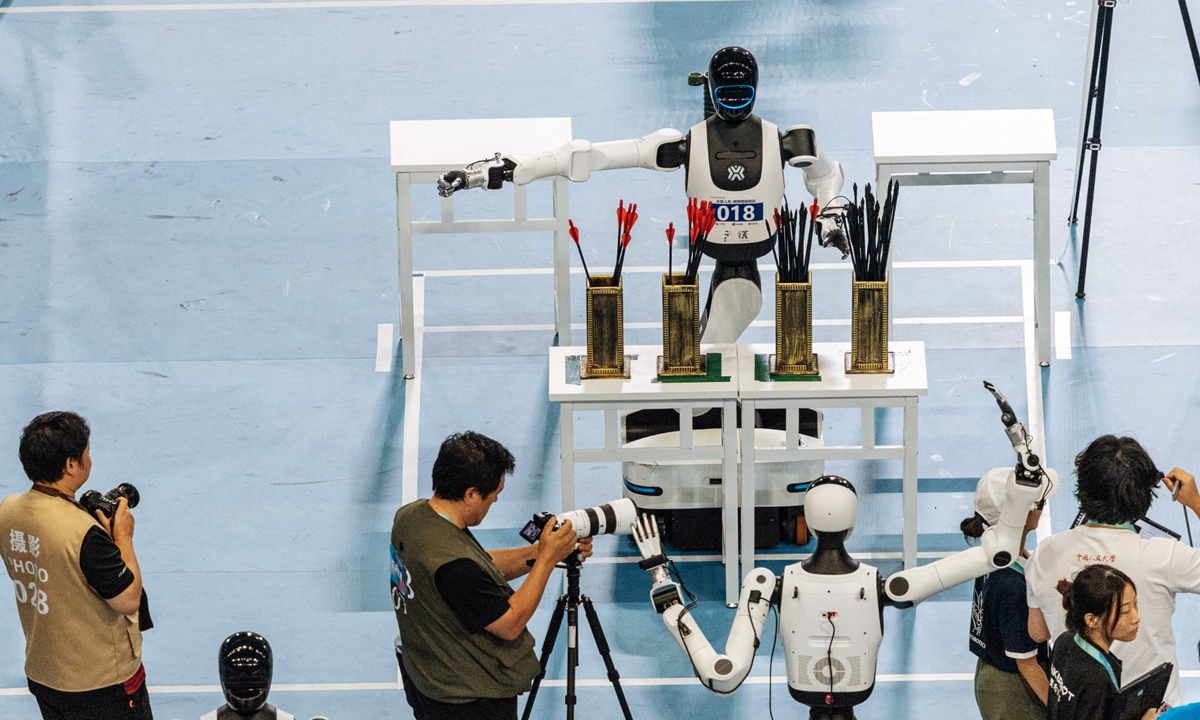
A humanoid robot participates in the pitch-pot competition at the 2nd World Humanoid Robot Games in Beijing on August 26, 2026. Photo: Li Hao/GT
Landing a slender arrow in a pot 1.5 meters away, and staying upright under hundreds of newtons of pulling force - the pot-throwing, tug-of-war and weightlifting events added at the 2nd World Humanoid Robot Games have pushed humanoid robots toward two opposite extremes: precision and power.The first demands that a robot's vision locate the pot and read the arrow's orientation, its "brain" plans the throwing angle and force, and its hand grip and release with precision - what organizers call a touchstone for fine force control and hand-eye coordination. The second tests foot-ground contact control, dynamic balance adjustment and sustained load capacity, or as organizers put it, whether a robot "can stand its ground, stay steady, and keep delivering force."
Touhu, a traditional Chinese game also known as pitch-pot, is among the traditional sports newly added to this edition. It is divided into bipedal and wheeled categories. Robots must stand behind a throwing line, pick an arrow from a rack with a dexterous hand, and swing it into a pot 1.5 meters away.
Organizers said the deceptively simple motion demands a full chain of eye-brain-hand coordination: Vision has to identify the pot's position and the arrow's orientation, the brain has to plan the angle and force of the throw, and the hand has to complete the grip and release precisely. "The arrows are long and thin, so the slightest deviation in where you grip changes the direction of the throw."
Unlike the speed events, which measure a robot's physical limits, pot-throwing tests target judgment, motion accuracy and force control. Force is still the variable, but here it has to be held within a tolerance of millimeters.
Wang Wenhao, director of manipulation algorithms at AgiBot, led the team that won gold in pitch-pot. The core of the event is sensor stability and precision, he told the Global Times after the final, explaining that his team had the robot take the arrow with one hand and throw with the other to keep the grip point fixed.
"The real value of this wave of robotics lies in performing complex tasks in scenarios that are more generalized, more flexible and more open," said Wang.
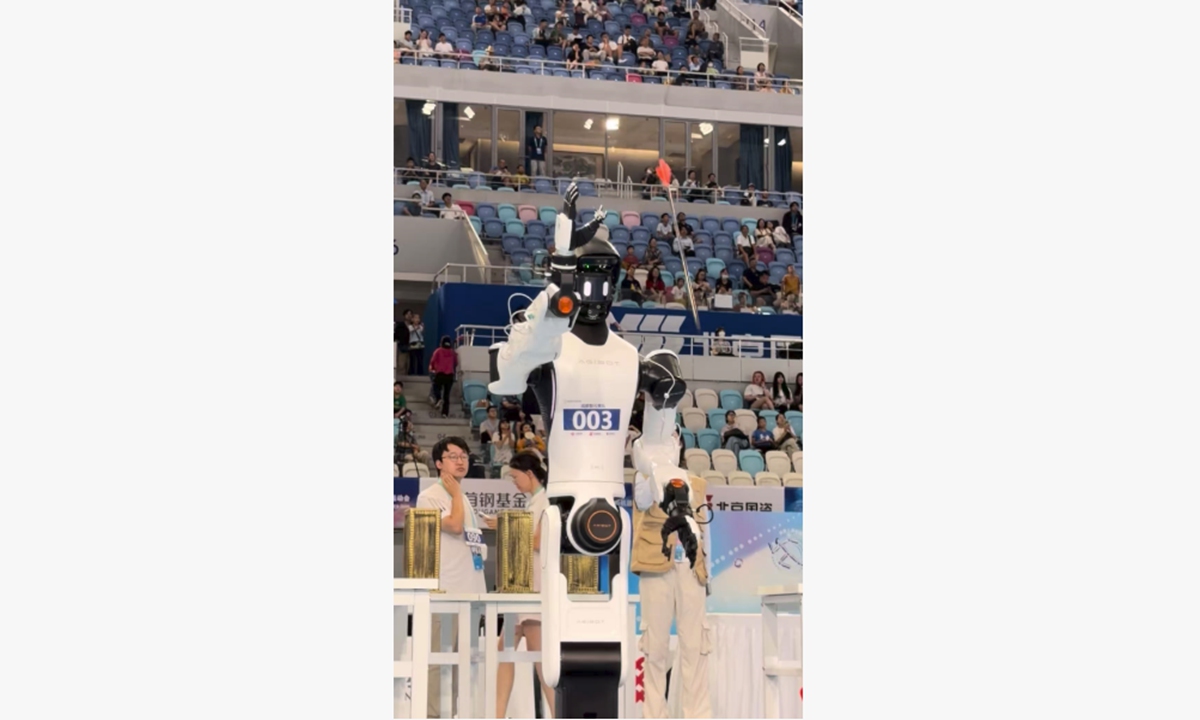
The AgiBot Genie G2 robot at the pitch-pot competition of the 2nd World Humanoid Robot Games on August 26, 2026. Photo: Courtesy of Wang Wenhao
At the other extreme was the tug-of-war event held on Tuesday, the first time the event has been staged as a formal competition at the games. Xingzhe Taishan, a robot built by Shandong-based Yobotics, won the lightweight championship title.
Zhou Tong, deputy general manager of Yobotics, told the Global Times that the team simulated a range of postures before settling on the sideways stance used by human tug-of-war athletes, and the robot held that stance throughout the competition. "We taught the robot to pull on its own - to read the opponent's force, adjust its posture, and then deliver force steadily," Zhou said. The entire bout runs on AI algorithms without human intervention, with the robot sensing changes in tension, adjusting its body attitude and managing its center of gravity.
Xingzhe Taishan was not only capable of tug-of-war. At the inaugural World Humanoid Robot Games in 2025, the same robot won the 100-meter exhibition race and took third in the 4x100-meter relay.
A fuller example of one machine covering many tasks comes from Tiangong, the general-purpose humanoid robot developed by the Beijing Humanoid Robot Innovation Center, which has spread across the program at these games. The X-Humanoid-Huake joint team won the heavyweight weightlifting title with a 16-kilogram lift and took silver in tug-of-war. On the track, a Tiangong robot clocked 9.32 seconds in the 100-meter large-group preliminaries, while Tiangong Ultra cleared 2.8843 meters to reset the standing high jump mark.
Those results rest on one set of hardware. Ding Gang, head of motion control algorithms at X-Humanoid, the developer of the Tiangong robot, said tug-of-war is in fact harder than weightlifting: "Weightlifting is static load capacity, while tug-of-war is dynamic interaction. Your upper body takes a heavy force, but your lower body cannot simply give way."
To prevent the robot from stepping out of the lane, his team decoupled the robot into two layers, with the upper body sensing the direction of the pull and the lower body moving the opposite way to cancel any disturbances. A dexterous hand has a load ceiling of its own, he added, so reaching 400 to 500 newtons of applied force requires whole-body joint coordination.
Hu Yufeng, an engineer from the X-Humanoid-Huake joint team, who helped the team take the tug-of-war silver, said the robot they fielded was fitted with a customized dexterous hand suited to high-torque scenarios and a vest serving as both fall protection and ballast. In laboratory conditions, a single robot can apply about 500 newtons.
Underpinning this versatility is a single paradigm for acquiring skills. Hu said his team used motion-capture equipment to record human tug-of-war postures for the robot to learn from. Ding said his team studied the strategies of accomplished athletes and recorded them for simulation - "There is still some prior human in there" - before letting the robot fall and recover in hundreds of millions of simulations.
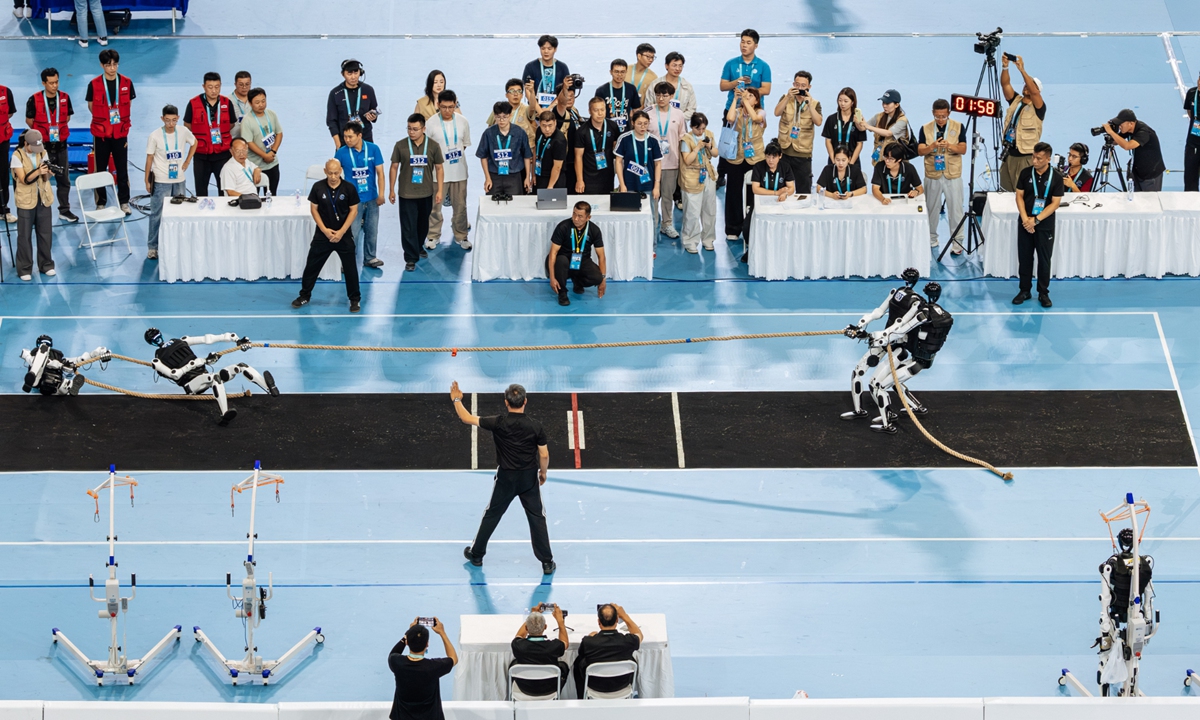
Two groups of humanoid robots compete in the tug-of-war event at the 2nd World Humanoid Robot Games in Beijing on August 25, 2026. Photo: Li Hao/GT
Wang He, founder of Galbot and a researcher at Peking University's School of Computer Science, said his company's embodied foundation model uses an end-to-end brain-pons-cerebellum architecture, in which the brain handles perception, planning and coarse motion generation while the cerebellum translates those signals into high-frequency whole-body control, allowing a robot to learn from human movement in real time. Whether it is the hand-eye coordination demanded by pot-throwing or the whole-body stability required by tug-of-war, the skills are ultimately transferred from human motion data rather than being programmed event by event.
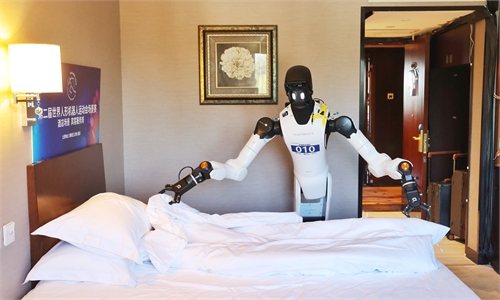
Competing fully autonomously, Galbot's robot model swept every gold medal across the three scenario events at the games: household, catering and retail.
For companies, that versatility points to a cost curve and a deployment timeline. Wang expects that as the general-purpose capabilities of embodied foundation models mature, the full humanoid form will become the greatest common denominator. One machine able to deliver meals, clear tables, clean and perform assorted services.
Capabilities honed at the extremes are already spilling into real scenarios. Ding said weightlifting and tug-of-war validate a robot's heavy-load, high-interaction abilities: "If it can lift 15 kilograms, it can lift 20." That translates into handling objects of 10 to 20 kilograms in daily operations such as material assembly, moving construction supplies, and clearing obstacles in emergency scenarios. The fine force control and hand-eye coordination sharpened by pot-throwing map directly onto peg-in-hole assembly on industrial lines and picking and restocking in retail.
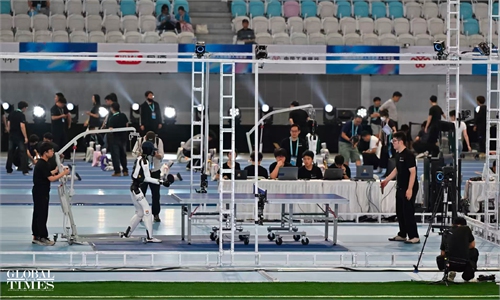
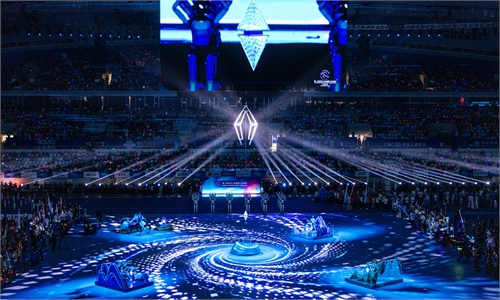
The games are being held at the National Speed Skating Oval in Beijing, drawing 666 teams and 2,056 robots from 16 countries.
Analysts said that from millimeter-precise throws to sideways grappling, these games validate the route China's humanoid robot industry has chosen: general-purpose platforms carrying a full range of skills, not machines tuned for single events. Backed by the world's most complete robotics supply chain and the densest real-world application scenarios, that versatility becomes a testable path toward lower costs and scale.
The games fill a gap that has long existed in robotics, said Wang, noting that the simulation environments and academia each have their own evaluation systems, but all of them are fairly narrow. "The games serve as an all-round benchmark that measures the performance of the whole machine - and that is their greatest significance."
RELATED ARTICLES