Robots make beds, shelve books as China's robot games leave stadium
Events show trend shifting from lab to concrete applications: analyst
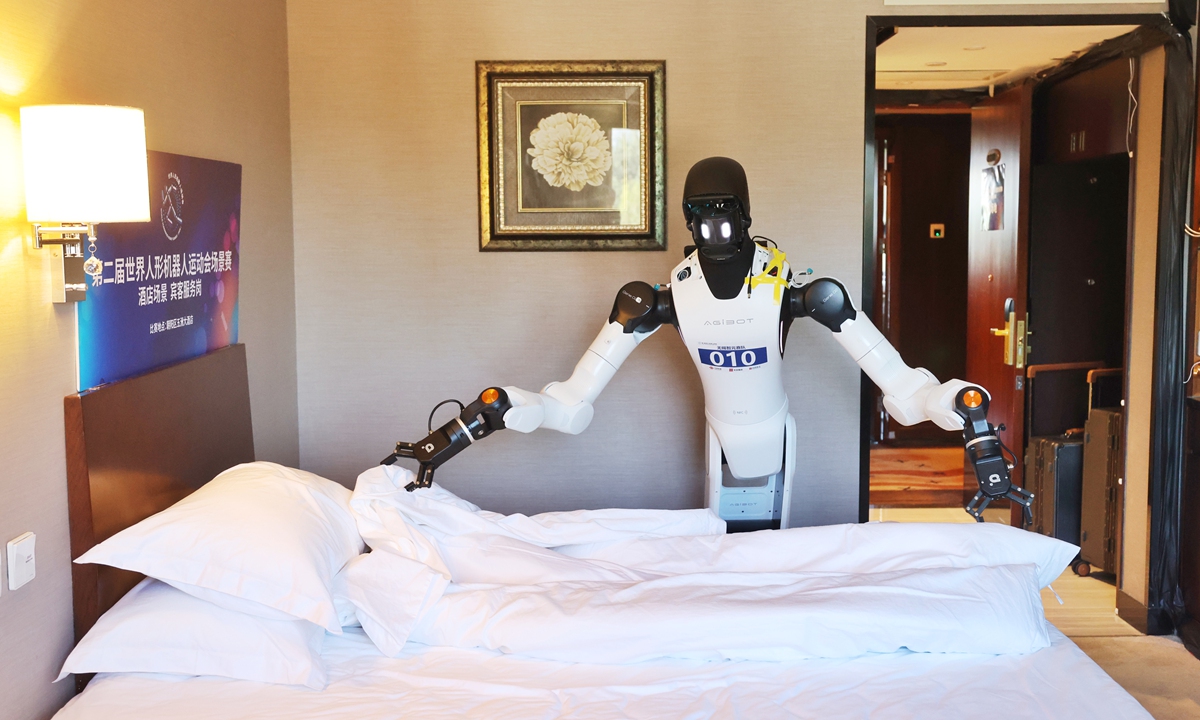
A robot makes a bed during the scenario competition of the second World Humanoid Robot Games in Beijing on August 16, 2026. Photo: VCG
From making up hotel rooms to shelving library books to tidying a living room, scenario competitions for humanoid robots have unfolded since Sunday in real settings outside the stadium. Analysts said that this process showed a clear development trend of the sector: humanoid robots are moving out of the laboratory toward concrete applications, even the home.
The whole scenario competition is part of the second World Humanoid Robot Games (WHRG), which will be held from August 22 to 26 at the National Speed Skating Oval. The household event, staged for the first time, tests robots on domestic service work. It kicked off on Tuesday at Habit@, a smart apartment in Beijing, with 38 teams competing.
The contest is scored out of 300 points: tidying the living room, folding clothes in the bedroom, and washing and hanging laundry in the bathroom and on the balcony, accounting for 75, 100 and 125 points, respectively. An unscheduled task interrupts the chores — taking in a parcel. On a voice prompt, a robot must stop, bring the delivery inside, then return and carry on.
Points are deducted for collisions, dropped items or crossing boundaries. If a human intervenes, the whole run is settled as remote control, with the weighting cut to 0.5.
TianYi 2.0, from the Beijing-based humanoid robot manufacturer X-Humanoid, is competing in all scenario games. The wheeled robot's torso raises and lowers between 130 centimeters and 165 centimeters and runs for more than two hours on a charge, allowing one machine to reach a towel rail and a bedside cabinet floor.
The company has entered four robots across roughly 40 events of the WHRG, all running on its Huisi Kaiwu operation platform, which sets "higher and faster" as the track target and "better at working" in the scenario events, the company said.
Similar contests began two days earlier. On Sunday, humanoid robot competitors "checked in" at the Beijing Continental Grand Hotel. Given 30 minutes, each robot had to wheel guests' luggage to an assigned room, restock towels, slippers and bottled water, then clear the dirty linen and make the bed, according to a post on the official WeChat account of the WHRG.
The scoring shows what the organizers are after. Li Ziye, who runs the hotel event, said that finishing within the time limit does not by itself earn a high score: neatness is marked, and an autonomous run is weighted at 1 against 0.5 under teleoperation. The household event applies the same discount, said the post.
Li listed what a working building throws at a machine: unstructured space, soft goods that change shape, a loaded trolley that is hard to balance, and a task chain long enough to expose any instability. Zhang Yizhuo, from a joint Renmin University and X-Humanoid team, put it plainly: the corridors were narrow, making luggage handling a test of manoeuvring in tight space, the post said.
A library shelving event was held on the same day. Inside a working library, robots had 30 minutes to collect returns, shelve books and correct misplacements — a test of precision, visual recognition and reasoning, said another post by the WHRG on Tuesday.
One competing team said that the scenario events were close to reality and amounted to an examination of how far humanoid robots have come — preparation, along with industrial validation, for the day robots become genuinely useful, according to the post.
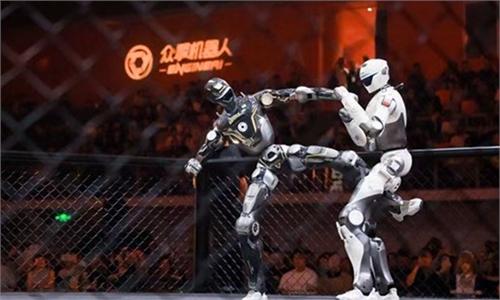
The WHRG also holds six events that pit robots against real-world settings, while the dexterous hand category stages eight "micro-manipulation" contests such as picking up beans and driving screws — in a battle of fingertips.
Spun off from Chinese humanoid robot manufacturer AgiBot in January, AGILINK told the Global Times that winning the dexterous hand competition certifies a product's capability and means it has cleared the "demonstration-grade" threshold for real-world use.
Moving out of a standardized course into hotels and homes mainly tests composite capability — the quality of the mechanical components, the algorithms inside, and how well the machine adapts to a particular scenario.
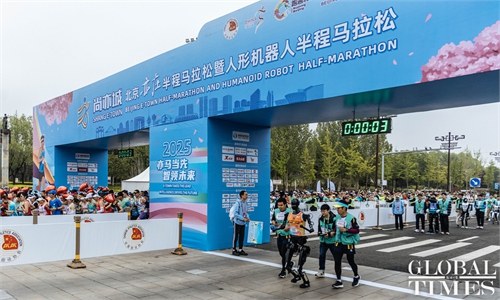
This year's games, like the humanoid robot half-marathon held in April in Beijing, set two modes, teleoperated and autonomous, the former weighted at half the latter. Veteran industry analyst Liu Dingding said that this process tests autonomous judgement once robots are combined with artificial intelligence, because autonomy is where the field is heading.
Under teleoperation, another person is still needed at the application stage to operate and assist, which means the robot has in effect lost the value it should have, Liu said.
The WHRG draws 666 teams and 2,056 robots from 16 countries. Another robot-related event, the World Robot Conference, opens on Wednesday in Beijing's E-Town, giving the capital two robot events in one week.
RELATED ARTICLES