The 2nd World Humanoid Robot Games to start in Beijing in August, striping robots of remote controls
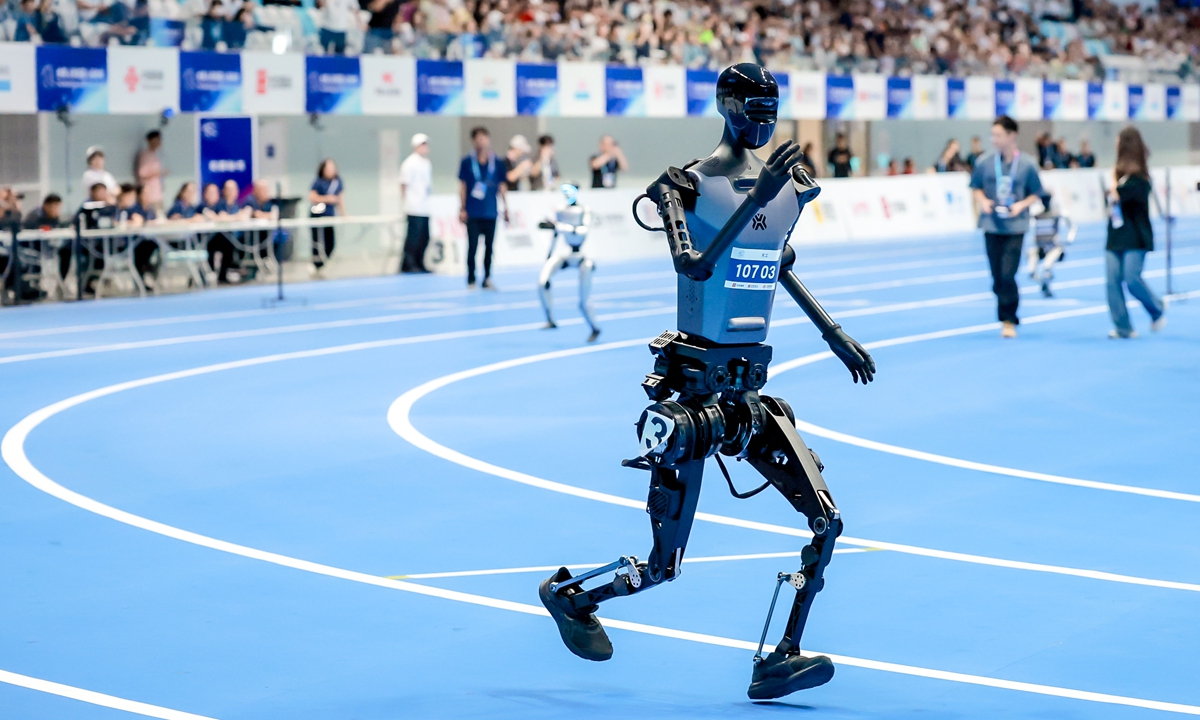
A TienKung robot competes at the first World Humanoid Robot Games. File photo: Courtesy of X-Humanoid
The second World Humanoid Robot Games (WHRG) will be held in Beijing on August 22 at the National Speed Skating Oval, also known as the "Ice Ribbon," doubling its event roster and sharply tightening the rules of autonomy control — a shift expert says moves the benchmark for Chinese humanoid robots from simply finishing a task to finishing it fast, accurately, steadily, and without human's remote control.
The planned 51 events span competitive, scenario-based and dexterous hand categories, which will reflect gains in motion control, perception-based decision-making and fine control, Chen Jing, a vice president of the Technology and Strategy Research Institute, told the Global Times on Thursday.
The Games will be followed by the World Robot Conference, which runs from August 19 to 23 in Beijing's E-Town.
The five-day games will stage 51 events and 1,301 matches, up from 26 events and 487 matches at the inaugural edition in 2025. Registered teams worldwide reached 666, CCTV News reported.
The rulebook has changed more than the schedule. Time limits for the 100-meter dash have been cut from three minutes to one, the 400 meters from 15 minutes to five, and the 1,500 meters from 40 minutes to 15. Except for the 100 meters and 400 meters hurdles, all track and competitive events must now be completed fully autonomously. In scenario-based contests, autonomous completion carries a scoring weight of 1, against 0.5 for teleoperation, said the report.
The compressed limits point to marked progress in dynamic balance, joint actuation and whole-body coordination, Chen said, and scenario events spanning nine categories of real settings show embodied AI decision-making and long-horizon task planning beginning to mature — carrying the industry out of the laboratory toward practical production use.
X-Humanoid, or the Beijing Innovation Center of Humanoid Robotics, will field four robots — TienKung Ultra, TienKung 3.0, TienKung Omni and TianYi 2.0, all trained on its HuiSi KaiWu embodied AI platform, the company told the Global Times.
On the track it is chasing "higher and faster," with some events benchmarked against human Olympic records; in scenario contests it is chasing "more capable." Joint teams from Tsinghua University, Renmin University of China and Huazhong University of Science and Technology will compete on the same platform, said the company.
The Games will also hold six events pit robots against real-world settings, while the dexterous hand category stages eight "micro-manipulation" contests — picking up beans, driving screws — in a battle of fingertips, CCTV News reported.
Spun off from Chinese humanoid robot manufacturer AgiBot in January, AGILINK told the Global Times on Thursday that winning the dexterous hand competition certifies a product's capability and means it has cleared the "demonstration-grade" threshold for real-world use.
Autonomy is the single most important technical storyline of this edition, Chen said. Humanoid robots have until now largely amounted to remote-controlled toys that needed an operator running alongside, which is not what embodied intelligence should mean. The gap between weightings of 1 and 0.5 forces teams to build a full stack of environmental perception, real-time decision-making and autonomous execution: in a real home, factory or hotel, a robot must identify objects, plan its own route and absorb unexpected interference while completing a long task alone, Lin said.
Whether machines can leave the laboratory and genuinely substitute for human labor comes down to full autonomy, he said, and the bar for the industry has moved from showmanship to utility.
Booster Robotics confirmed with the Global Times that it is preparing to compete. Its Booster T1 platform carried Tsinghua University's THU Huoshen Team to a second consecutive Humanoid League title at RoboCup 2026 in Incheon, South Korea, in July — a year after the same team ended a 28-year championship drought for Chinese entrants.
A global consensus is rapidly emerging around standardized embodied AI hardware platforms, the company told the Global Times, letting leading squads focus on perception and multi-agent collaboration rather than building robots from scratch.
The Games could become a proving ground for de facto standards, Chen said, since more than 50 events with quantified metrics give companies benchmarks that are comparable and reproducible. But a single global platform remains difficult: the rules are written by the organizers rather than through the working procedures of bodies such as IEEE or ISO, and metrics will not align across competitions.
The event is better understood as an incubator of industry consensus, he said — competition first identifies the testing methods that Chinese and foreign firms both accept, which can then evolve toward international standards.
RELATED ARTICLES