Cultural merchandise related with China’s National Games surges in popularity, market sales
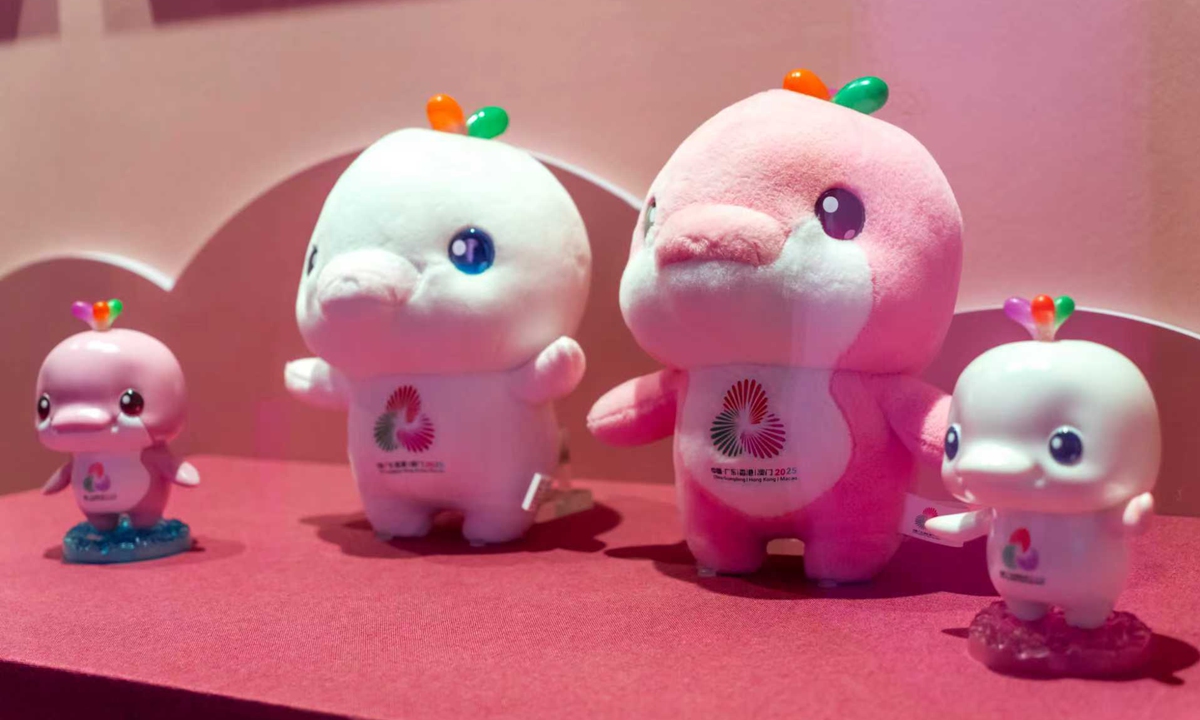
Mascots “Xiyangyang” and “Lerongrong” from China’s 15th National Games and National Para Games are on display at the Guangdong Museum in Guangzhou, South China’s Guangdong Province, on November 18, 2025. Photo: VCG
As the fanfare about China's 15th National Games envelops the country, licensed retail stores for the Games and the National Para Games have witnessed rising crowds, with some popular merchandise selling out thanks to strong demand.
Chinese experts told the Global Times that the booming market for sports-themed cultural products and IP-based merchandise is not only boosting public enthusiasm for sports, but also driving consumption and broader economic activity, creating a multiplier effect.
At the venues of the 15th National Games, spectators carrying backpacks decorated with the mascots "Xiyangyang" and "Lerongrong" have become a striking "moving scene" on the streets. The eye-catching bag — officially named the "Guangzhou Joy Bag" — has gone viral nationwide. Lead designer Zeng Zhenwei shared with the Global Times the creative inspiration behind the trending accessory.
In developing the design, Zeng identified the key creative anchor — the bright, expressive eyes of mascots "Xiyangyang" and "Lerongrong".
"I magnified the dolphin-inspired facial elements and positioned those signature large eyes to face outward, creating instant eye contact with anyone behind the wearer," he told the Global Times. The result, he said, is a playful sense of interaction — passersby instinctively feel engaged and curious the moment they notice the "gaze" on the backpack.
That concept was vividly validated on the streets after the opening ceremony, as countless people stopped in their tracks, drawn by the pair of "talking eyes." "Seeing the design become a symbol of Guangzhou's urban identity and receive such enthusiastic public response — the recognition has far exceeded our expectations," Zeng said.
Another key consideration behind the "Guangzhou Joy Bag" was its broad appeal across age groups and lifestyles. "The biggest strength of the design is that it resonates with everyone — young or old," Zeng said, noting how rare it is for a single product to win over such a diverse audience.
To achieve this, the team created four distinct versions: one customized for athletes and three others distributed randomly in a "blind box" format. Zeng explained that the varied patterns cater to different aesthetic preferences, which is why the bag has been so widely embraced. Zeng said a good cultural product must look appealing and be genuinely useful. He hopes the bag will become a lasting symbol of Guangzhou, so it was made with a durable, waterproof, skin-safe material for everyday use. In his view, its commemorative value outweighs the price. Multiple Xiyangyang and Lerongrong merchandise items have sold out within minutes, with the "Three Kingdoms Lion Dance" blind box proving the hottest seller and even subject to a one-per-person limit.
Store staff told the Global Times that since the opening of the Games, restocked items are still snapped up instantly. The lion dance blind box, for example, is released at 10 am each day, yet buyers begin lining up as early as 7-8 am, and only those with queue numbers can purchase before it sells out. The "Chinese Zodiac" blind box has been out of stock entirely.
Shoppers looking for mascot merchandise told the Global Times they have visited dozens of stores across Guangzhou—some even driving across cities—yet still struggled to secure the most popular blind boxes. On social media, posts asking where to find specific items are flooding in.
"When retail began in January, it took nine months to reach the first 5 million yuan ($700,000) in sales; but in just the first 10 days of November, sales were close to 10 million yuan," Peng Hao, deputy general manager of Guangzhou Cultural Group's industry operations unit, told the Global Times, noting that the surge has caught some suppliers and manufacturers off guard.
Peng said market feedback shows the blind-box series is the hottest seller, with the Three Kingdoms lion dance, zodiac and Journey to the West designs all in short supply. Factories are now rushing production to meet demand, and a large restock is expected soon. "Objectively, this year's IP merchandise rollout has been a success, especially in drawing young buyers and attracting consumers from well beyond the Greater Bay Area," Zhang Yi, CEO of the iiMedia Research Institute, told the Global Times on Wednesday. "The strong results reflect solid design and planning, as well as close collaboration with many local manufacturers."
He added that the trend underscores robust demand for cultural-creative IP products. "China has rich content resources. When strong story-telling and cultural depth are built into a recognizable IP image, the market potential grows significantly," he said. "Sports-themed cultural products have been gaining momentum since the 2008 Beijing Olympics, when the five Fuwa mascots showed how athletic IP could translate into popular merchandise," Liu Dingding, a Beijing-based industrial observer told the Global Times. "The Winter Olympics' Bing Dwen Dwen pushed this even further, proving how sports IP and commercial products can create economic value."
He said today's wave of sports IP continues this trajectory. "These products not only boost public enthusiasm for sports through cultural storytelling and IP marketing, but also stimulate consumption and broader economic activity — creating a multiplier effect that's worth encouraging," Liu noted. Cultural and creative merchandise gains emotional appeal and commemorative value from the atmosphere of major sporting events, and as emotional value becomes an increasingly important driver of youth consumption, such products are likely to remain popular among young consumers, experts said.
This year's National Games has rolled out more than 2,800 licensed products of 20 categories. Guangdong alone has opened over 500 offline retail outlets and more than 70 online stores, with total sales now exceeding 680 million yuan. The mascot-driven craze is not only boosting cultural-creative consumption, but also showcasing the Greater Bay Area's vibrancy and inclusiveness, according to China Media Group (CMG).
RELATED ARTICLES