Beijing humanoid robot half marathon holds first test run ahead of upgraded 2026 race
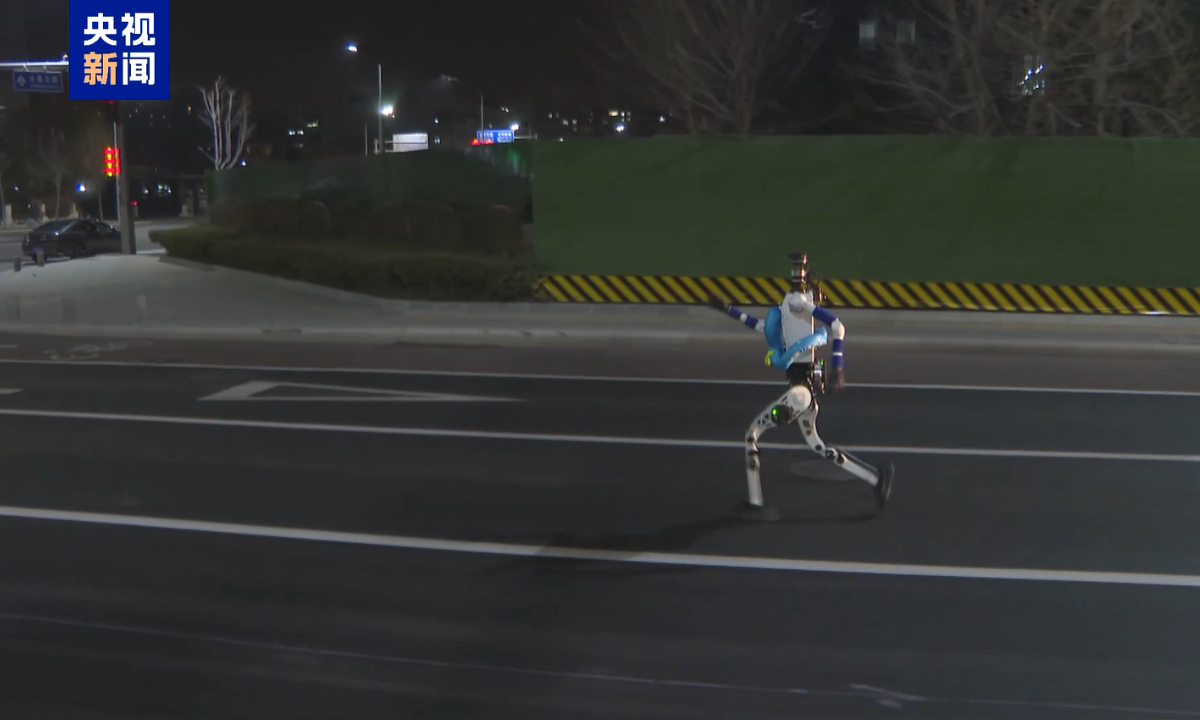
A Tiangong humanoid robot, developed by the Beijing Humanoid Robot Innovation Center, approaches the finish line during the first test run for the 2026 Beijing E-Town Humanoid Robot Half Marathon on March 15, 2026. Photo: Screenshot from a CCTV video.
The first practice test for the Beijing E-Town humanoid robot half-marathon, scheduled for April 19, 2026, was carried out from Saturday night to early Sunday morning, the Global Times learned on Sunday from the Beijing Economic-Technological Development Area (also known as Beijing E-Town), the host of the event and a major hub for China's robotics industry.
More than 20 autonomous-navigation teams from enterprises and universities took part in the trial among the registered participants. Beijing E-Town successfully hosted the world's first humanoid robot half-marathon last year, drawing widespread attention, and the 2026 race is set to see a comprehensive upgrade.
During the upcoming event, human runners and humanoid robots will start at the same time and follow the same course, but will run on separate lanes divided by guardrails or median strips.
"This year's course design has undergone a comprehensive upgrade, with more participating teams. In particular, the addition of autonomous-navigation teams has raised the requirements for both the course and the testing process," the organizer said in a statement sent to the Global Times.
Compared with last year, the route now includes more challenging urban slopes, undulating road sections and ecological paths within park areas. The more complex course conditions place higher demands on robots' ability to adapt to various types of terrain and their motion-control algorithms.
The race format has also evolved in terms of navigation technology. Last year, robots were guided by technicians running alongside or ahead of them, enabling manual remote control. This year, newly added autonomous-navigation teams will rely entirely on robots navigating independently using electronic maps.
According to a video released by China Central Television, the Global Times observed that the humanoid robot "Tiangong" developed by the Beijing Humanoid Robot Innovation Center took part in the practice run. Robots from the same series won the championship in last year's race.
Explaining the purpose of the test run, the statement said that it aims to evaluate humanoid robots' autonomous mobility in real urban road environments. The test will also assess key capabilities including environmental perception, autonomous navigation, real-time decision-making and endurance, while examining their ability to adapt to complex road conditions and multiple scenarios along the course.
Alongside the half-marathon, a new sub-event - the Robot "Baturu" Challenge - will also be held this year, focusing on emergency rescue training scenarios in natural disasters, according to the event's official social media account.
The challenge will feature 17 tasks across four categories: general challenges, humanoid-specific tasks, quadruped-robot tasks and additional challenge items. The event will test robots' autonomous decision-making, precise manipulation and sustained operational capabilities in complex real-world environments, providing an important testing platform for humanoid robots as they move toward broader real-world applications.
This year's event also builds on the momentum generated by last year's competitions. The 2025 World Humanoid Robot Games took place in August 2025, drawing 280 top robot teams from 16 countries and regions to compete in 26 events across 487 matches, showcasing cutting-edge advances in humanoid robots' intelligent decision-making and collaborative movement.
Beijing E-Town has become one of China's key clusters for the robotics industry, bringing together nearly 300 robotics ecosystem companies. The sector's industrial chain has exceeded 10 billion yuan ($1.39 billion) in scale, and the area is stepping up efforts to build a world-class hub for the embodied-intelligence robotics industry.
This year is widely seen as a key year for accelerating the rollout of humanoid robot applications and real-world scenarios, as well as for companies to advance pilot testing and mass production of complete machines.
"Beijing will continue to strengthen support in areas such as technological breakthroughs, product supply, real-world application and industrial ecosystem development," Jiang Hongchao, deputy director of the Beijing Municipal Bureau of Economy and Information Technology, said at a press briefing introducing the event in December last year.
RELATED ARTICLES