Robot rentals surge from Spring Festival Gala to boost culture, tourism, education, healthcare services
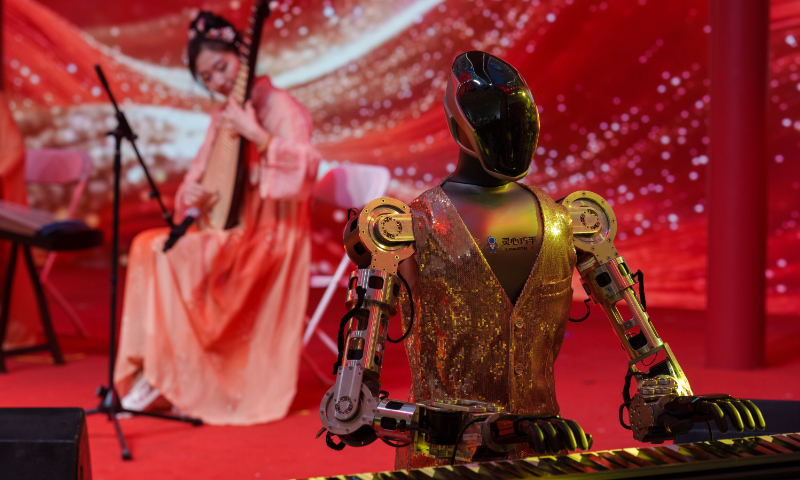
A robot accompanies a traditional music performance on stage at a Spring Festival tech temple fair in Beijing, on February 19, 2026. Photo: VCG
Just days after the Chinese Spring Festival, robots are making frequent appearances at offline events.
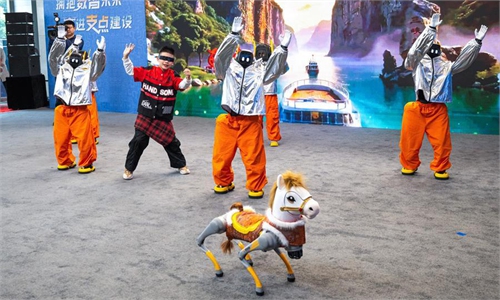
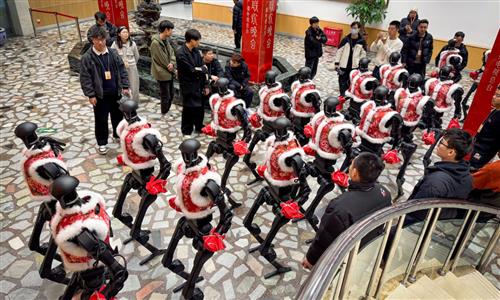
From dancing at shopping malls to greeting guests at brand launches and interacting with visitors in open squares and scenic spots, a wave of "robot fever" has spread beyond the Spring Festival Gala stage, after robot performances on the show drew widespread attention.
A number of robot rental companies told the Global Times that inquiries and orders have risen markedly since the Spring Festival, with some firms already booked through March or beyond. Once mainly seen as tech showcases, robots are increasingly being used as tools for event planning, brand marketing and cultural tourism experiences.
BOTSHARE, a robot rental platform operated by Agibot (also known as Zhiyuan Robotics Co), reported that orders during the Spring Festival holiday rose by about 70 percent. Orders related to festive scenarios - such as Chinese New Year greetings, temple fairs and lantern parades, and mall holiday events - accounted for more than 54 percent of total bookings, up over 76 percent from last year's Spring Festival.
The increasing popularity was achieved in just one year. In the 2025 CCTV Spring Festival Gala, Unitree Robotics was the only robotics firm to appear on stage, drawing widespread attention with its Yangge folk dance performance.
However, at the 2026 CCTV Spring Festival Gala, four robotics companies - Unitree Robotics, Noetix Robotics, MagicLab, and Galbot - appeared on stage, showcasing different types of robots in language-based skits, martial arts, song-and-dance performances, and a festive short film, making robotics one of the highlights of the show.
Industry watchers said the surge in robot rentals has been fueled by the "Spring Festival Gala effect," which reflects a broader shift from showcase-style demonstrations to wider commercial use, with public acceptance steadily rising.
Market orders surge
Yu Jian, general manager of Jike Robot Technology Co, a robot manufacturing and rental company, told the Global Times that most robots used during the Spring Festival had been booked in advance, mainly for Chinese New Year events and exhibitions, with rental demand concentrated in East China's Jiangsu and Zhejiang provinces.
"New orders have risen notably after the Spring Festival, especially since the eighth day of the Chinese new year holiday (February 24), with growing demand from school events," Yu said, adding that the company is fulfilling earlier bookings and the team has been busy since the holiday.
The trend was also evident in commercial and tourism events. During the Spring Festival, nearly 300 robots and robotic dogs were showcased at Shanghai's landmark shopping mall Global Harbor, performing boxing, dancing and martial arts routines that drew crowds of onlookers, according to Xinhua News Agency.
Another company providing robot rental and digital intelligence services, Land Mark, has seen a similar trend too. Inquiries and orders surged after the Spring Festival Gala, with rental fees typically ranging from several thousand yuan to tens of thousands of yuan per day depending on the model, event scale and service duration, Zhao Binran, the company's general manager, told the Global Times.
"Since the second half of February, new orders have increased many times compared with the period before the holiday, with the team's schedule now largely full, giving the company greater confidence in market growth this year," Zhao said.
"Catalyzed by the state broadcaster's live gala show, demand for robots has surged across industrial, commercial and household scenarios," Liu Dingding, a veteran industry analyst told the Global Times.
"But with production capacity still struggling to keep pace and prices remaining high, many users cannot afford outright purchases. This has created strong demand for robot rentals, which is emerging as an important way to bridge supply and demand and accelerate wider adoption," Liu said.
Nurturing an ecosystem
Yu said Jike Robot Technology Co is not focusing solely on robot rentals, but also placing greater emphasis on nurturing a broader robotics application ecosystem. This includes developing robot experience centers, offering robotics programming education, exploring medical-use scenarios, and providing customized robot development.
"Current demand growth is increasingly concentrated in practical applications of robotics, such as secondary development projects with enterprises or providing robotics solutions for hospitals and elderly care institutions," Yu said.
The company is building large-scale robot experience centers in multiple Chinese cities, aiming to use immersive displays and interactive experiences to help more people engage with robotics and accelerate real-world applications, Yu noted.
"We rented a robotic dog for students before the holiday in order to give them a more intuitive way to experience the cutting-edge technology and spark their imagination and creativity," a principal surnamed Shang at a primary school in Beijing told the Global Times.
"The rental costs about 2,600 yuan ($360) per day. As the market matures and more providers enter, prices could fall further, making robot rentals more accessible to the public," she said.
Liu said the significance of the 2026 Spring Festival Gala lies not in the popularity of a single show, but in how it bridged robotics technology with the public and marked a major step in awakening demand. Compared with 2025, more robot rental providers - both online and offline - have emerged, making rentals more convenient and helping fuel the market boom.
Liu added that for quite some time to come, robots are likely to be used rather than owned. However, their functionality and ability to serve specific scenarios need to improve, and wider consumer adoption will depend on practical solutions emerging in areas such as education, commercial services, healthcare and elderly care.
"As market demand for rentals continues to rise, more providers are expected to enter the market, ranging from small firms to major platforms, while a growing variety of robots may become available for leasing," said Liu.
Industry observers said that relevant authorities may introduce clearer policies and regulations to standardize the rental business and better protect consumer rights, supporting the sector's long-term healthy development.
RELATED ARTICLES