IN-DEPTH / IN-DEPTH
From robots to AI and smart infrastructure, China is reshaping how the world imagines everyday modern life
New tech frontier
By Liang Rui and Published: Mar 06, 2026 06:54 PM


Visitors watch a humanoid robot on the street in Zhengzhou, Central China's Henan Province, on February 14, 2026. Photo: VCG
Editor's Note:
In early 2026, the phrase "Very Chinese Time" went viral on global social media platforms. Content centered around China's everyday life has been widely viewed and discussed, bringing the Chinese experience into the international public sphere in a highly accessible way. However, this phenomenon goes beyond mere online popularity - it is unfolding amid the ongoing reshaping of the global order and the accumulation of anxiety in Western societies. A deeper transformation is underway as China's lifestyles, pop culture and technological practices are increasingly recognized, discussed, and adopted worldwide.
This series uses "Very Chinese Time" as a lens to go beyond a single internet trend and systematically showcase how the Chinese experience is entering global everyday life. This is the third installment in the series.
How can you learn how many shaded areas are along your route on a digital map? Have you seen automated drug delivery system in hospitals? Has unmanned delivery technology reached remote areas in your country? Users from various countries are posting about glimpses of everyday life in China.
On overseas social media platforms, a wide range of real-life applications of Chinese robots and other cutting-edge technologies has drawn significant attention - from hotel and restaurant service robots that most Chinese people are already familiar with, to the recent trend in home intelligence, AI-managed humanoid robots directing urban traffic, and elderly companionship robots.
"Is this real?" On X, many users keep turning to AI to verify the authenticity of these technologies, and the AI keeps giving affirmative answers time and again.
Under a February 27 post on X by Chinese Foreign Ministry spokesperson Mao Ning showing a dual-arm robot navigating high-voltage cables with striking precision, one user wrote: "Robots doing the jobs that used to cost lives. That's progress." Another added: "As the EU and US push for more war and death, China is building the future."
Recently, American magazine Wired examined the explosive growth of China's robotics sector, noting the sheer number of robotics firms in China has created a global scale advantage.
This expansion is not limited to concept demonstrations. Technology is moving beyond laboratories and trade shows into factories, neighborhoods, hospitals, and city streets.
China is 'living in 2050'
"Here's why China is advancing at such a fast rate and we just aren't. They have these cities that are so futuristic compared to anything we have, it's not even funny," a US netizen said in a video posted on China's social media platform Xiaohongshu.
As The Guardian noted, toy robot dogs are already part of daily life in China. On the streets of Shanghai, a woman was seen walking her robot dog, which was helpfully carrying a basket for shopping on its back.
Hannah, a 28-year-old London resident, had traveled to China as a high school student. When she first came across online images of robot baristas, cashier-less convenience stores, and AI-managed traffic intersections, she assumed they were purpose-built demonstration zones, because "it felt very different from the China I remembered."
"Later, my Chinese friends told me these things are becoming common - some have already blended into everyday life. They even showed me videos they had filmed back home. That's when I realized this really is just daily life," Hannah told the Global Times.
Back in London, she began to notice the absence of such systems. "I gradually started to understand the sense of contrast some Chinese people here talk about," Hannah said. "One of them once told me that while London is an attractive tourist destination, something always feels missing when it comes to daily living."
Edward Wang, a Chinese student who has lived in the US for many years, described to the Global Times a kind of parallel comparison. "In the US, many tech products still feel like something you actively choose to opt into," he said. "But in China, they are increasingly becoming part of the environment itself." He cited mobile payments integrated into public services, AI-powered hospital scheduling systems, and robotics embedded in warehousing and logistics.
Zhang noticed that a growing number of foreign observers are documenting, comparing, and discussing these developments. China is increasingly used as a reference point when people imagine what modern life could look like.
"Now, whenever someone posts about China's cutting-edge technology on social media, the proportion of foreign users reflecting and expressing admiration in the comments section has risen sharply," Zhang said.
"A few years ago, mockery used to dominate. Now they're seriously thinking about how China manages to build such advanced products. From product quality to technological innovation, from design philosophy to user experience, their long-held preconceptions are gradually being challenged," he stressed.
"China is already in 2030!" In September 2024, the Xinhua News Agency reported on a video by the Hutchinsons, a British family with almost 200,000 followers on TikTok, when they documented their first experience of drone delivery service in Shenzhen, South China's Guangdong Province. The vlog has garnered millions of views.
"And now, if you ask me, I think China is already living in 2050, or even further ahead, " Hannah said.
Coordinated industrial chain
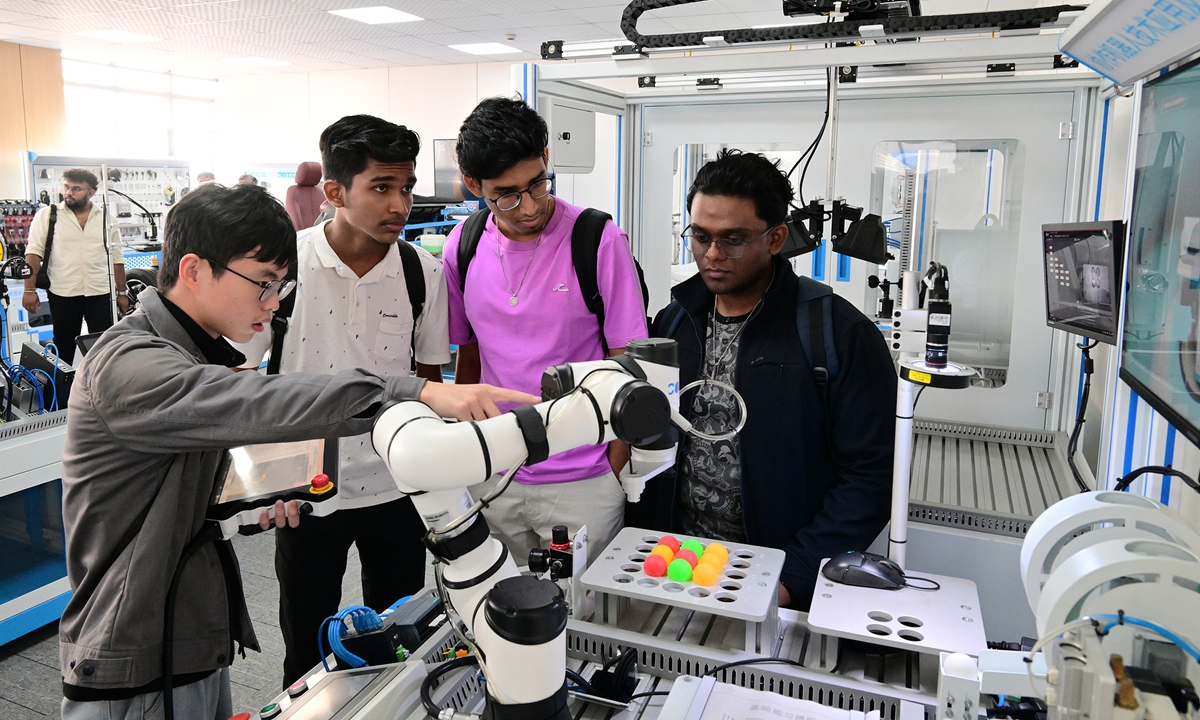
Students from Malaysia visit an electronic technology company in Jinhua, East China's Zhejiang Province, to learn about the application and innovation of collaborative robot technology on November 7, 2025. Photo: VCG
What sets China apart is not how impressive a robot looks on stage, but how quickly this technology can move from demonstration to large-scale real-world deployment.The Guardian, in an article in April 2025 demonstrating China's use of AI and robots, summarized the benefits derived from the mature industrial chains developed through high-tech sectors such as electric vehicles and drones. It noted that China possesses both the capacity to mass-produce key components and the ability to assemble them into complex systems and rapidly push them into real-world scenarios.
According to the Guardian, building a "robot brain" capable of learning human-like behaviors and movements has long been one of the most elusive challenges in the field.
Yet the report also highlighted a key variable: the emergence of DeepSeek's R1 model. Analysts at Goldman Sachs described it as a development that "changed the game," arguing that it could pave the way for domestic humanoid robotics companies to catch up with overseas competitors.
More importantly, even if one acknowledges that the industry currently faces elements of hype and overheating, the ultimate test remains unchanged: whether technology can truly operate in real-world scenarios.
The New York Times article in February said that for a decade China has pursued factory modernization as a national project driven by governments "at all levels."
Across the Pacific, however, US AI policy has largely focused on frontier AI research and the development of large language models. While the US leads in those fields, such emphasis has also meant that other practical areas of AI and automation have received less attention, making it harder for US manufacturers to integrate digital tools on factory floors, The New York Times stated.
"China's real confidence lies in having the world's most complete and best-coordinated industrial chain," Lü Benfu, vice president of the China National Innovation and Development Strategy Research Association, said in an interview with the Global Times.
He noted that China continues to make progress in emerging technology sectors such as drones, intelligent vehicles and robotics, while traditional industries including home appliances are also undergoing continuous technological upgrading. "No other country in the world possesses such a comprehensive industrial capability across so many sectors at the same time," Lü said.
A high-level manager of a leading Chinese tech innovation enterprise also told the Global Times that Chinese technology firms have been undergoing a shift in their role within the global value chain in recent years.
"In the past we mainly sold consumer goods with relatively low technological content. Today we are exporting not only 'Made in China,' but also the intelligence behind it, bringing the world advanced technological solutions from China," the manager said.
A global reference point
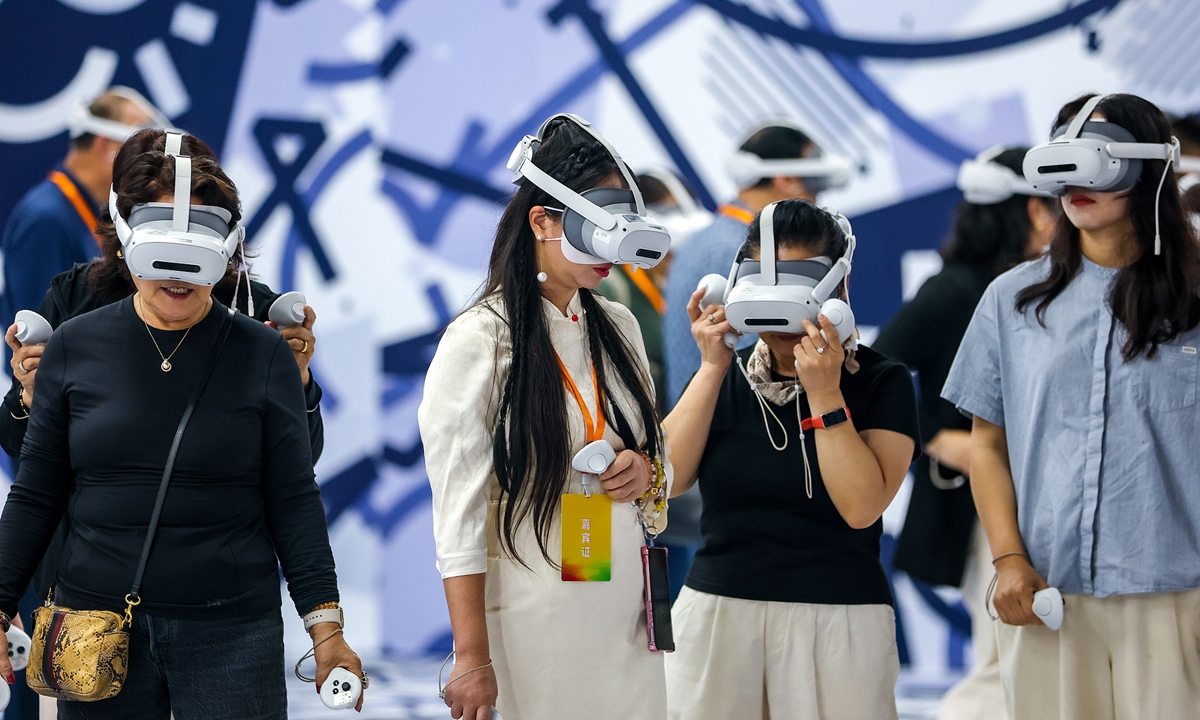
Media representatives from various countries experience VR glasses at a digital economy industrial park in Wuhan, Central China's Hubei Province, on September 24, 2025. Photo: VCG
As these technologies gradually move from laboratories into city streets and household spaces, China is increasingly appearing as a key reference point in global discussions about technology.Beyond the expressions of amazement and comparisons seen on social media, international technology exhibitions, industrial cooperation projects, and media agendas are also beginning to treat China as a real-world sample for observing the future of everyday life.
This shift is particularly visible at global technology exhibitions. The 2026 Mobile World Congress (MWC), recently held in Barcelona, Spain, attracted about 2,900 exhibitors and participants from more than 200 countries and regions. Among them, more than 350 Chinese companies took part, covering telecom operators, equipment manufacturers, terminal producers and core component suppliers, forming a comprehensive display of the entire industrial chain, Xinhua reported.
In terms of specific showcases, Chinese companies made a strong showing across multiple fields including telecommunications, AI and robotics. For example, Huawei launched the U6GHz full-scenario product series and solutions at the event, promoting the steady evolution from 5G-Advanced toward 6G. Honor, meanwhile, displayed a "robot phone" featuring embodied AI interaction capabilities as well as its first humanoid robot, according to Xinhua.
Luigi Gambardella, president of the Brussels-based international digital association ChinaEU, said in an exclusive interview with Xinhua that China is leading the way in building cognitive networks and operationalizing AI at scale. Chinese companies at MWC 2026 are not showcasing isolated technological breakthroughs, Gambardella said, but integrated architectures.
Chinese technological innovation is also increasingly benefiting people in other parts of the world.
According to a report by the People's Daily, Chinese companies' power-grid AI models are helping Brazil modernize the intelligent operation and maintenance of its electricity network, addressing inspection challenges in complex environments. In Africa, Chinese firms have deployed intelligent systems for South Africa's railway network, reducing safety incidents and improving inspection and maintenance efficiency. In Southeast Asia, Chinese medical AI technologies have been applied in Singapore's healthcare system, improving the efficiency and accuracy of lung nodule screening.
Lü noted that the significance of China's technological development lies not only in technological breakthroughs themselves, but also in the ability for those technologies to be widely used. "One of China's most important contributions to the world is providing high-quality, cost-effective products to the global market. Without Chinese manufacturing, the cost of living for people in many countries would rise significantly," Lü said.
"At the same time, Chinese products such as robots and drones maintain advanced technological capabilities while being offered at prices that are accessible to ordinary institutions and consumers," he said.
RELATED ARTICLES