IN-DEPTH / IN-DEPTH
How Chinese view the world: over 90 percent of Chinese expect China to help shape a fairer global order
Editor's note:
Amid the turbulence and hope that have defined 2025, the Global Times has launched its 20th annual survey, titled "How Chinese view the world." Since 2006, the survey has not only reflected evolving public opinion in China, but also offered a unique lens into the changing dynamics between China and the rest of the world. This year's results show that, compared with the "cautious and low-key" sentiment of respondents in the early 2000s, Chinese public opinion now reflects confidence and rationality befitting a major power. Over the past two decades, the proportion of respondents who believe that "China is already a global power" has doubled. In addition, China-Russia ties have remained the most valued neighboring relationship for 17 consecutive years, while China-US relations have once again topped all bilateral relationships in terms of importance. Notably, 94 percent of respondents hope China to play a greater role in promoting a fairer international order.
Proportion of people who see China as global power doubled in 20 years
From November 19 to December 5, the Global Times Research Center conducted the annual "How Chinese view the world" survey through invitation-only online questionnaires. The survey covered ordinary residents aged 18 to 69 in more than 280 cities across 31 provincial-level regions on the Chinese mainland, ranging from tier-one to tier-five cities. DATA100 provided sample support, and a total of 3,578 valid responses were collected. The results were weighted based on the gender and age structure of internet users, as outlined in the 56th Statistical Report Statistical Report on China's Internet Development, released in July by the China Internet Network Information Center.
Since its launch in 2006, the survey has repeatedly asked respondents: "Do you believe China is already a global power?" In 2006, the proportions of "Yes," "Not fully," and "No" were 20 percent, 51 percent, and 24 percent, respectively. By 2025, the "Yes" figure had risen to 45 percent, while the shares of "Not fully" and "No" dropped to 44 percent and 8 percent, respectively. Over the past two decades, the proportion of people who believe "China is already a global power" has doubled, reflecting greater confidence and composure among the Chinese public in facing the world.
More than 70 percent of respondents believe that China is the safest (76 percent) and most convenient (74 percent) place to live, feel proud to be Chinese (76 percent), and agree with the traditional saying, "Everyone has a duty toward his country" (74 percent).
The fundamental driver behind changes in public opinion lies in the country's long-term capacity building and the achievement of landmark accomplishments, Zhao Long, deputy Director of the Institute for International Strategic and Security Studies in Shanghai, told the Global Times.
For example, in the military sphere, significant progress has been made in defense and military reforms and equipment modernization over the past decade. In particular, this year's military parade on September 3 boosted public confidence, according to Zhao.
On the economic front, China has maintained a relatively high growth rate and strong resilience, giving the public a sense of stability and confidence in the country's economic foundations and risk resistance.
Looking ahead to the next five years, the public expresses strong confidence in China's development across multiple areas including the economy, technological innovation, further opening-up, cultural innovation, social welfare, green transformation, social governance, and national defense.
Between 70 and 80 percent of respondents reported high levels of optimism (selecting "very optimistic" or "relatively optimistic"). The highest levels of optimism were recorded in national defense (86 percent) and technological innovation (84 percent).
China-US ties return to top of priorities
"In the following list of China's bilateral relations, which do you think are the most important to China?" This question has been included in the Global Times Research Center's surveys for several consecutive years. In 2025, the top three bilateral relationships as rated by respondents are: China-US ties (54 percent), China-Russia ties (47 percent), and China-EU ties (32 percent).
For most of the past 20 years, China-US relations ranked first in importance. However, they dropped to third and fourth place in 2021 and 2022. In 2023 and 2024, they climbed back to second place, just behind China-Russia relations. This year, China-US ties returned to the top. From 2014 to 2020, China-Russia ties consistently held the second-highest ranking.
Li Haidong, a professor at the China Foreign Affairs University, told the Global Times that "although China-US relations face challenges, China's ability to manage this relationship has improved. The data reflects public recognition of China's growing influence and effectiveness in shaping the trajectory of China-US relations. As for China-Russia ties, they remain in second or first place due to a solid strategic foundation and shared interests. Chinese citizens have high expectations for this relationship."
In recent years, the US government has labeled China as a "strategic competitor" and imposed increasing restrictions in areas such as technology and the economy. In response, the Chinese public has shown a balanced attitude. A total of 30 percent of respondents believe China should respond forcefully, 31 percent supports a moderate response, and 28 percent says such moves are not worth worrying about.
Data from the past three years shows that Chinese public confidence in responding to US provocations is growing. The combined share of respondents who support either moderate or forceful countermeasures rose from 51 percent in 2023 to 62 percent in 2025.
"China's countermeasures in sectors like rare earths and agriculture reflect a broader strategic perspective," Li said. "They are aimed at safeguarding China's development while preserving the global process of globalization. Through concrete actions, China has demonstrated to the world how to counter anti-globalization behavior and encouraged other countries to value multilateral mechanisms. These moves have made the US gradually realize that unilateral tariff threats do not work and ultimately hurt its own interests."
China-Russia ties top neighbor relations for 17 consecutive years
The survey found that among neighboring relations, China-Russia relations were ranked as the most important by the public, with nearly 60 percent selecting it as the top choice. China-Japan relations (42 percent) and relations with Southeast Asian countries (36 percent) ranked second and third, respectively.
Since 2009, China-Russia relations have consistently ranked first as the "most important neighboring relationship" in the eyes of the Chinese public in this survey for 17 consecutive years.
Vladimir Petrovskiy, a research fellow at the Institute of China and Contemporary Asia of the Russian Academy of Sciences, told the Global Times that survey data indicates that Chinese citizens highly value the current state and prospects of Russia-China relations and Russian citizens also share this high assessment. According to a survey in Russia, China ranks first among Russians' friendliest countries.
Over the past 20 years, Chinese public perceptions of the importance of China-Japan relations have shown significant fluctuations. From 2006 to 2008, China-Japan relations ranked first among the neighboring relationships most valued by respondents. From 2009 to 2019, it remained in second place. Between 2020 and 2024, it fluctuated between third and fifth place.
Xiang Haoyu, a distinguished research fellow at the China Institute of International Studies, told the Global Times that "this fluctuation in public perception is influenced by multiple factors, including historical disputes, geopolitics, and economic interests. From 2006 to 2008, China-Japan relations ranked first because the relationship had broken the ice and warmed politically after the frigid period during Junichiro Koizumi's tenure as prime minister. The fluctuations in ranking after 2020 were influenced by Japan's policies aimed at containing and curbing China.
Regarding Takaichi's errors on the Taiwan question, respondents expressed negative emotions such as "anger," "shock," and "concern." Over 80 percent of respondents believed that these remarks indicate that the Japanese government lacks genuine reflection on the war of aggression against China. More than 60 percent of respondents believed that the remarks "exacerbate tensions in China-Japan relations," while around half also believed that they lead to "tensions across the Taiwan Straits," "reduced China-Japan economic, trade, and people-to-people exchanges," and "damage to regional peace and stability."
Regarding future in China-Japan relations, more than 70 percent of respondents believe they will be "good and bad in cycles" or "getting worse and worse."
In an interview with the Global Times, Noriyuki Kawamura, emeritus professor at Nagoya University of Foreign Studies, stated that many members of the Takaichi cabinet and senior figures in the Liberal Democratic Party lack sufficient understanding of China and have few personal connections with Chinese people. Takaichi's erroneous remarks have led to a deterioration in the sentiments between the two nations' peoples, a deterioration that will be difficult to reverse in the short term and will also affect political mutual trust between the two countries.
"Only if Japan stops testing China's bottom lines and returns to a rational and pragmatic track can China-Japan relations avoid falling into long-term confrontation," Xiang said.
Regarding China's overall diplomatic trajectory, 80 to 90 percent of respondents believe that China's relations with Russia, ASEAN, Central Asia, the Middle East, Africa, and Latin America responded that it will either "remain unchanged" or "get better and better" in the coming years. Around 70 percent of public opinion holds that China's relations with the US, the EU, Australia, South Korea, and India will "remain unchanged" or "good and bad in cycles" in the coming years.
Perception of global risks increased, overall attitude optimistic
As the international situation becomes increasingly unstable and uncertain; Chinese public perception of risks in the future international environment has risen compared to 2024. For instance, 44 percent of respondents believe that China will face more threats or challenges, an increase of about 17 percentage points. At the same time, 38 percent of respondents believe that China will have more opportunities. More than 60 percent of respondents consider "strategic intervention and hedging by extraterritorial major powers such as the US" to be the most significant challenge currently facing China's peripheral diplomacy.
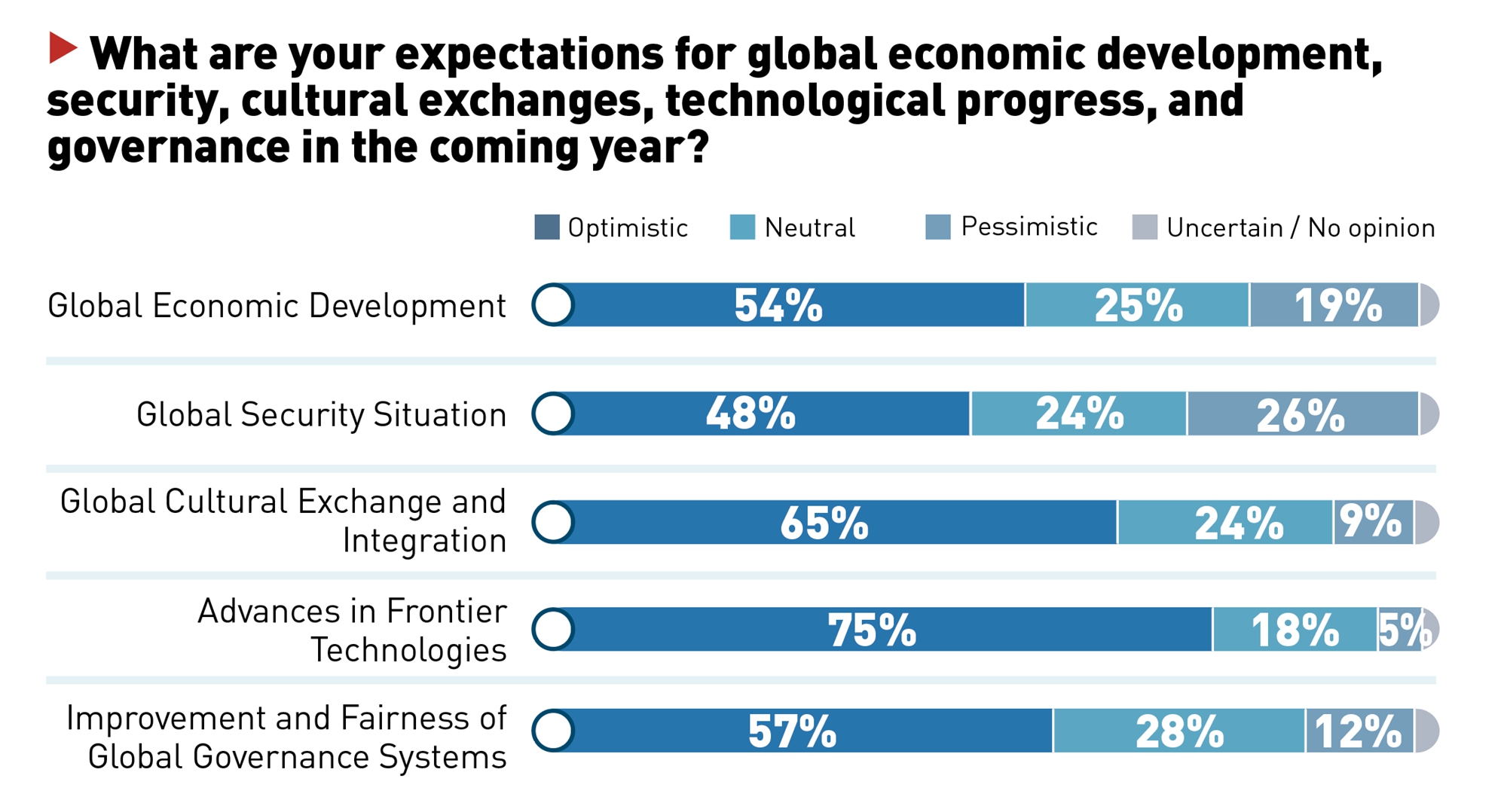
Nevertheless, the overall Chinese perspective on the world remains positive and optimistic. Approximately 80 percent of respondents hold optimistic or neutral expectations for global economic development in the coming year; more than 70 percent hold optimistic or neutral expectations for the global security situation; and the proportion of respondents holding optimistic or neutral expectations for global civilizational exchanges and the governance system is no less than 85 percent.
"The Chinese public's positive expectations for world development stem from their perception of China's current socioeconomic development and the surrounding environment. In a world intertwined with changes and turbulence, China's neighboring regions remain generally peaceful and stable overall. China is also able to resolve regional conflicts and differences more through political channels, consultation, and dialogue via regional mechanisms. This plays a positive role in fostering optimistic expectations among the public," Zhao told the Global Times.
Currently, protracted conflicts in many global hotspots pose a serious challenge to international security. Ninety-three percent of respondents expect China to take more action in mediating and coordinating international or regional hotspots, contributing to the maintenance of world peace and stability. Regarding global governance, 77 percent of respondents believe China is one of the "major leaders" or an "important participant" in global governance. Over 80 percent of respondents expect China to participate more and play a greater role in international affairs. Ninety-four percent of respondents expect China to contribute more to promoting the just development of the international order.
"Amid a complex and turbulent international landscape, China's Global Governance Initiative has injected new hope into the world," Li said. "Public opinion polls show a positive interaction between the Chinese people's personal feelings and the international community's expectations of China. The consensus that 'China embraces the world, and the world welcomes China' is being transformed into a tangible reality."
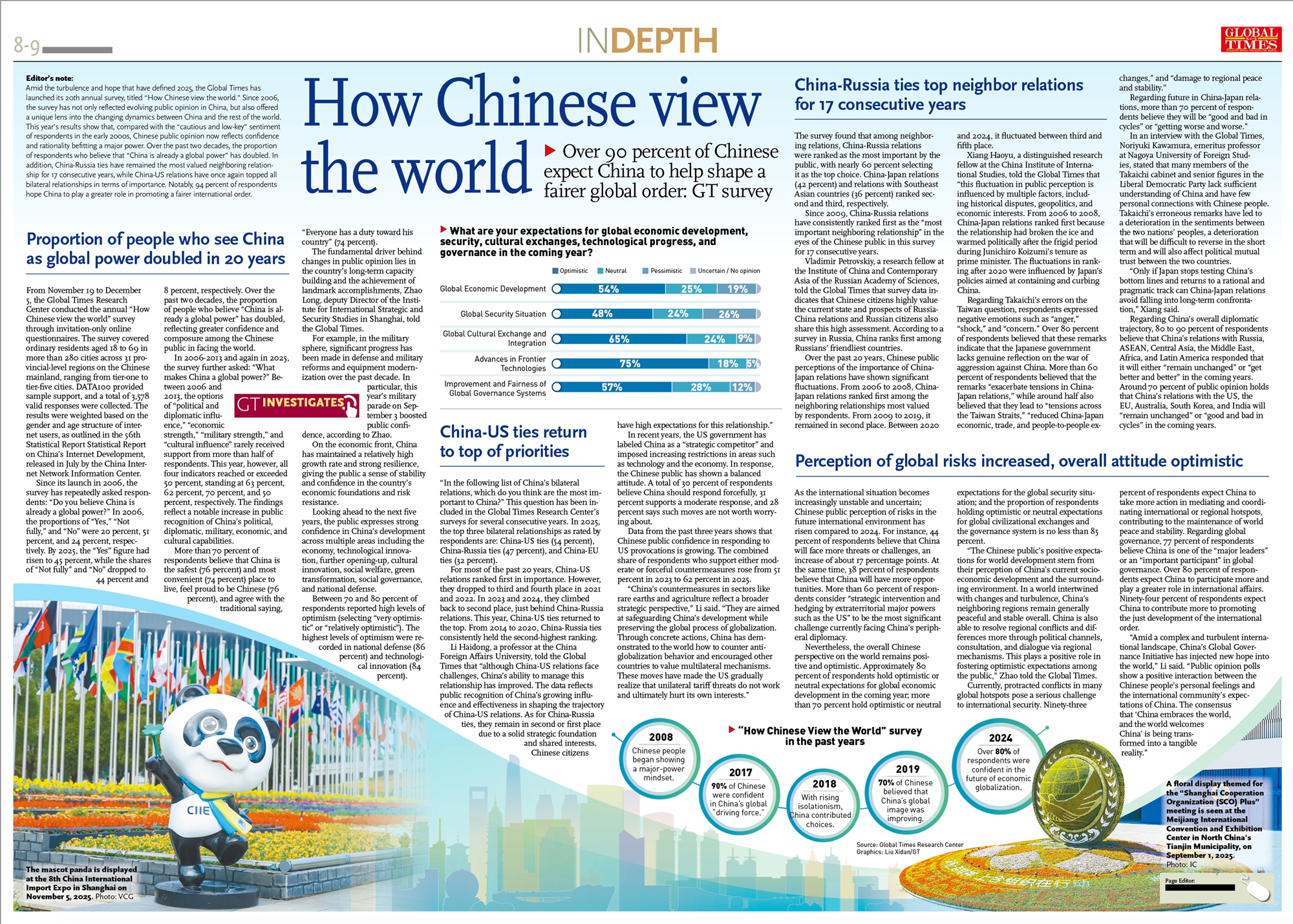
Amid the turbulence and hope that have defined 2025, the Global Times has launched its 20th annual survey, titled "How Chinese view the world." Since 2006, the survey has not only reflected evolving public opinion in China, but also offered a unique lens into the changing dynamics between China and the rest of the world. This year's results show that, compared with the "cautious and low-key" sentiment of respondents in the early 2000s, Chinese public opinion now reflects confidence and rationality befitting a major power. Over the past two decades, the proportion of respondents who believe that "China is already a global power" has doubled. In addition, China-Russia ties have remained the most valued neighboring relationship for 17 consecutive years, while China-US relations have once again topped all bilateral relationships in terms of importance. Notably, 94 percent of respondents hope China to play a greater role in promoting a fairer international order.
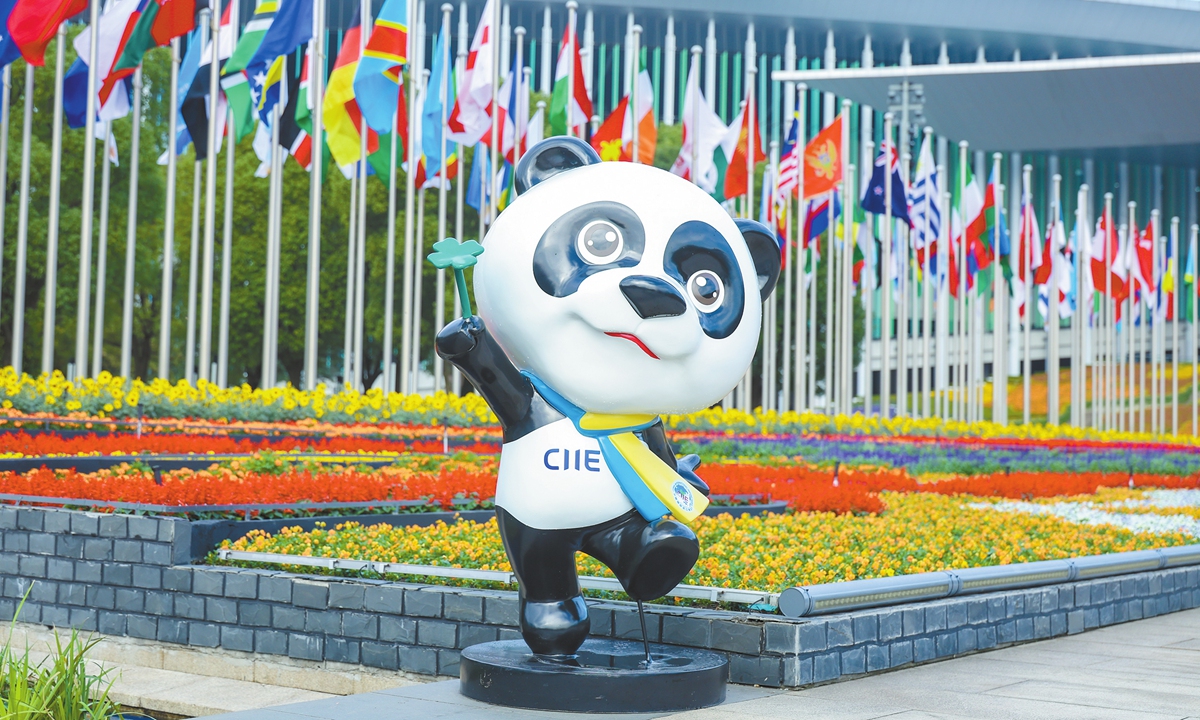
The mascot panda is displayed at the 8th China International Import Expo in Shanghai on November 5, 2025. Photo: VCG
Proportion of people who see China as global power doubled in 20 years
From November 19 to December 5, the Global Times Research Center conducted the annual "How Chinese view the world" survey through invitation-only online questionnaires. The survey covered ordinary residents aged 18 to 69 in more than 280 cities across 31 provincial-level regions on the Chinese mainland, ranging from tier-one to tier-five cities. DATA100 provided sample support, and a total of 3,578 valid responses were collected. The results were weighted based on the gender and age structure of internet users, as outlined in the 56th Statistical Report Statistical Report on China's Internet Development, released in July by the China Internet Network Information Center.
Since its launch in 2006, the survey has repeatedly asked respondents: "Do you believe China is already a global power?" In 2006, the proportions of "Yes," "Not fully," and "No" were 20 percent, 51 percent, and 24 percent, respectively. By 2025, the "Yes" figure had risen to 45 percent, while the shares of "Not fully" and "No" dropped to 44 percent and 8 percent, respectively. Over the past two decades, the proportion of people who believe "China is already a global power" has doubled, reflecting greater confidence and composure among the Chinese public in facing the world.
In 2006-2013 and again in 2025, the survey further asked: "What makes China a global power?" Between 2006 and 2013, the options of "political and diplomatic influence," "economic strength," "military strength," and "cultural influence" rarely received support from more than half of respondents. This year, however, all four indicators reached or exceeded 50 percent, standing at 63 percent, 62 percent, 70 percent, and 50 percent, respectively. The findings reflect a notable increase in public recognition of China's political, diplomatic, military, economic, and cultural capabilities.
More than 70 percent of respondents believe that China is the safest (76 percent) and most convenient (74 percent) place to live, feel proud to be Chinese (76 percent), and agree with the traditional saying, "Everyone has a duty toward his country" (74 percent).
The fundamental driver behind changes in public opinion lies in the country's long-term capacity building and the achievement of landmark accomplishments, Zhao Long, deputy Director of the Institute for International Strategic and Security Studies in Shanghai, told the Global Times.
For example, in the military sphere, significant progress has been made in defense and military reforms and equipment modernization over the past decade. In particular, this year's military parade on September 3 boosted public confidence, according to Zhao.
On the economic front, China has maintained a relatively high growth rate and strong resilience, giving the public a sense of stability and confidence in the country's economic foundations and risk resistance.
Looking ahead to the next five years, the public expresses strong confidence in China's development across multiple areas including the economy, technological innovation, further opening-up, cultural innovation, social welfare, green transformation, social governance, and national defense.
Between 70 and 80 percent of respondents reported high levels of optimism (selecting "very optimistic" or "relatively optimistic"). The highest levels of optimism were recorded in national defense (86 percent) and technological innovation (84 percent).
China-US ties return to top of priorities
"In the following list of China's bilateral relations, which do you think are the most important to China?" This question has been included in the Global Times Research Center's surveys for several consecutive years. In 2025, the top three bilateral relationships as rated by respondents are: China-US ties (54 percent), China-Russia ties (47 percent), and China-EU ties (32 percent).
For most of the past 20 years, China-US relations ranked first in importance. However, they dropped to third and fourth place in 2021 and 2022. In 2023 and 2024, they climbed back to second place, just behind China-Russia relations. This year, China-US ties returned to the top. From 2014 to 2020, China-Russia ties consistently held the second-highest ranking.
Li Haidong, a professor at the China Foreign Affairs University, told the Global Times that "although China-US relations face challenges, China's ability to manage this relationship has improved. The data reflects public recognition of China's growing influence and effectiveness in shaping the trajectory of China-US relations. As for China-Russia ties, they remain in second or first place due to a solid strategic foundation and shared interests. Chinese citizens have high expectations for this relationship."
In recent years, the US government has labeled China as a "strategic competitor" and imposed increasing restrictions in areas such as technology and the economy. In response, the Chinese public has shown a balanced attitude. A total of 30 percent of respondents believe China should respond forcefully, 31 percent supports a moderate response, and 28 percent says such moves are not worth worrying about.
Data from the past three years shows that Chinese public confidence in responding to US provocations is growing. The combined share of respondents who support either moderate or forceful countermeasures rose from 51 percent in 2023 to 62 percent in 2025.
"China's countermeasures in sectors like rare earths and agriculture reflect a broader strategic perspective," Li said. "They are aimed at safeguarding China's development while preserving the global process of globalization. Through concrete actions, China has demonstrated to the world how to counter anti-globalization behavior and encouraged other countries to value multilateral mechanisms. These moves have made the US gradually realize that unilateral tariff threats do not work and ultimately hurt its own interests."
China-Russia ties top neighbor relations for 17 consecutive years
The survey found that among neighboring relations, China-Russia relations were ranked as the most important by the public, with nearly 60 percent selecting it as the top choice. China-Japan relations (42 percent) and relations with Southeast Asian countries (36 percent) ranked second and third, respectively.
Since 2009, China-Russia relations have consistently ranked first as the "most important neighboring relationship" in the eyes of the Chinese public in this survey for 17 consecutive years.
Vladimir Petrovskiy, a research fellow at the Institute of China and Contemporary Asia of the Russian Academy of Sciences, told the Global Times that survey data indicates that Chinese citizens highly value the current state and prospects of Russia-China relations and Russian citizens also share this high assessment. According to a survey in Russia, China ranks first among Russians' friendliest countries.
Over the past 20 years, Chinese public perceptions of the importance of China-Japan relations have shown significant fluctuations. From 2006 to 2008, China-Japan relations ranked first among the neighboring relationships most valued by respondents. From 2009 to 2019, it remained in second place. Between 2020 and 2024, it fluctuated between third and fifth place.
Xiang Haoyu, a distinguished research fellow at the China Institute of International Studies, told the Global Times that "this fluctuation in public perception is influenced by multiple factors, including historical disputes, geopolitics, and economic interests. From 2006 to 2008, China-Japan relations ranked first because the relationship had broken the ice and warmed politically after the frigid period during Junichiro Koizumi's tenure as prime minister. The fluctuations in ranking after 2020 were influenced by Japan's policies aimed at containing and curbing China.
Regarding Takaichi's errors on the Taiwan question, respondents expressed negative emotions such as "anger," "shock," and "concern." Over 80 percent of respondents believed that these remarks indicate that the Japanese government lacks genuine reflection on the war of aggression against China. More than 60 percent of respondents believed that the remarks "exacerbate tensions in China-Japan relations," while around half also believed that they lead to "tensions across the Taiwan Straits," "reduced China-Japan economic, trade, and people-to-people exchanges," and "damage to regional peace and stability."
Regarding future in China-Japan relations, more than 70 percent of respondents believe they will be "good and bad in cycles" or "getting worse and worse."
In an interview with the Global Times, Noriyuki Kawamura, emeritus professor at Nagoya University of Foreign Studies, stated that many members of the Takaichi cabinet and senior figures in the Liberal Democratic Party lack sufficient understanding of China and have few personal connections with Chinese people. Takaichi's erroneous remarks have led to a deterioration in the sentiments between the two nations' peoples, a deterioration that will be difficult to reverse in the short term and will also affect political mutual trust between the two countries.
"Only if Japan stops testing China's bottom lines and returns to a rational and pragmatic track can China-Japan relations avoid falling into long-term confrontation," Xiang said.
Regarding China's overall diplomatic trajectory, 80 to 90 percent of respondents believe that China's relations with Russia, ASEAN, Central Asia, the Middle East, Africa, and Latin America responded that it will either "remain unchanged" or "get better and better" in the coming years. Around 70 percent of public opinion holds that China's relations with the US, the EU, Australia, South Korea, and India will "remain unchanged" or "good and bad in cycles" in the coming years.
Perception of global risks increased, overall attitude optimistic
As the international situation becomes increasingly unstable and uncertain; Chinese public perception of risks in the future international environment has risen compared to 2024. For instance, 44 percent of respondents believe that China will face more threats or challenges, an increase of about 17 percentage points. At the same time, 38 percent of respondents believe that China will have more opportunities. More than 60 percent of respondents consider "strategic intervention and hedging by extraterritorial major powers such as the US" to be the most significant challenge currently facing China's peripheral diplomacy.
Nevertheless, the overall Chinese perspective on the world remains positive and optimistic. Approximately 80 percent of respondents hold optimistic or neutral expectations for global economic development in the coming year; more than 70 percent hold optimistic or neutral expectations for the global security situation; and the proportion of respondents holding optimistic or neutral expectations for global civilizational exchanges and the governance system is no less than 85 percent.
"The Chinese public's positive expectations for world development stem from their perception of China's current socioeconomic development and the surrounding environment. In a world intertwined with changes and turbulence, China's neighboring regions remain generally peaceful and stable overall. China is also able to resolve regional conflicts and differences more through political channels, consultation, and dialogue via regional mechanisms. This plays a positive role in fostering optimistic expectations among the public," Zhao told the Global Times.
Currently, protracted conflicts in many global hotspots pose a serious challenge to international security. Ninety-three percent of respondents expect China to take more action in mediating and coordinating international or regional hotspots, contributing to the maintenance of world peace and stability. Regarding global governance, 77 percent of respondents believe China is one of the "major leaders" or an "important participant" in global governance. Over 80 percent of respondents expect China to participate more and play a greater role in international affairs. Ninety-four percent of respondents expect China to contribute more to promoting the just development of the international order.
"Amid a complex and turbulent international landscape, China's Global Governance Initiative has injected new hope into the world," Li said. "Public opinion polls show a positive interaction between the Chinese people's personal feelings and the international community's expectations of China. The consensus that 'China embraces the world, and the world welcomes China' is being transformed into a tangible reality."
RELATED ARTICLES