SPORT / MISCELLANY
Guizhou’s cave adventure craze takes niche outdoor sport mainstream
Exploring the unknown
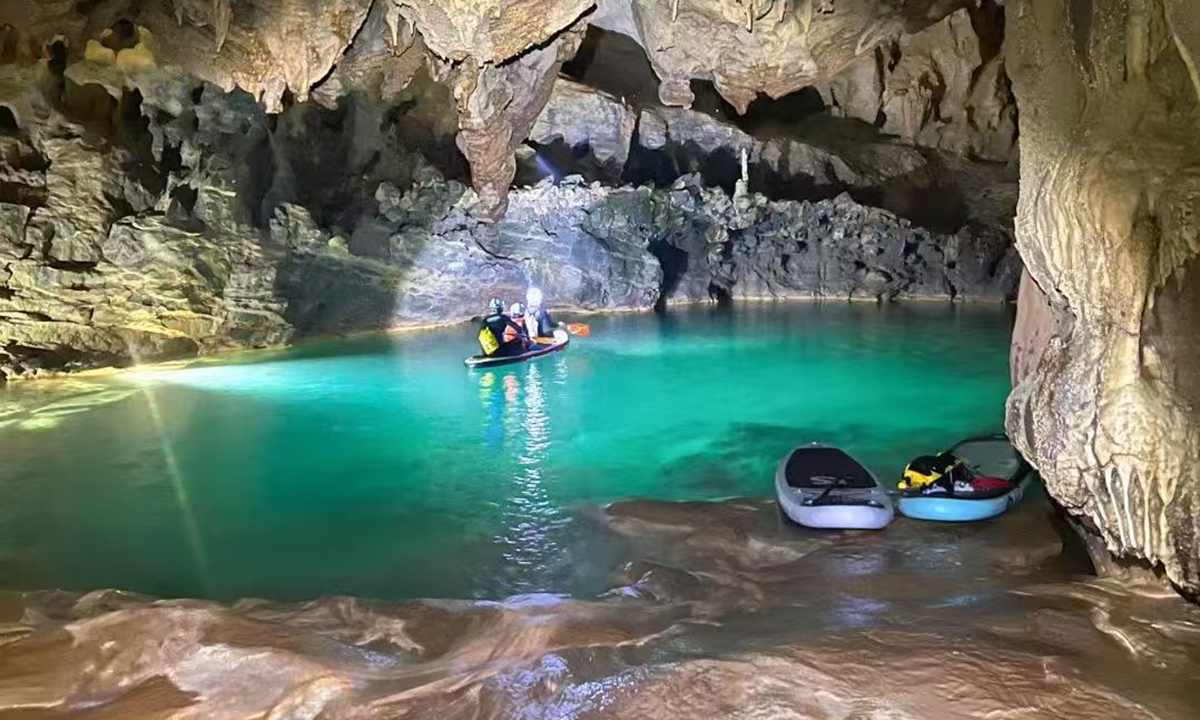
A cave exploration team paddles through Shilong Cave in Southwest China's Guizhou Province. Photo: Courtesy of Jiang Jun
Inside the Shilong Cave in Qingzhen, Southwest China's Guizhou Province, visitors of all ages in outdoor gear glide slowly forward on paddleboards. The cave grows quieter as they move deeper inside, with their headlamps illuminating only a few meters ahead.Above them are striking stalactites and stalagmites; below, cool underground water flows beneath their boards.
When they reach a narrow passage, they duck to get through; once the cave opens up again, they resume paddling.
"It felt completely different from my usual travel experiences," Zhou, a 26-year-old visitor from Southwest China's Yunnan Province, told the Global Times.
She had never tried an outdoor activity like this before, but after repeatedly seeing videos of cave exploration on social media, she decided to give it a try.
"You're not just sitting there looking at things. You're paddling, walking, and you never know what you'll see next," she said.
Her child kept asking questions along the way, turning the trip into something that felt "less like ordinary sightseeing and more like exploring nature."
Visitors like Zhou are becoming increasingly common in caves across Guizhou.
A Long, a local cave exploration guide and outdoor instructor certified by the Chinese Mountaineering Association, has witnessed the activity evolve from a niche hobby into a tourism product.
He told the Global Times that visitors from outside the region now make up a growing share of his customers, especially families and children.
The change has become evident this summer, with his team receiving several thousand visitors.
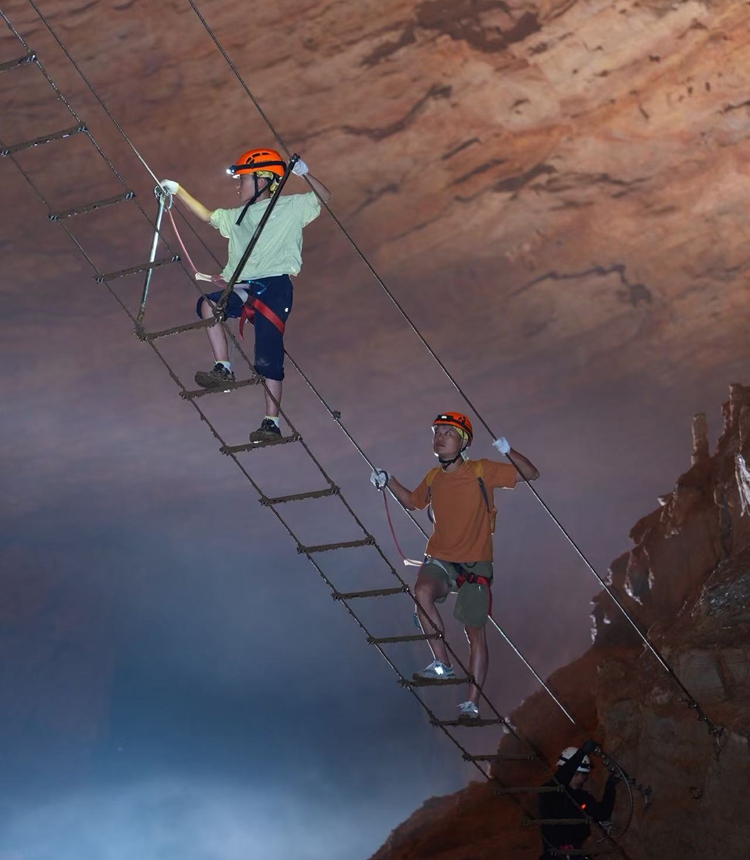
Visitors on a cave suspension bridge Photo: Courtesy of A Long
Underground thrillsThe growing popularity of cave exploration is also reflected on social media. Recently, popular videos about cave exploration in Guizhou have garnered more than 5 million likes on social media platforms, while related topics have surpassed 100 million views.
Guizhou is home to as many as 42,800 identified karst caves, making it a veritable "underground wonderland," according to the Xinhua News Agency.
Among the caves drawing visitors is Shilong Cave, a natural water-eroded cave stretching about 6.8 kilometers, 2.5 kilometers of which have been developed for tourism.
The cave features dozens of cascading green pools, small waterfalls and calcified pools, earning it the reputation of a top attraction among water caves, according to CCTV News.
For many visitors, the appeal lies in more than what they can see.
"Visitors are not simply coming to 'see a cave,' they want to immerse themselves in the experience," A Long said.
"This is particularly true for families with children; kids can control their own paddleboards while learning about caves and karst landscapes from their guides."
To accommodate visitors without prior experience, A Long and his team provide basic instruction on paddling, safety and emergency response before each activity.
"Speedboats are also deployed for safety on the water, while children who are too young and people over 60 are advised against participating depending on the circumstances," he said.
Such precautions also put a limit on how many visitors the team can take.
"We usually take around 60 to 80 people a day, and that's our limit," A Long said.
During peak periods, taking in more tourists is not necessarily better.
"You don't dare to take too many, because then you can't guarantee their safety or the quality of their experience."
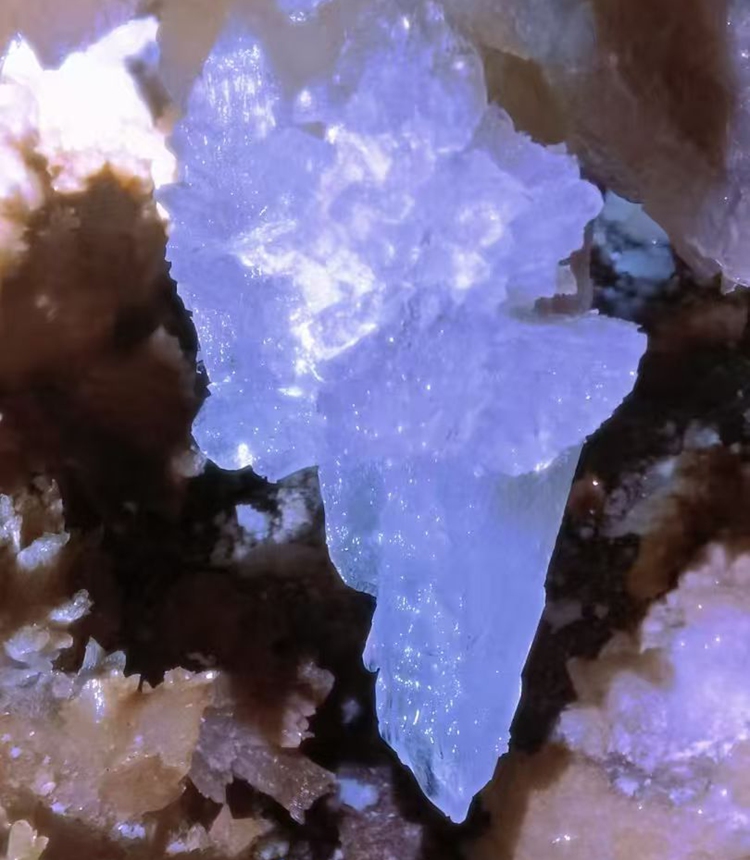
A stalactite inside Shilong Cave Photo: Courtesy of Jiang Jun
Beyond adventureThe limit points to a larger challenge as cave exploration moves into the mainstream: How to make the activity accessible to ordinary tourists without losing sight of its professional demands.
Professional outdoor explorer Jiang Jun told the Global Times that more demanding cave expeditions require a very different set of skills and equipment.
"You definitely need a helmet, a headlamp, backup lighting and a power source that can last," Jiang said.
Caves that require vertical descents also call for ropes and SRT equipment, while water caves require wetsuits to prevent hypothermia.
According to Jiang, the unique nature of cave environments also means the activity can never be treated simply as ordinary leisure tourism.
"Some caves require descents of hundreds of meters using ropes; others require diving, while some may have areas with insufficient oxygen," he said.
"Once inside, mobile phone signals are often unavailable, leaving explorers temporarily cut off from the outside world."
As cave exploration has moved beyond its professional niche and entered the public eye, becoming something ordinary people can experience, that does not mean the activity can simply be scaled up without limits.
"Ultimately, it's because caves contain too many unknowns and risks," Jiang said.
Those risks extend beyond the safety of visitors to the protection of the caves themselves.
Jiang said that visitors are reminded before entering to abide by the principle of "leaving nothing behind and taking nothing away."
They are asked to keep their distance from growing stalactites and stalagmites and never touch, break or remove them.
"Some caves are developed for tourism, while others are permanently closed for conservation," he said.
That tension becomes harder to ignore as more people enter the caves.
What draws visitors underground is precisely what can be lost if these places are changed beyond recognition.
The appeal of a cave lies not only in what visitors can experience inside, but also in what has remained untouched.
The more people venture underground, the more important it becomes to ask what should be left untouched.
RELATED ARTICLES