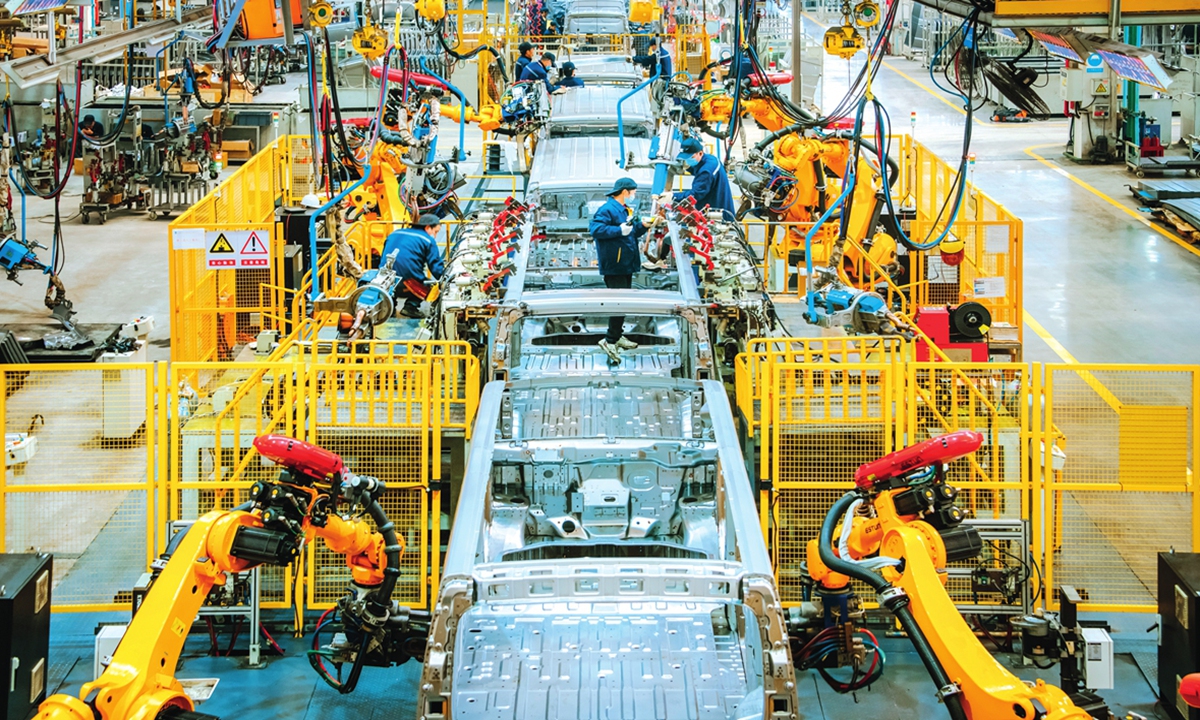
Staff members from a local NEV enterprise catch up on orders on the production line in Ganzhou, East China's Jiangxi Province on December 26, 2023.Photo: VCG
Editor's Note:
China's new-energy vehicle (NEV) industry has made striking progress in recent years, changing not only the cars themselves but also how they are developed, sold, and taken to global markets. The sector is also helping set new industry standards, making NEVs one of the most visible symbols of Chinese manufacturing.
As China enters the 15th Five-Year Plan period (2026-30) and moves toward its goal of basically realizing socialist modernization by 2035, a research team from People's Daily and China Automotive News examined how the country can sustain high-quality growth in the NEV sector and strengthen its competitive edge in the global market. This is the second installment of the series.
Two numbers, 40.3 percent and 77.4 percent, are the respective market shares of Chinese-brand passenger cars in the domestic market for the full year of 2013 and for July 2026.
Cars have changed, and so has the automotive industry. Increasingly, it is Chinese automotive brands that are starting to take center stage. From SAIC, BYD, Geely, Chery and Changan to Leapmotor, Li Auto, NIO, XPeng, Seres, Xiaomi and others, Chinese auto brands in the new-energy vehicle (NEV) arena shine like a constellation of stars.
The collective rise of Chinese automotive brands and the new model created by China's automotive industry are two sides of the same coin.
Systemic innovation
The novelty of the new model lies in the "full-chain" systemic innovation.
In the exhibition hall of the Seres super factory in Chongqing, the company's chairman Zhang Zhengping points to seven groups of core components on display, including various domain controllers and telematics modules. "In the past," he said, "cars iterated around the engine, transmission, and chassis. Today, what determines a vehicle's level of advancement is these seven 'boxes.'"
These "boxes" are precisely the critical links in the NEV industry — the "three electrics" system of battery, motor, and electronic control, along with chip computing power, integrated perception, algorithms, and intelligent systems. Whoever masters these tech capabilities holds the initiative in the industry. And these capabilities are now firmly in the hands of Chinese companies.
At every critical link in the NEV industrial chain, Chinese enterprises are leading the way: BYD was the first to fully master the "three electrics," making "charging as fast as refueling" a reality with its flash charge technology; CATL's latest battery technology has raised the peak charging rate to 15C, enabling a charge from 10 percent to 80 percent in just three minutes; Huawei's Qiankun smart driving system progresses from reliance on high-definition maps to map-free full-domain navigation.
Moreover, Changan introduced a generative large model, one of the few in China to pass the filing and approval process for generative AI services; GAC Group's Hyptec GT Climbing Edition features 1,004 chips, all designed domestically; and Leapmotor has achieved in-house R&D and production of components that account for 65 percent of vehicle costs.
China's NEVs have become an "innovation platform for industrial integration," connecting semiconductors, software, materials, processing and manufacturing, battery chemistry, AI and related industries.
New production models
The novelty of the new model lies in the production methods of the "super factories."
Stepping inside the Seres super factory in Chongqing, one will find none of the deafening noise or flying sparks of a traditional auto plant. Stamping, welding, and painting are fully automated. More than 3,000 industrial robots work in precise coordination; automated guided vehicles glide quietly through the workshops. An AI visual inspection system operates continuously, catching even "hairline" defects invisible to the human eye.
Zhang, the company's chairman, said that one production line can handle mixed-model welding and assembly for multiple vehicle models. From the launch of its first car, AITO saw its one millionth vehicles roll off the line in just 46 months — setting the global record for the fastest time to one million units among luxury NEVs.
Rapid response to market orders is powered by the "industrial brain," the decision-making core of intelligent manufacturing. With deep AI involvement, Seres' "industrial brain" integrates an industrial ecosystem of more than 300 partners and links directly to over 50 core suppliers. R&D efficiency has risen by 20 percent, and the on-time order delivery rate has improved by 13 percent.
A large number of such super factories form a brilliant constellation for China's NEV industry.
BYD's super factory in Zhengzhou is the world's largest single-site NEV production base, capable of rolling out a vehicle in less than one minute and producing a battery cell roughly every three seconds. At NIO's plant in Hefei, 80 percent of manufacturing scenarios are assisted by AI decision-making. Xiaomi's super factory in Beijing has realized 100 percent unmanned "lights-out" production in the key processes of its six core workshops.
Ten-thousand-ton-class mega integrated die-casting, highly flexible production lines, and full digital traceability are becoming signature manufacturing strengths of China's NEV super factories, delivering both visual impact and intellectual inspiration to visitors from around the world.
More than a century ago, Henry Ford created the industrial assembly line. In the 1950s and 1960s, Toyota pioneered lean production. Today, China's "industrial brain + future factory" manufacturing model delivers far more than simply higher speed or lower cost. It represents a complete restructuring of the entire chain — from R&D and manufacturing to supply and service — and an all-around leap in total-factor productivity.
Vibrant industrial ecosystem
The novelty of the new model lies in the industrial ecosystem of "four-chain integration."
An NEV is composed of tens of thousands of parts. Behind every vehicle brand stands a massive system of supply chains.
"China possesses the world's most complete 'three-electrics' supply chain and the most mature intelligent connected vehicle industrial ecosystem." This was the near-unanimous consensus among those interviewed.
In the Yangtze River Delta, a renowned "four-hour industrial circle" has taken shape: Shanghai supplies the chips and software that form the vehicle's "brain," Jiangsu provides power batteries, Zhejiang supplies integrated die-casting machines, and Anhui does the final step of vehicle assembly. All the supporting components for an NEV can be sourced within a four-hour drive.
"In the past, original equipment manufacturers had to send people to suppliers' plants for inspections and to guard shipments," said Wang Zhijie, director of the Chongqing Municipal Commission of Economy and Information Technology.
"Now, data from key equipment is visible in real time, dramatically improving supply-chain efficiency and security. Drawing on the data accumulated in the supply chain, banks can offer 'data loans' to small and medium-sized enterprises. The innovation chain, industrial chain, capital chain, and talent chain are fully connected in the system," Wang said.
"It is not only the vehicle makers that are advancing," said Zhao Fei, general manager of China Changan Automobile. "The entire industrial chain and supply chain are progressing together — batteries, motors, electronic controls, chips, software, and AI. Everyone is moving forward in tandem."
Moving forward together has led to transformations in quality, efficiency, and driving force.
The first integrated carbon-fiber cabin of the BYD YANGWANG U9 is 420 kilograms lighter than a traditional steel-aluminum structure yet five to six times as strong as steel. The quality upgrade of China's NEVs goes beyond the mere surpassing of manufacturing process parameters; it represents a comprehensive elevation of brand quality.
In six years, BYD launched its second-generation blade battery and flash charge technology, completing multiple technological leaps from battery to electric drive to full-vehicle control. CATL's continuous technological advances have resolved long-standing pain points for users including driving range, charging speed, and winter energy consumption. Deeper specialization, tighter collaboration, and faster iteration: this is the efficiency code of China's NEVs.
Xiaomi Auto's HyperOS operating system, previously released on its smartphones, has become the technological foundation for its intelligent cockpit. FAW Hongqi's "Lingxi cockpit," developed in cooperation with Alibaba Cloud and Amap, integrates the Qianwen intelligent agent. Traditional automakers, technology companies, platform enterprises, software firms, and energy companies each leverage their strengths within the same innovation network. The automobile has become the most dynamic application carrier of new quality productive forces.
These new forces in the supply chain, with their powerful product innovation and technological leadership, are redefining both their own roles and the automotive industry itself.
This is a complete, vibrant, and rapidly evolving new model of industrial development — a systemic leap, an open and cross-sector integration, and a symbiotic collective rise.
There is no doubt that the collective vitality generated by this new model has transformed Chinese automotive brands from industry "followers" into industry "definers."
This was excerpted from an article originally published on the front page of the People's Daily on August 27, 2026. The article was written by the research team members Xu Lijing, Xie Rongbin, Du Haitao, Gui Junsong, Wang Zheng, Shen Qian, Ge Mengchao and Feng Yingjie.
RELATED ARTICLES