Chinese carmakers reported to top 2025 global sales for the first time, overtaking Japan; projection reflects ‘inevitable’ trend: expert
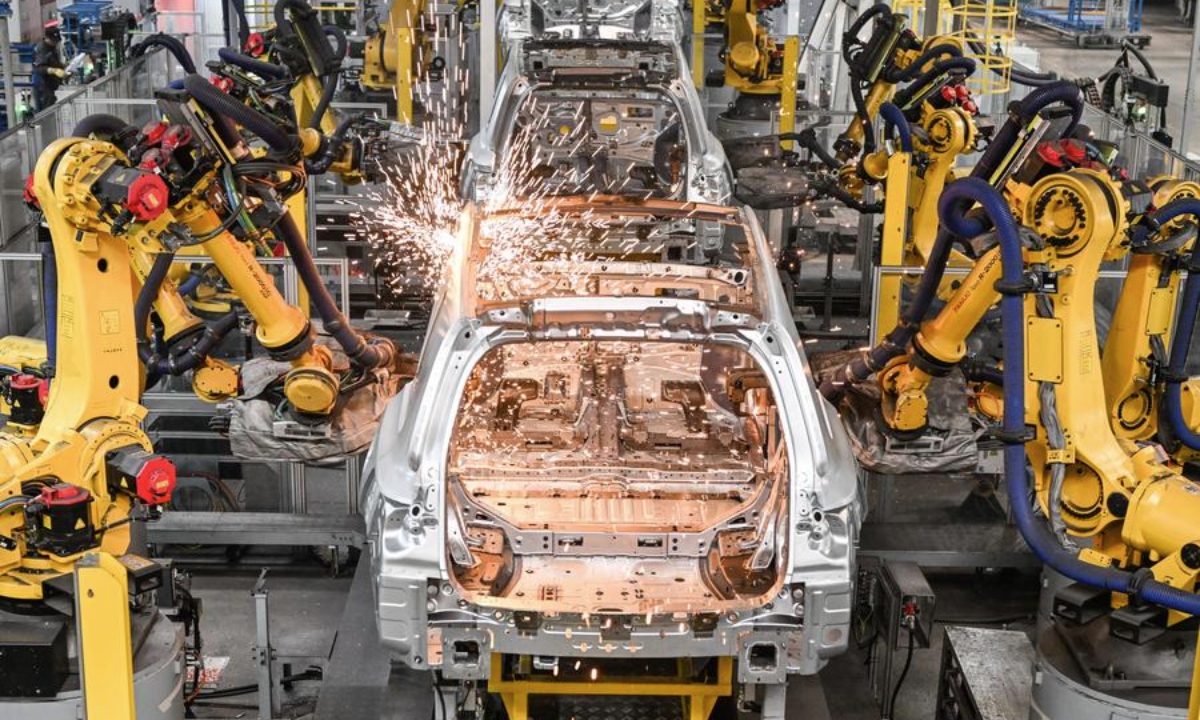
Robots weld bodyshells of cars at a workshop of Chinese electric vehicle (EV) maker Li Auto Inc. in Changzhou, east China's Jiangsu Province, Jan. 10, 2024. (Xinhua/Ji Chunpeng)
Chinese carmakers are projected to take the top position in global new vehicle sales for the first time in 2025, surpassing Japanese players, which held the position for more than 20 years but are set to drop to second place this year, Nikkei Asia reported on Tuesday.
While the report has yet to be confirmed by official Chinese data, Chinese experts said that the reported milestone is an inevitable and undisputed trend, as China's well-established industrial chain and clear technological pathways have been the core drivers enabling domestic auto brands to rapidly and steadily gain market share, especially in the new-energy vehicle (NEV) sector.
Global sales of Chinese vehicles are projected to increase 17 percent year-on-year to about 27 million units; in comparison, worldwide sales for Japanese automakers are projected to remain flat at just under 25 million units, according to Nikkei Asia, which noted that this means China, after becoming the world's top car exporter in 2023, is on track to take the top spot in overall sales this year.
The Nikkei Asia report cited full-year sales figures based on automakers' announcements and S&P Global Mobility data from January to November. Official figures on full-year sales had yet to be released as of press time on Tuesday.
These estimates underscore the sharp rise in China's manufacturing strength and a structural leap in the global auto industry driven by the green transition, Cui Dongshu, secretary-general of the China Passenger Car Association (CPCA), told the Global Times on Tuesday.
Also on Tuesday, the 2025 China Manufacturing Power Development Index Report showed that China's manufacturing power index has reached the same range as Germany and Japan, placing China in the second tier of global manufacturing powers and making it the fourth country — after the US, Germany, and Japan — to enter the ranks of global manufacturing powers.
Cui said that by advancing both battery electric and plug-in hybrid pathways, China's NEV output neared 15 million units this year, reshaping the automotive landscape. "Japan, which is still focused mainly on conventional hybrids, lags China in emissions reduction and intelligent electrification, leaving China as the clear global leader in NEVs," Cui noted.
In the first 11 months, China's retail sales of passenger vehicles rose 6.1 percent year-on-year to 21.483 million units, up 6.1 percent year-on-year, data from the CPCA showed in early December. Notably, wholesale sales of NEVs totaled 13.756 million units, up 28.3 percent.
Market watchers noted that amid the global green transition and rising environmental awareness, more countries are accelerating the adoption of NEVs, expanding global demand.
"Backed by cost competitiveness, technological strength and a complete supply chain, China's NEV exports have surged, reflecting both shifting global demand and China's early-mover advantage," said Bian Yongzu, executive deputy editor-in-chief of Modernization of Management magazine.
Bian told the Global Times that as the global auto industry pivots toward electrification, China has overtaken some traditional automotive powers, underscoring a structural transformation of the sector.
China's auto exports have been surging. CPCA data showed that passenger vehicle exports, including complete vehicles and completely knocked down kits, reached 601,000 units in November, up 52.4 percent year-on-year and up 9.1 percent month-on-month. Notably, exports of Chinese domestic brands reached 525,000 units in November, up 52 percent year-on-year and 9 percent month-on-month, according to industry data.
In November, NEV exports stood at 284,000 units, soaring 243.3 percent year-on-year and climbing 19.3 percent from the previous month. NEVs accounted for 47.3 percent of total passenger vehicle exports, up 26.3 percentage points from a year earlier, according to CPCA data.
From January to November, automakers exported 5.15 million passenger vehicles, up 17.2 percent year-on-year, the data showed.
The rise of China's auto industry is also closely tied to the broader macroeconomic environment, Bian said, adding that against a backdrop of rising global trade protectionism, China is building a hard-to-replicate competitive moat through its comprehensive automotive supply chain and economies of scale, making it difficult for other countries to match its cost and efficiency.
"As advantages in technology, human capital and industrial systems are further unleashed, China's auto industry is expected to widen its lead over traditional automotive powers," he said.
The continued rise of China's vehicle industry comes despite the protectionist actions of certain countries and regions. Bian emphasized the need for enhanced dialogue to manage differences, while encouraging Chinese automakers to accelerate technological accumulation and innovation, reduce reliance on price competition, and support long-term, sustainable industry growth.
RELATED ARTICLES