ARTS / CULTURE & LEISURE
Tianjin sets up new rules, complete Beijing-Tianjin-Hebei framework for Great Wall protection
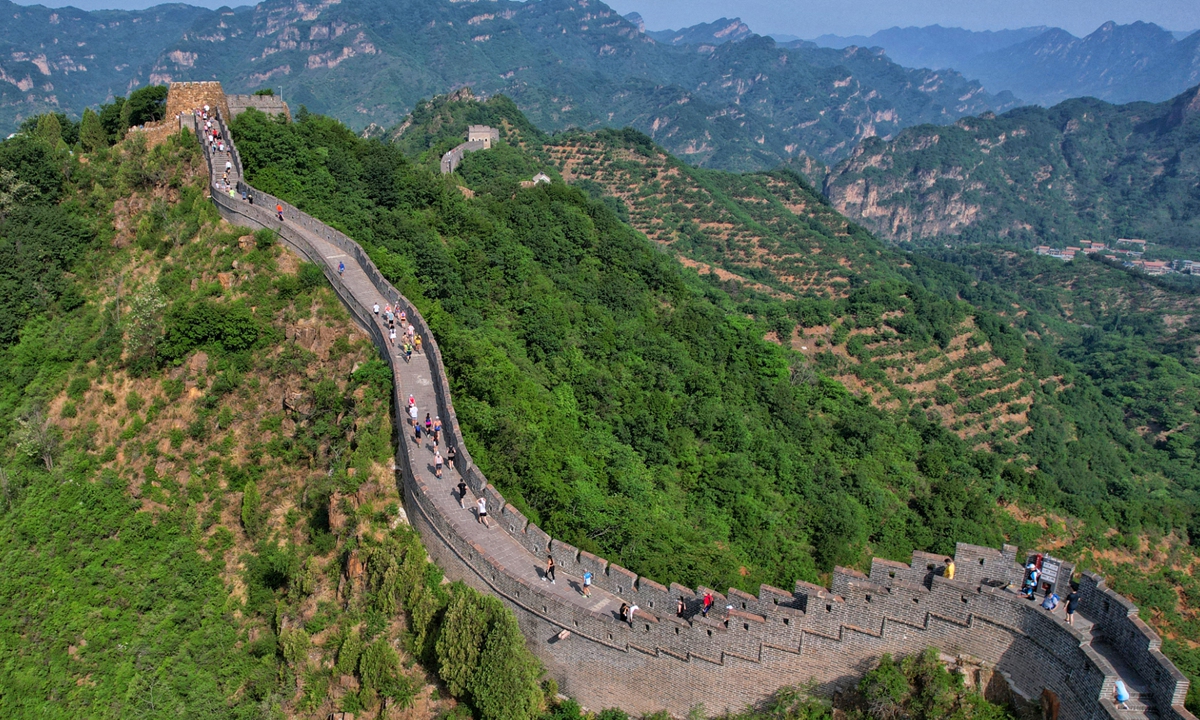
Photo: VCG
North China's Tianjin Municipality has introduced dedicated regulations to strengthen protection of the Great Wall, becoming the latest of the 15 provincial-level regions that are home to the ancient heritage site to enact specialized local legislation. The regulations are set to take effect on Tuesday.The regulations' biggest breakthrough and significance lies in establishing and improving a coordinated mechanism for protecting the Great Wall across the Beijing-Tianjin-Hebei region, Zhang Man, a professor at the Academy of Architectural Heritage, Beijing University of Civil Engineering and Architecture, told the Global Times.
Beijing and Hebei had previously taken the lead in introducing dedicated regulations on Great Wall protection. With Tianjin's legislation now in place, the three regions have achieved greater legal coordination and consistency in implementing laws governing Great Wall protection, filling a key legal gap in regional collaborative conservation, Zhang noted.
The regulations require the establishment and improvement of a coordinated Great Wall protection mechanism with Beijing and Hebei, under which the three regions will consult on major issues such as the conservation, restoration, opening, and use of the Great Wall. They will also strengthen information sharing, joint law enforcement and emergency response coordination, working together to raise the overall level of Great Wall protection across the region.
In Tianjin, the Great Wall is represented by the Huangyaguan section, which lies entirely within the city's Jizhou district and extends 40.28 kilometers in length. Apart from a restored stretch open to visitors, about 36 kilometers remain unrestored and under routine protection.
Liu Hongming, general manager of the Jizhou Tourism and Culture Group, told the Global Times that the group has been promoting the active use of the Great Wall's cultural resources while further exploring its historical and cultural significance. The group is the operator of the Huangyaguan Great Wall scenic area.
"We have held two academic symposiums on Qi Jiguang and the Huangyaguan section of the Great Wall, and published books based on the research. We have also organized events such as a folk culture theme park, a hiking and fun run festival, and the Huangyaguan Great Wall International Marathon," Liu noted.
Qi Jiguang was an ancient Chinese national hero who lived during the Ming Dynasty (1368-1644). He is best known for leading Ming forces to defend China's eastern coastal regions from raids by Japanese pirates in the 16th century.
In acknowledging the efforts in the living transmission and sustainable use of cultural heritage, Zhang also suggested using the development of the Great Wall national cultural park as the key vehicle for advancing coordinated implementation of rules and regulations.
As part of China's endeavor to construct five prominent national cultural parks, the Great Wall cultural park spans 15 provincial-level regions, including Beijing, Hebei and Inner Mongolia in the north, and Gansu and Xinjiang in the northwest. Construction started in 2019.
It comprises Great Wall sections and defense systems dating back to the Warring States Period (475BC-221BC).
Zhang also called for removing key barriers to coordinated protection by enabling the sharing of Great Wall resource and conservation data across the three regions, and aligning law enforcement standards and protection efforts.
Given the increasing frequency of extreme weather and the vulnerability of the mountainous terrain along the Great Wall, it is vital to establish a joint emergency warning and rescue mechanism for border areas, she said.
As of August, seven provincial-level regions along the Great Wall have enacted dedicated legislation on its protection, including Shanxi, Gansu, Shandong and Ningxia, according to the Legal Daily.
RELATED ARTICLES