Illustration: Chen Xia/GT
In a new essay published on Wednesday, Bill Gates, the billionaire co-founder of Microsoft, warned that artificial intelligence (AI) is ushering in "one of the most turbulent times in human history," which could either become "the greatest equalizer ever invented, or the worst source of injustice."
Notably, he wrote that "Some cooperation between the US and China will be required … And the countries that host the leading AI developers and control critical parts of the supply chain should begin meeting now to set up shared norms, before competitive pressure makes it harder for them to cooperate."
He did not attribute AI risks to any single country; instead, he identified the three biggest risks accompanying the AI transition. Indeed, the speed of AI advancement has already outpaced the effectiveness of related policies and regulations worldwide. AI code generation tools can now independently handle core modules of complex industrial software, and in some scenarios, advanced AI systems can launch cyberattacks that bypass existing safeguards, let alone the broader social and safety challenges AI poses.
These borderless risks cannot be managed by any country alone. If unilateralism prevails in global governance, fragmented national regulations and unchecked AI growth will leave the entire world exposed to runaway technology.
Despite the misleading narrative by some Washington politicians that frames China's AI as a "security risk," Gates' stance signals that certain segments of the US tech sector have come to a sober realization: AI security risks are not manufactured by any one country, but are a crisis born of the technology itself operating without effective guardrails.
Globally, the call for major powers to shoulder AI governance responsibilities has grown increasingly louder. For instance, the UN Secretary-General's High-level Advisory Body on Artificial Intelligence, established in October 2023, comprises 39 preeminent AI leaders from 33 countries across all regions and multiple sectors. In its final report, the panel presented seven recommendations for global cooperation on AI governance.
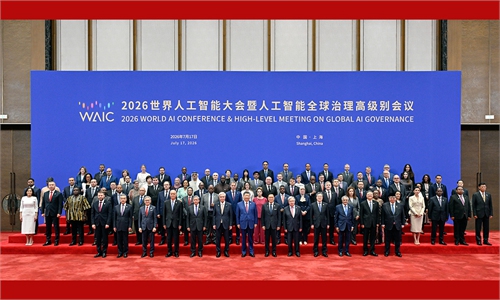
China has been an active participant and promoter of global AI governance. In July, it put forward the Global AI Governance Initiative, advocating a people-centered approach and the development of AI for the good of humanity.
There have also been voices within US industry and policy circles stressing the importance of cooperation between the US and China in AI security, ethics and risk control.
Moreover, the pre‑eminence of China and the US in global AI development is becoming ever more apparent. According to Stanford University's annual AI report, the performance gap between the top US and Chinese AI models had narrowed to 2.7 percentage points. The US dominated in the scale of private AI investment, while China ranked first in the world in the number of papers, the share of citations, patents, and industrial robot installations. This landscape of strength means that coordination between the two technology leaders is imperative for global AI governance rules to take shape.
Market choices also show the weight of cooperation. China's cost-effective, high-performance open-source large-language models continue to attract global attention. US companies are increasingly using Chinese-developed models as they build out tools and products using AI.
Also, China has become an important engine of the global intelligent transformation, creating broad market opportunities for US businesses. Microsoft Corp is expanding its AI business in China, with ByteDance expected to spend more than $1 billion annually on the company's AI and cloud services, according to a Bloomberg report.
These industrial collaborations demonstrate that cooperation between China and the US in AI can break down barriers in technology, markets, and industry, unleashing a two-way innovation dynamic.
Competition in AI will persist; nonetheless, the turbulence of this era calls for multilateral collaboration over unilateral restraint. Engaging in constructive interaction to build consensus will allow the dividends of technological progress to be shared by all. This approach serves the fundamental interests of both the Chinese and American peoples, and responds to the call of the broader international community.
RELATED ARTICLES