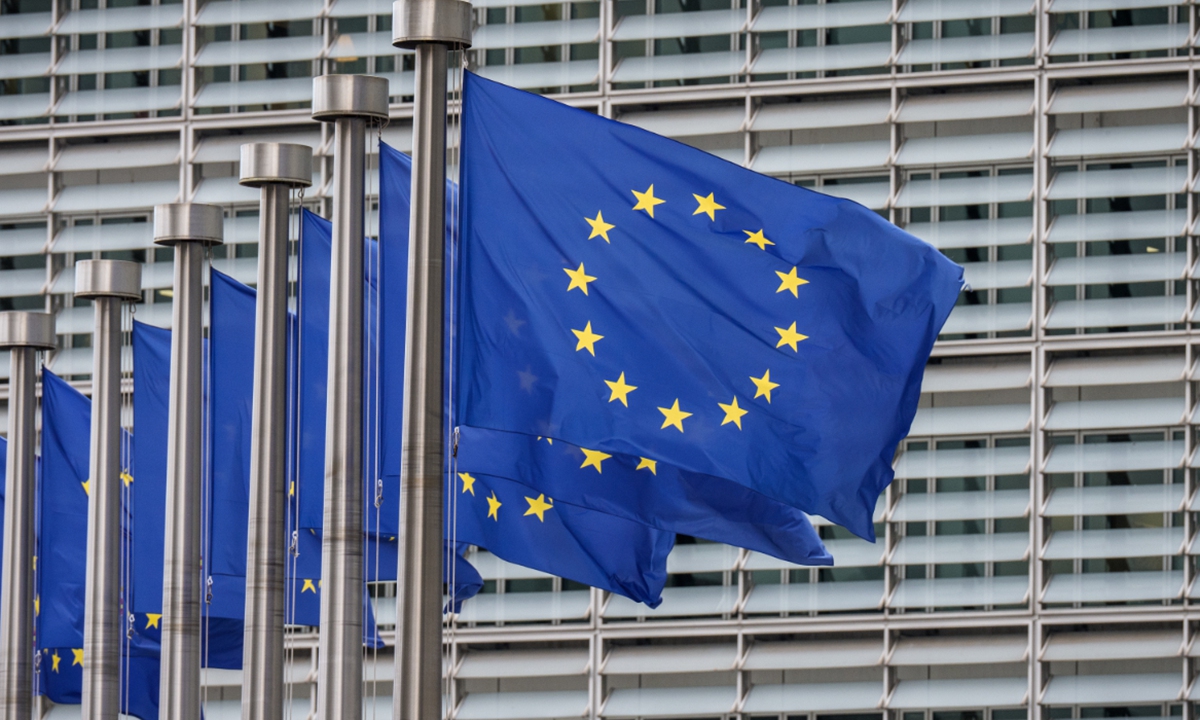
The European Union (EU) flags in front of EU headquarters in Brussels, Belgium. Photo: VCG
European Commission President Ursula von der Leyen's latest claims about so-called trade imbalance with China and potential protectionist measures against China will not help resolve trade disputes between China and the EU, Chinese experts said on Friday, calling on the EU to pursue dialogue, rather than protectionism, to address trade issues.
European Commission President Ursula von der Leyen told French business leaders on Thursday local time that the EU's trade deficit with China cannot be accepted as "permanent imbalance," adding that the EU must be ready to use trade defense instruments when dialogue falls short, according to the EU's official website.
"What von der Leyen calls a trade imbalance is only a result. Using this outcome to justify protectionist measures is unreasonable," Hu Qimu, a professor at the Maritime Silk Road Institute of Huaqiao University, told the Global Times on Friday.
The core reason for the EU's trade deficit lies in various problems within the EU itself, coupled with China's growing industrial competitiveness. If the EU keeps focusing only on its trading partners without fixing its own problems, it will neither improve competitiveness nor fundamentally change the trade balance, Hu said.
Hu noted that von der Leyen herself acknowledged high energy prices and an incomplete single market in her speech. "These are self-inflicted constraints," Hu said.
Specifically, energy costs in Europe remain far higher than in China or the US, eroding the price competitiveness of European manufacturers in global markets, while regulatory burdens, from lengthy permitting processes to complex compliance requirements, raise operational costs and slow down innovation and investment, according to the expert.
Another overlooked driver is the EU's own export restrictions. Controls on high-tech goods, including some advanced machinery and semiconductor-related equipment, limit what EU firms can sell to China. While framed as security measures, these restrictions directly reduce EU export revenues and widen the trade deficit. If Europe restricts its most competitive products from entering the Chinese market, it should not be surprised when the deficit grows, experts noted.
"The EU leader's framing of 'de-risking' as a justification for protectionism is inaccurate," Bao Jianyun, dean and professor of the Department of International Politics at the School of International Studies at the Renmin University of China, told the Global Times on Friday.
Resorting to protectionist measures under the guise of risk management would only weaken the EU's long-term global standing and its bargaining leverage in trade negotiations with other partners, Bao said.
Experts also noted that China has been actively in talks with the EU, which shows its sincerity to solve trade issues through dialogue.
China has established a Trade and Investment Consultation mechanism with the EU, with workstreams covering balance of trade, export controls, intellectual property and WTO reform.
A Chinese Foreign Ministry spokesperson said earlier that "the root causes of the challenges facing the EU do not lie with China" and called for deeper cooperation.
"China and the EU have deep economic complementarities, and that forced decoupling or de-risking would undermine mutual benefits. Instead, differences over industrial policies, market access and risk management can be resolved through existing dialogue and consultation mechanisms, and simple protectionism runs counter to historical trends," Bao said.
RELATED ARTICLES