Token economy takes spotlight as China's Big Data Expo kicks off
By and Chen Zishuai in Guizhou Published: Aug 28, 2026 10:07 PM

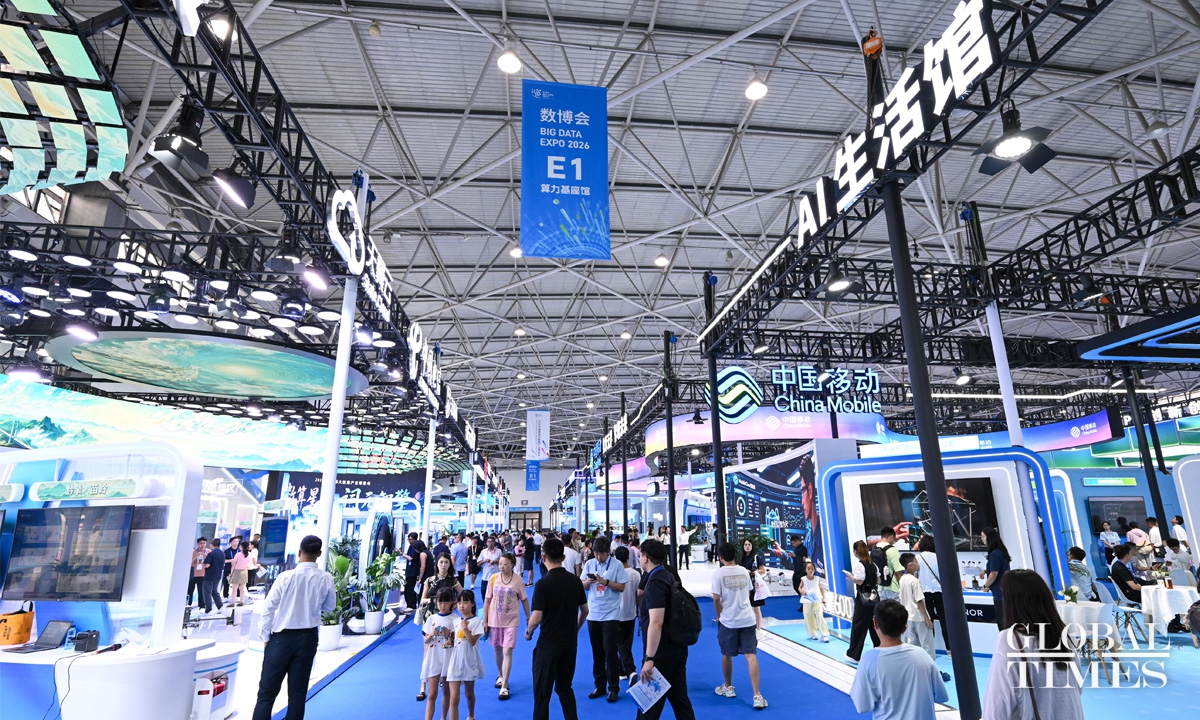
Photo: Chen Tao/GT
The China International Big Data Industry Expo 2026, a bellwether for China's data sector, kicked off on Friday in Guiyang, Southwest China's Guizhou Province, drawing more than 300 exhibitors and with key themes ranging from computing infrastructure to data supply.
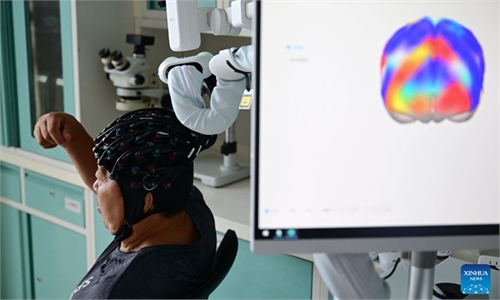
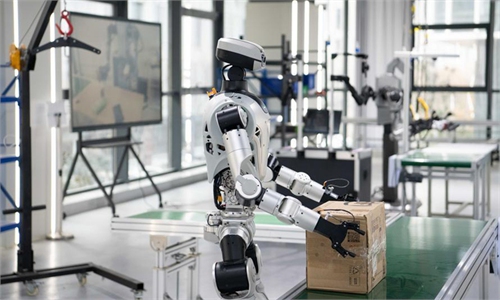
The advances of China's digital economy were on vivid display at the expo: inside the exhibition hall, a humanoid robot dazzled with Miao ethnic dance and martial arts; outside, driverless buses and retail pods hit the streets - signs of high-tech leaving the showroom for the real world.
This year marks the 12th edition of the Big Data Expo, and for Miao Yu, a Hangzhou‑based industry insider attending the fair for a fifth time, the broad transformation is obvious.
"China's data industry has come a long way in just a few years. From the early rush to build data centers and computing capacity, to the push for compute‑driven applications, and now this year's spotlight on the token economy - it really charts the trajectory of China's digital economy, moving from resource accumulation to full‑scale ecosystem innovation," he told the Global Times on Friday.
Notably, the theme of this year's Big Data Industry Expo is "Token- A new path for unlocking the value of data elements."
As generative artificial intelligence (AI) scales up in application, the measurable, priceable, and tradable nature of tokens is being progressively unlocked. Token call volume is emerging as a key indicator for measuring AI activity, the depth of industrial penetration, and the level of intelligent development.
China's data industry reached 6.78 trillion yuan ($1.01 trillion) in 2025, up 15.7 percent year‑on‑year, maintaining sustained and rapid growth, according to a report released by the National Data Administration's national institute for data development on Friday.
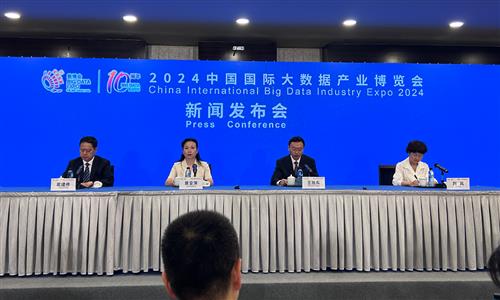
Data‑oriented software products, including AI application software, and data resource products, including token‑based services, together generated 4.99 trillion yuan in output value, accounting for 73.6 percent of the total, said Hu Jianbo, head of the institute at the opening ceremony.
Looking ahead, token-based services will give rise to new industrial ecosystems. AI will open up new horizons for data industry development. Breakthroughs in AI-native data technologies and industrial innovation will accelerate, and the data industry will continue to maintain relatively rapid growth, said Hu.
Chinese companies are also mapping their token business and even exploring overseas opportunities — a trend already taking shape on the ground.
Peng Hailin, who is from Guizhou Data Treasure Network Technology Co, told the Global Times that he had just hosted two Thai visitors who spent considerable time studying the computing power dispatch display.
Peng revealed that his company is already in talks with overseas manufacturers — mostly from Southeast Asia, but also from Europe and the US — who have made substantial computing power requests. The sector is advancing so quickly that overseas computing power exports could begin as early as this year, with Southeast Asia likely leading the charge, he said.
Overseas attendees at the expo also hailed vast potential for cooperation among developing countries in emerging industries.
"With wise governance and investment in people, especially in the Global South, artificial intelligence can indeed bring shared prosperity, not a new barrier," Muhammadou M.O. Kah, chair of the United Nations Commission on Science and Technology for Development and vice chair of the UN Data Governance Working Group, told the Global Times on Friday. "Our task is to ensure that innovation and governance advance together, not separately — advancing together where we leave no one behind and no country behind."
He calls open and inclusive cooperation, trusted and balanced data governance and enhance South-South and triangular partnerships, and leverage the experience of digital front-runners like Guizhou to help developing countries overcome bottlenecks.
Guizhou has years of big-data groundwork with advantages of solid computing infrastructure backed by China's national "East Data, West Computing" project, diverse application scenarios from smart manufacturing to tourism, offering real-world testing grounds; and a growing data industry with quality datasets and labeling capabilities to support model training and iteration, Zhang Jianwei, foreign academician of the Chinese Academy of Engineering and academician of the National Academy of Engineering of Germany, said at the opening ceremony.
Maryam Nawaz Sharif, chief minister of Government of the Punjab, Pakistan, said that a new corridor - one that connects data, innovation, and mindsets - should be built under the China-Pakistan Economic Corridor.
Sharif said that Guizhou has already taken the lead, where data is no longer just a byproduct of administrative work, but critical infrastructure, and Punjab also shares a similar vision: building a digital governance framework anchored in trusted data — integrating data with identity, services, infrastructure, energy, finance, and economic opportunity, transforming it into trusted, verifiable, and executable assets.
RELATED ARTICLES