IN-DEPTH / IN-DEPTH
How Shanghai immigration officers spot forged identities, stop cross-border crimes with technology and experiences
Behind 7,000 fake documents
By in Shanghai Published: Aug 28, 2026 10:46 PM

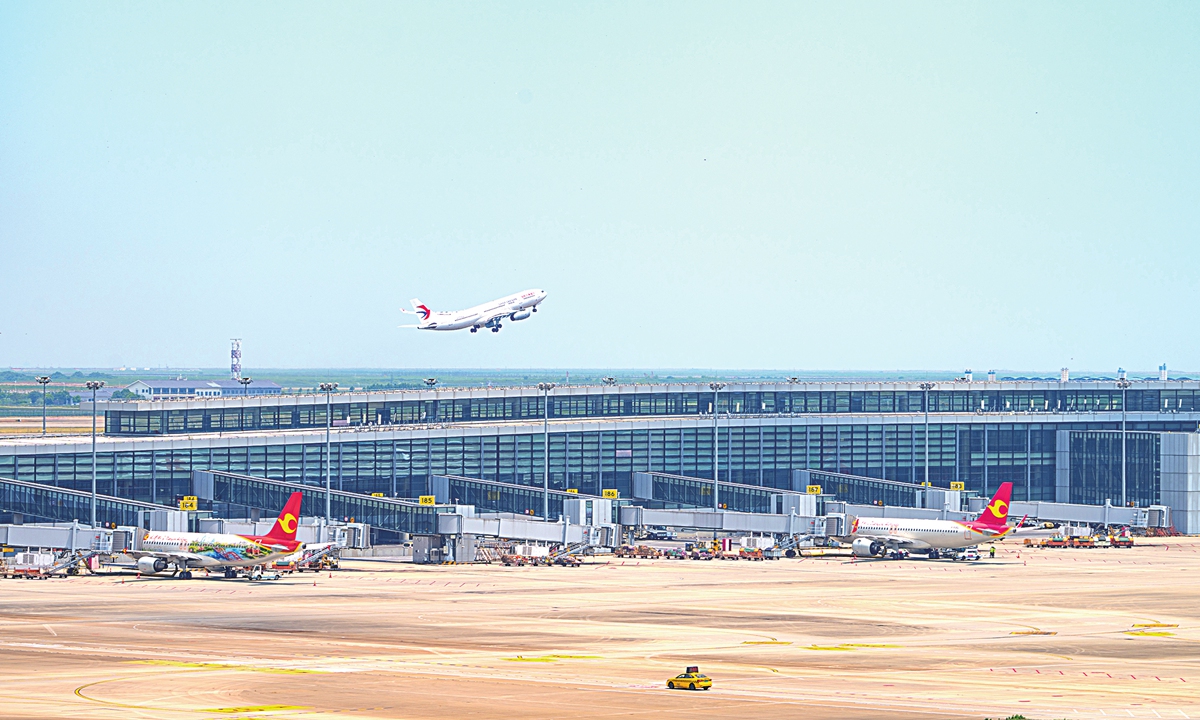
A view of a part of Shanghai Pudong International Airport Photo: Courtesy of Shanghai General Station of Immigration Inspection
At the arrival hall of Shanghai Pudong International Airport's Terminal 2, the crowd moved in a steady stream. As a middle-aged man handed over his passport, his eyes flickered away for a brief moment.
That slight hesitation did not go unnoticed by a border inspection officer on duty, who looked at him a second time. The officer opened the passport and let his fingertips glide across the data page. Seconds later, the expertly made but ultimately flawed counterfeit was identified, and the man was denied entry in accordance with the law.
This ability to tell genuine from fake at a glance, comes not only from years of experience honed by local border inspection officers, but also from the support of advanced technology. Not far from the airport, in a building nearby, the Document Examination Center of the Shanghai General Station of Immigration Inspection has been operating for years. Its collection of more than 7,000 forged documents records a long-running battle between those who make fakes and those who expose them.
What exactly is housed in this center? How do Chinese immigration officers outsmart a wide range of forged documents, holding fast to the front-line of border security? Earlier this week, a Global Times reporter visited the center, as well as the arrival halls of Pudong airport, to explore the efforts behind safeguarding China's borders.
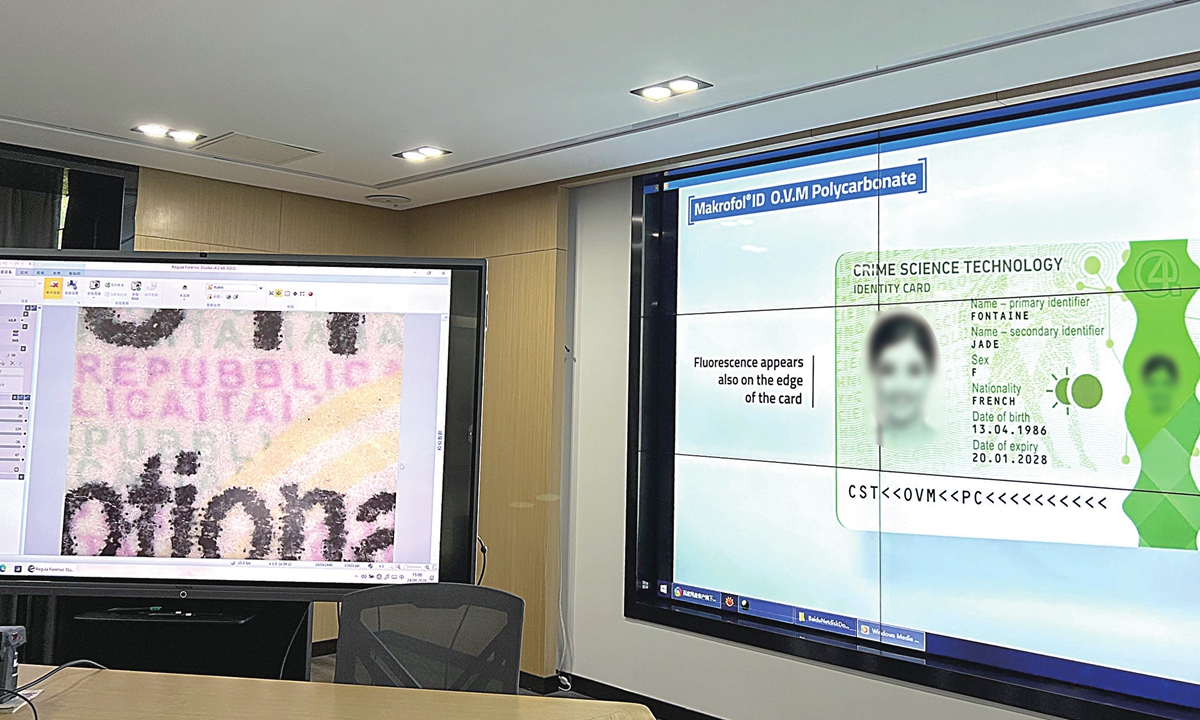
An audio-visual room of the Document Examination Center of the Shanghai General Station of Immigration Inspection Photo: Huang Lanlan/GT
Outsmarting forgers
Walking into the hall of the document examination center, visitors are greeted by several screens flashing images of forged identity documents from different times and produced with different methods. Altered visa pages, entire counterfeit passports, tampered residence permits...each one lays bare the forgers' malicious intent.
Space of the center is divided into multiple functional zones, including an audio-visual room, a specialized laboratory and a storage room. Inside the storage room are over 7,000 samples of documents, including more than 6,000 counterfeit and altered ones.
Among them, there is a forged document whose data pages are made of polycarbonates (PC) polymer material. "This one was seized 10 years ago, and materials like this were still rare in China at the time," Wei Tuni, director of the center, told the Global Times. "Some counterfeiting techniques run ahead of us, so our research and training have to keep pace."
How can front-line border inspectors tell real from fake in just a few seconds? Wei said that in addition to continuous learning, just as important is "perceptual ability" - the intuition seasoned border inspectors develop when something feels off, when "the hand-feel isn't right." "We need to keep analyzing counterfeiting techniques and the flaws they leave behind, and pass that information on to the front-line, helping the inspectors develop a kind of 'sixth sense' for counterfeit documents," she added.
In 2024, the center obtained China National Accreditation Service for Conformity Assessment (CNAS) laboratory accreditation, and the appraisal reports it issues carry the same legal force in 119 economies around the world. That means, a counterfeit passport identified here can become compelling evidence in a courtroom even thousands of miles away, said Wei.
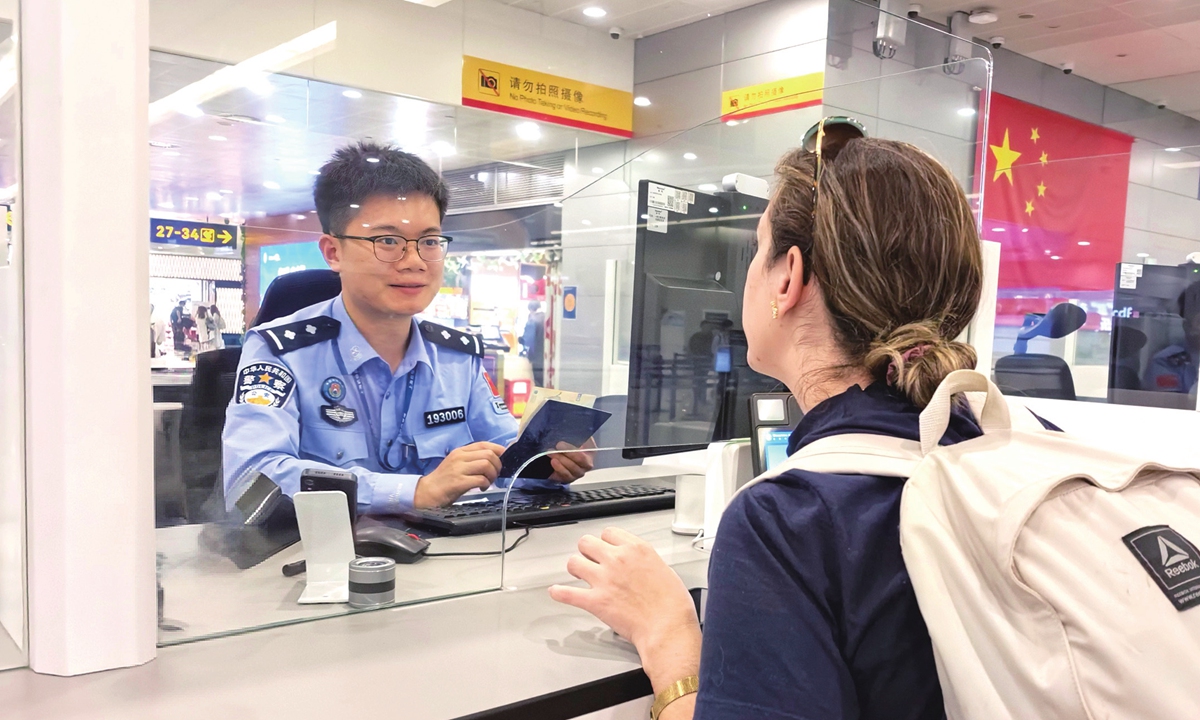
An immigration officer checks documents of an inbound passenger at Shanghai Pudong International Airport. Photo: Courtesy of Shanghai General Station of Immigration Inspection
Spotting fakes, fugitives
Around 5 pm, Pudong airport entered rush hour of arrivals. Sitting at an inspection desk, immigration officer Yuan Lei took an overseas traveler's passport, flipping through it, comparing details and scanning it. The whole process took barely more than ten seconds.
During a shift break, Yuan showed the Global Times reporter two samples: one was a counterfeit Chinese visa, the other a genuine one. "Maybe the difference doesn't seem that obvious to you, but for us who look at these documents every day, the irregularities are almost immediately apparent," he said.
Such speed and precision are honed at a port that has ranked first among China's airports for 23 consecutive years, clearing nearly 40 million inbound and outbound trips in 2025. In addition to identifying forged documents, local immigration authorities have extended their lines of defense into deeper layers of security with the help of technology.
In front of a screen at the airport, Wang Huibin from Shanghai General Station of Immigration Inspection recalled a case. After Chinese authorities released a list of 100 persons wanted worldwide in April, 2015, Shanghai immigration officers combed through massive volumes of exit-entry data, and in the same month identified a suspect surnamed Dai, who had changed his identity. Three days later, he was apprehended along with the evidence. Dai became the first fugitive on the list to be captured.
Today, an intelligent early-warning system has been put in place, weaving vast amounts of daily clearance data into a more sophisticated protective network, Wang added.
Thanks to powerful technology and the relentless efforts of personnel on the ground, Shanghai airport border inspection authorities have handled more than 3,100 cases of cross-border illegal activity over the past three years, detaining more than 4,200 suspects, according to data provided by the station.
"We hold fast to the security bottom line while also delivering service with a human touch," Zheng Jianqiao, an immigration police officer who has worked in the post for more than a decade, told the Global Times. "We crack down precisely on illegal activities, while ensuring that every law-abiding traveler can feel the openness, inclusiveness and warmth of China at its port of entry."
RELATED ARTICLES