S.Korean investors reportedly eye Samsung, SK Hynix as CXMT takes global lead on advanced mobile memory
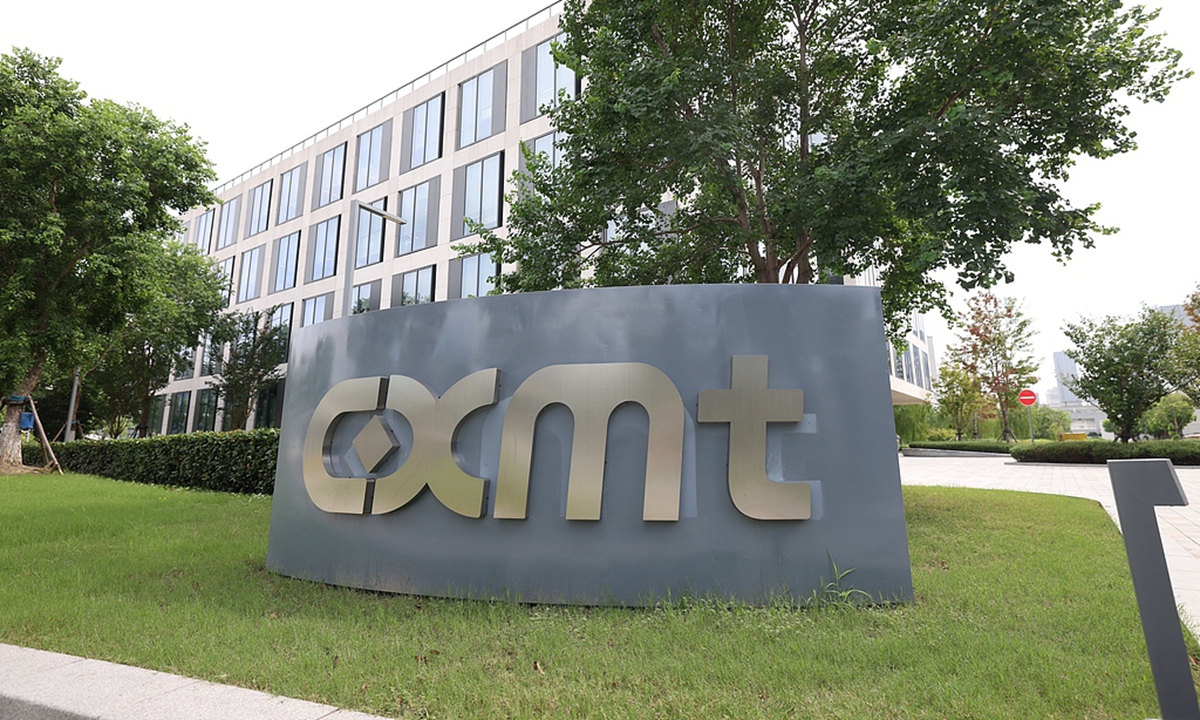
CXMT Photo: VCG
South Korean newspaper the Chosun Daily reported on Sunday that investors are watching how shares of Samsung Electronics and SK Hynix will trade when markets reopen on Monday, after China's largest DRAM maker ChangXin Memory Technologies (CXMT) posted what the paper called an "earnings surprise" — attention that comes as the Chinese company also took the global lead in next-generation mobile memory as its advanced LPDDR6 memory chip over the weekend.The reaction of the South Korean side reflects where competitive pressure in the memory market now comes from, Xiang Ligang, a veteran telecom observer, told the Global Times on Sunday. Among the players capable of challenging the two South Korean suppliers, Chinese companies now carry the most weight, he said.
CXMT announced on Saturday that its self-developed LPDDR6 had entered mass production, with the first batch shipping in Xiaomi's 18 Fold foldable flagship. It is the world's first commercial deployment of an LPDDR6 product, the company said — the first time a Chinese memory maker has reached the market ahead of overseas suppliers on a high-end memory standard.
The chip reaches a peak transfer rate of 12,800 Mbps with a maximum single-chip capacity of 16GB, according to the company. Joint Electron Device Engineering Council (JEDEC) released the LPDDR6 standard only in July 2025; CXMT moved from standard alignment through sampling to mass production in about a year, and is also sampling the product to server and smart-cockpit customers.
Low-power memory is one of the key directions in a market where demand is diverging by product type, Xiang said. Every operation on a smartphone calls on memory, and higher power consumption translates directly into heat and shorter battery life. Demand extends beyond handsets to robots, smart home devices and smartwatches, he said.
The launch followed CXMT's interim report on Friday, which showed first-half revenue of 150.31 billion yuan ($22.37 billion), up 873.64 percent year-on-year, and net profit of 77.60 billion yuan, reversing a loss of 2.332 billion yuan a year earlier. It was the company's first earnings report since its STAR Market debut on July 27.
CXMT attributed booming demand to servers, smartphones and personal computers, as well as emerging segments such as smart vehicles and wearables. A global supply shortage since the second half of 2025 lifted both prices and sales volumes, and the company expects it to persist into the second half of the year, according to the company.
The Chosun Daily drew a series of comparisons between CXMT and the two South Korean suppliers. Citing TrendForce, it reported that CXMT expanded its share in LPDDR4X as Samsung scaled back that line, and said competition in the mobile DRAM market long led by Samsung could intensify once CXMT begins supplying LPDDR6 to Chinese handset makers.
The report cited Morgan Stanley's projection that CXMT will reach a monthly wafer capacity of 300,000 by year-end — about 13 percent of global DRAM wafer capacity and 11 percent of global bit shipments — rising to 500,000 by 2028, with a target price of 88 yuan, more than 10 times the offer price.
Counterpoint Research data showed CXMT was the fastest-growing DRAM supplier globally in the second quarter, with a 7 percent share of global revenue, behind Samsung Electronics, SK Hynix and Micron.
Xiang pointed to what happens when prices eventually normalize. When the cycle turns, there has to be a market capable of absorbing the capacity being built out now, he said. Chinese suppliers have a large domestic market behind them, while South Korean suppliers also depend on the Chinese market — one reason Seoul is watching it closely.
UBS expects the global shipment share of Chinese DRAM makers to rise from 7 percent in 2025 to 9.4 percent in 2027, and said their capacity additions would likely be absorbed by AI data center demand, with the up-cycle running into the second quarter of 2028.
CXMT has continued to expand capacity under US restrictions. The company sued the US Defense Department last week over its designation as a "military company" on the 1260H list, telling the Global Times it designs and manufactures DRAM products for commercial and civilian use only.
A large domestic market, talent supply and infrastructure capability all work in Chinese firms' favor, Xiang said, adding that delivering these results under restrictions points to greater resilience.
RELATED ARTICLES