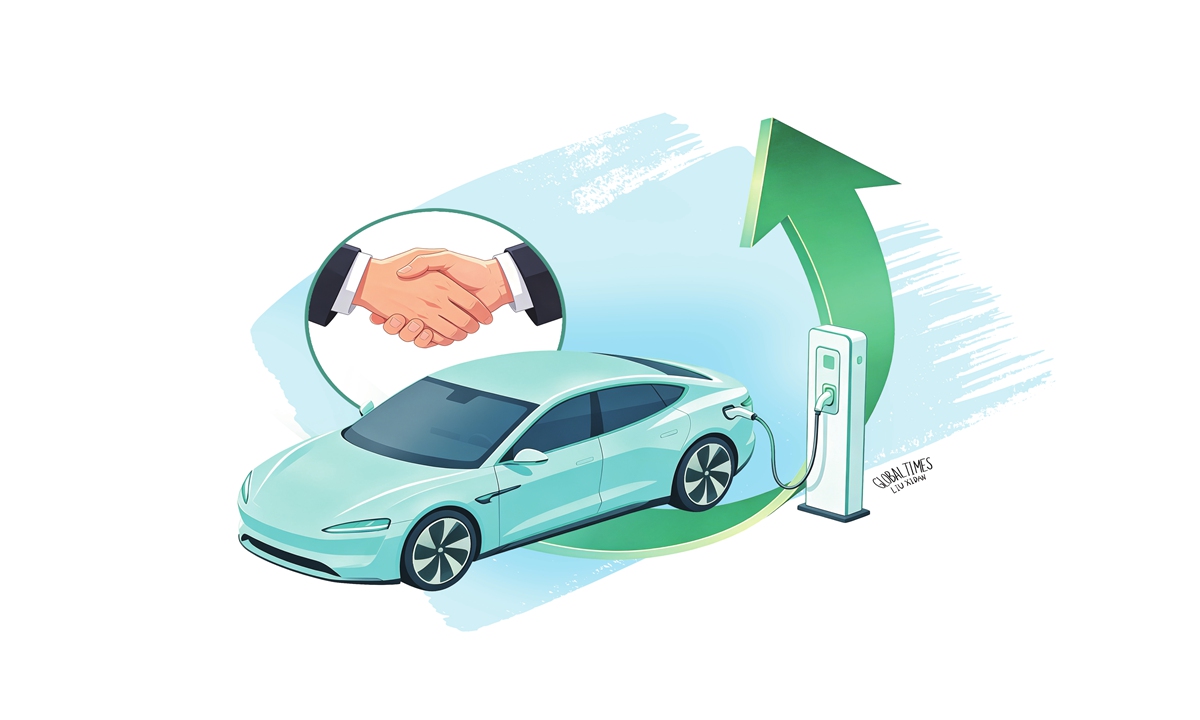
EV, export, green energy, auto Illustration: Liu Xidan/GT
Some commentaries in the West portray the rise of China's auto industry as a loss for foreign carmakers. The carmakers themselves, however, are taking a more pragmatic approach, drawing on the technology, supplier base and manufacturing expertise that China has built up to boost their competitiveness.A recent example is Toyota Motor. According to a Nikkei Asia report, Toyota plans to build a next-generation electric sport utility vehicle in China beginning in fall next year under its Lexus brand. While the plan is still some way off, Toyota's actions in China point to a broader direction. In February 2025, Toyota Motor announced the establishment of a company in Shanghai's Jinshan district for the research and production of Lexus electric vehicles (EVs) and batteries.
Why China? And why Shanghai's Jinshan? The answer is not simply the size of the market. Toyota is putting research and production there, and the strength of the local industrial base may help explain the choice. As of April 2025, Jinshan was home to 159 companies across the auto supply chain, 64 of which were recognized for their specialized expertise and innovation. Together, they cover a broad range of activities, from R&D and component manufacturing to data collection and analysis.
China's rapidly expanding EV supply chain has been very impressive. It has also built an industrial base that foreign companies can tap into. Battery producers, component suppliers, engineers and manufacturers can work in close proximity, bringing ideas, prototypes and finished vehicles closer together. That matters in a market where product cycles are getting shorter and technology is evolving quickly.
This is why more foreign automakers are deepening their links with China's industrial base. Last year, Volkswagen completed the core expansion of its R&D center in Hefei, East China's Anhui Province, making it Volkswagen's first and largest integrated R&D base outside Germany with full-process vehicle development and validation capabilities.
BMW offers another example. The iX3, unveiled in Munich in 2025, was reportedly developed with Chinese technology partners in areas including batteries, artificial intelligence, and autonomous driving.
These examples point to a broader change in what China offers foreign automakers. It is no longer simply a market to sell to or a supply base to buy from. It is also becoming a place to develop products, work with technology partners and move more quickly from engineering to production. For global automakers, access to these capabilities can be as valuable as access to Chinese consumers.
This matters because it can make foreign automakers more competitive globally. Some entered the EV market later than their Chinese peers. Operating in China gives them a chance to gain experience and improve their products in a market that has moved quickly. China can, in this sense, be a kind of lab - a place where automakers can build up their EV expertise before taking that experience into global markets.
The global debate over Chinese EVs often starts with a simple question: Are Chinese EVs taking more market share from foreign automakers? The question itself carries a zero-sum assumption. Walk out of the stereotype, and a broader picture emerges.
Think of the global auto industry as a vast industrial network. China has built one of the world's most active and also technologically complicated automotive hubs, with extensive infrastructure and a deep industrial base bringing batteries, components, engineers and manufacturers together. That industrial base is open to foreign automakers, too. They can use China's industrial capabilities to strengthen their own competitiveness.
Competition from Chinese companies is real. But it can also push foreign automakers to look more closely at the industrial base behind that competition - and find ways to use it themselves. China's openness makes this possible. The global auto industry does not need more barriers between markets and supply chains. It needs more openness and cooperation.
The author is a reporter with the Global Times. bizopinion@globaltimes.com.cn
RELATED ARTICLES