ARTS / CULTURE & LEISURE
China-Kyrgyzstan joint archaeology underlines millennium of friendship along ancient Silk Road
China, Kyrgyzstan uncover shared history along ancient Silk Road
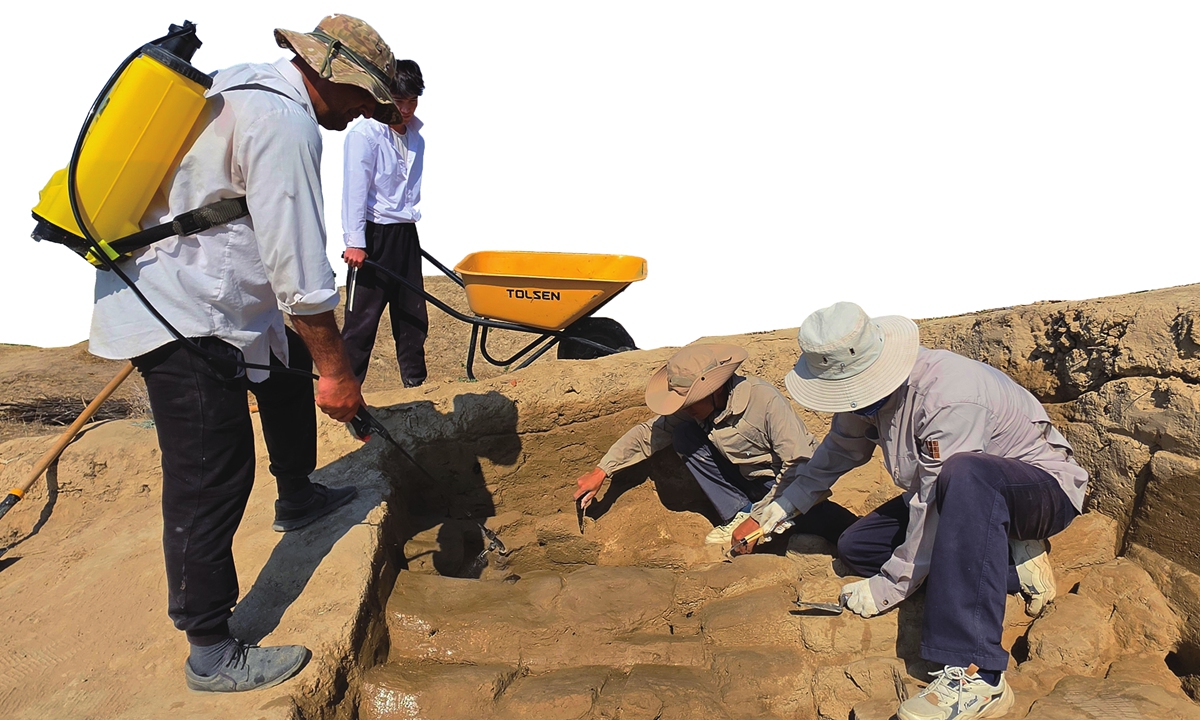
Chinese and Kyrgyz archaeologists conduct archaeological excavations at the Krasnaya Rechka Site, Kyrgyzstan, in July 2026. Photo: Courtesy of the Shaanxi Academy of Archaeology
In downtown Bishkek, a white building at the National Academy of Science of the Kyrgyz Republic stands on the street. Taking the elevator to the third floor and pushing open an unassuming door, sunlight streams through the window and falls on a small bronze mirror lying on a restoration bench. This room, the first cultural relics conservation laboratory established by the Shaanxi Academy of Archaeology under its China-Kyrgyzstan joint archaeology project, is one of the quietest yet busiest corners in the building.Inside this temporary laboratory, Song Junrong, an associate research fellow from the Shaanxi Academy of Archaeology, sits at the bench, bent over a handled bronze mirror that she is restoring. From time to time she dips her brush into pigment and then adds the final touches of color.
A few days ago, when the mirror was brought in by a local archaeologist, it was shattered into nearly a hundred pieces. What made it even more challenging was that someone had attempted to glue it back together, but the job had been handled poorly. Song and her team had no choice but to take it all apart and start over from scratch.
Fortunately, Song doesn't lack patience. When local archaeologists heard that the Chinese team offers free restoration services, they kept showing up at the team's door with broken artifacts.
"They bring them in battered and broken, and we send them back in good shape," Song told the Global Times. "Although this bronze mirror is just 15.8 centimeters across, it is no small project. For every artifact, we first examine it, analyze the problems, and then draw up a restoration plan. Each plan runs about 20 pages. We must make sure that the artifact is not only properly restored, but also preserved in a condition suitable for long-term storage," she explained.
The story of this bronze mirror is a microcosm of a new chapter in the China-Kyrgyzstan joint archaeology project: cultural relic conservation. In October 2017, the Shaanxi Academy of Archaeology and the Institute of History and Cultural Heritage of the National Academy of Science of the Kyrgyz Republic signed a cooperation agreement.
Since 2018, archaeological cooperation between the two countries has continued to deepen and the joint team has grown in size, while the scope of research has become increasingly systematic.
From June 26 to July 14, 11 members of the Shaanxi Academy of Archaeology arrived in Kyrgyzstan in three groups, launching this year's joint archaeological efforts.
Besides routine projects, conservation of ancient relics has been added to the list of goals this year, along with the establishment of the joint laboratory, which provides an important platform to enhance academic exchange and cultural heritage protection by the two sides.
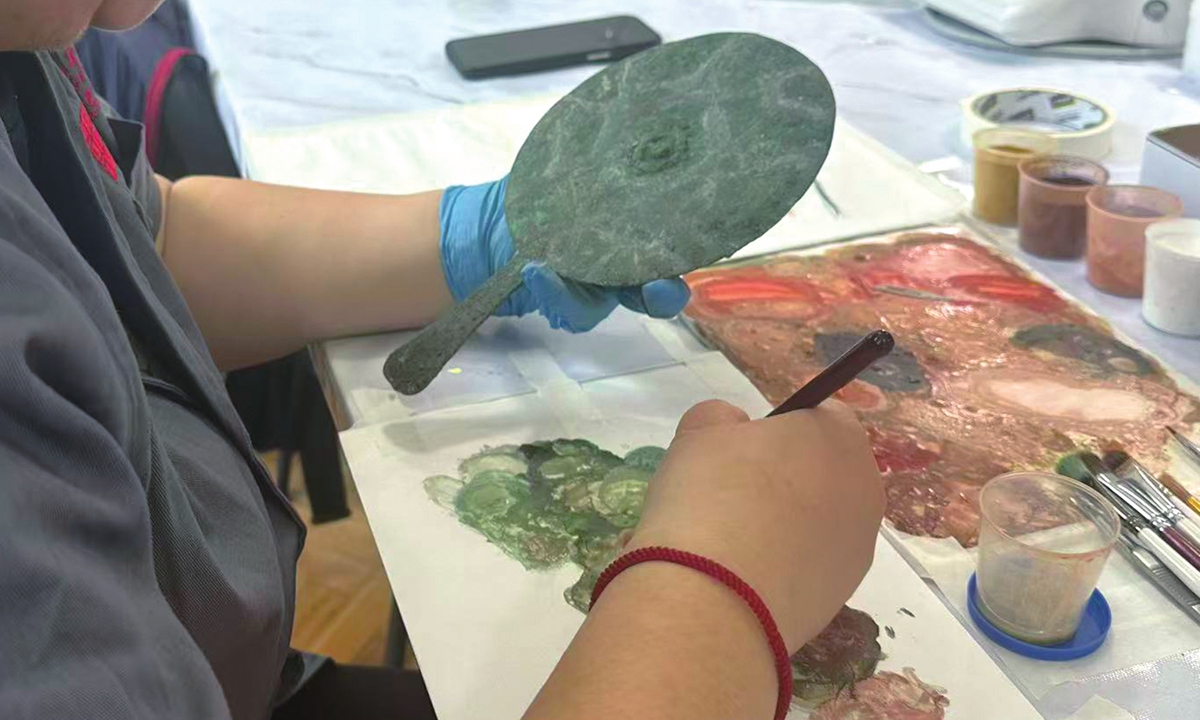
Song Junrong, associate research fellow from the Shaanxi Academy of Archaeology, restores a handled bronze mirror at the cultural relics conservation laboratory in Bishkek, Kyrgyzstan on August 29, 2026. Photo: Ma Jingjing/GT
Years of devotionShi Yanxin of the Shaanxi Academy of Archaeology has worked in Kyrgyzstan for five years. He told the Global Times that a key task of the joint project is to survey, excavate and research the Krasnaya Rechka Site, the ancient Silk Road city of Navekat, meaning "New City" in the ancient language known as Sogdian, and a UNESCO World Heritage site.
This site sits deep in the Chui Valley. This area is uninhabited, with no buildings but only endless green grass rippling in the wind. Every morning at 6 am, Shi and his team are already up and driving toward this silent wilderness. The scorching sun beats down on the open grassland, where not even a single tree offers shade. Crouching in marked excavation squares, they clean away the millennia-old soil layer by layer with their brushes.
Since arriving on June 26, this routine has been repeated for over 60 days without a single break. "As long as we are in Kyrgyzstan, the work must go on every day," Shi said.
The Chui Valley is a typical area where oasis civilization, steppe civilization and Central Plains civilization interacted. During the medieval period, Sogdian merchants traveled through the region to reach the East, while the Tang Dynasty (618-907) established the ancient city of Suyab, spreading advanced Central Plains technology and culture deep into Central Asia.
Through remote sensing and targeted excavation, the team has discovered city wall structures that had vanished from the surface due to modern agriculture, as well as kiln sites inside the city related to handicrafts, information previously unknown to Russian and Central Asian scholars, he said.
"Through archaeology we reveal this history, finding materials for the friendship between our two countries and providing inspiration for the present," Shi said.
Seeds for future
While they were conducting archaeological work, nurturing a new generation of archaeologists in Kyrgyzstan has been a wish deeply held by the Chinese team since the project's inception. Now this wish is taking root step by step.
Bekturusun, a local university student in his fourth year, recently joined the team. Calm and quiet, Bekturusun is extremely tenacious in his work.
During the excavation, he actively asked to learn Chinese surveying techniques. Surveying is physically demanding work, and combined with the sweltering heat, can be more than some can handle. Shi initially worried that the young man might not be able to endure it. To his surprise, Bekturusun not only persevered but also made rapid progress under the careful guidance of several technicians, with his ability to identify remains growing day by day.
From the restoration of a bronze mirror to the rediscovery of a city wall, the project is piecing together the historical fragments of a millennium past, and meanwhile cementing the friendship, bit by bit. Today, a group of Chinese and Kyrgyz archaeologists crouch on the same land, revealing a shared history through collective effort.
RELATED ARTICLES