China, West need to cooperate on setting global AI governing standards: Oxford AI governance expert

Conceptual diagram of AI Photo: VCG
Editor's Note:
As China expands its role in global AI innovation, questions are growing over how new technologies can benefit developing countries and how international cooperation can keep the global AI ecosystem open, inclusive and interoperable. Sam Daws (Daws), senior advisor to the Oxford Martin AI Governance Initiative at the University of Oxford, founding director of Multilateral AI, and former First Officer to UN Secretary-General Kofi Annan, spoke with the Global Times (GT) about China's contribution to AI capacity-building and governance, as well as the scope for China-West cooperation on AI safety and standards.
GT: AI, robotics and innovative medicine are becoming increasingly prominent areas of innovation in China. What does this reveal about China's evolving role in global innovation, and what opportunities could it create for other countries?
Daws: China has invested significantly in innovation in these new technologies, with the result that it is now the global leader in embodied AI applications in manufacturing and robotics.
The diffusion of these technologies outside China has the potential both to lower the cost for developing countries and to help create interoperable standards, so that a robot in one country works seamlessly with an algorithm from another country.
The new World Artificial Intelligence Cooperation Organization (an independent intergovernmental organization established in Shanghai in July 2026 to promote global AI cooperation and governance) can contribute to international capacity-building, embodied AI standard-setting and AI adoption, and help the UN achieve the Sustainable Development Goals by 2030.
GT: You previously noted that China's affordable, open-source and full-stack AI solutions could help developing countries bridge the digital divide. Where do you see the greatest potential for Chinese AI to make advanced technologies more accessible and responsive to different languages, cultures and local needs?
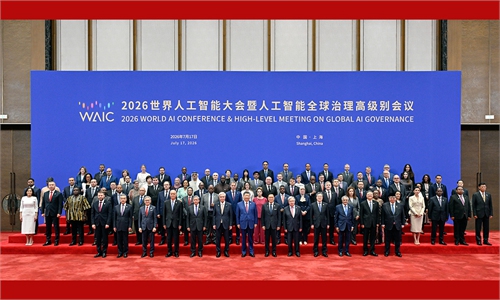
Daws: At the World AI Conference in Shanghai in July 2026, China stressed that AI development should respect and preserve the cultural uniqueness of different countries. This is vital if we are to ensure that AI deployment increases understanding across civilizations and proves useful across very different cultural contexts, from Albania to Zimbabwe.
To achieve this, China's open-source AI approach can provide the foundation on which algorithms, datasets and applications are optimized to support local contexts, whether that is education in Southeast Asia or agriculture in sub-Saharan Africa. Universities and AI companies in China can work together to help preserve linguistic, cultural and civilizational diversity while supporting common international governance standards.
China can partner with regional initiatives such as the pan-African Masakhane, while also contributing to the development of global standards and best practices through UN bodies such as UNESCO and the International Telecommunication Union (ITU), to ensure interoperable international approaches to preserving cultural and linguistic diversity.
GT: China has called for stronger international AI capacity-building. What would such cooperation mean for developing countries seeking more equal access to technology?
Daws: Capacity-building for developing countries is essential if they are not to be left behind in the AI revolution. Capacity-building will be most successful when it seeks to do three things.
First, it should be coordinated with international partners to maximize effectiveness, including through national-level support to developing countries by the ITU, UNIDO, UNDP and UNESCO. Second, it should be targeted at priorities set by individual governments in areas such as food security, health and medicine, smart cities and the delivery of digital government services. Third, it should be optimized for local contexts, cultures and languages.
China has a particular contribution to make through its leadership in low-cost, open-source AI and its advances in embodied AI for manufacturing and smart cities.

Sam Daws, senior advisor to the Oxford Martin AI Governance Initiative at the University of Oxford, founding director of Multilateral AI, and former First Officer to UN Secretary-General Kofi Annan Photo: Courtesy of Sam Daws
GT: China supports a central role for the UN in global AI governance. How can China help build a more inclusive system and give developing countries a greater voice in shaping AI rules?
Daws: The UN Global Digital Compact has opened several important pathways for international AI cooperation, including a scientific panel, a global policy dialogue, international capacity-building, cooperation on standards and stronger data governance.
China has been playing a leading role at the UN across these areas, while also supporting greater understanding and cooperation through regional partnerships and "minilateral" initiatives such as BRICS+, the Shanghai Cooperation Organization, the Digital Belt and Road Initiative and now the World Artificial Intelligence Cooperation Organization.
Chinese universities, think tanks and diplomats can specifically look to support and "upskill" diplomats from smaller developing-country missions at the UN through initiatives such as the Group of Friends for International Cooperation on AI Capacity-building in New York, or through support for and partnerships with the ITU's AI for Good initiative, the United Nations Institute for Training and Research (UNITAR), the Geneva Science and Diplomacy Anticipator (GESDA) and DiploFoundation in Geneva.
GT: Where is there the most realistic scope for China to work with other countries on AI? How could cooperation help prevent the global AI ecosystem from fragmenting?
Daws: Despite the existing challenges of navigating geopolitical competition, commercial sensitivity and rapidly evolving technology, it remains essential for China and Western countries to cooperate if we are to maximize the global benefits of AI and minimize the shared risks.
On AI safety, the shared starting point should be to create cooperative pathways to address the risks outlined in the 2026 Preliminary Report of the UN Independent International Scientific Panel on AI.
While political support for a new international agency to evaluate risks from frontier AI models before deployment remains limited, growing awareness of cyber and emerging AI risks suggests there may be scope for an independent body to monitor shared post-deployment risks from advanced AI systems. These could include risks arising from open-source modifications, collaboration or collusion among AI agents, as well as loss-of-control risks such as deception and attempted replication.
There should also be scope for China to participate in meetings of the International Network of Advanced AI Measurement, Evaluation and Science. Bilateral China-UK and China-EU tracks on AI safety collaboration could be initiated in the second half of 2026.
On AI capacity-building, the new World Artificial Intelligence Cooperation Organization can work closely with UN agencies such as the ITU, UNIDO, UNDP and UNESCO to maximize the benefits for individual developing countries.
On AI for science, it is highly likely that there will be spectacular breakthroughs over the next five years in mathematics, medicine and science. These will be driven by improvements in AI models' reasoning capabilities, supported by rapid cycles of recursive self-improvement. The challenge for companies, countries and universities will therefore be how to quickly identify and harness the most promising of these technologies for the benefit of humanity within increasingly short timeframes.
To this end, there may be merit over time in developing a "CERN for AI"-type scientific cooperation initiative. In the meantime, governments should each adopt new innovation systems and institutions in anticipation of this new era, while working through UNESCO, the International Science Council and other collaborative mechanisms.
International AI standard-setting has proved to be one of the most productive areas where experts and companies have collaborated on mutually beneficial standards despite geopolitical and commercial challenges. There is real scope for cooperation between China and the West in advancing AI through standard-setting within the ITU, ISO/IEC and IEEE, including agreeing on methodologies to track the growing energy and water demands of AI, both from data centers and from the growth of agentic and embodied AI.
RELATED ARTICLES