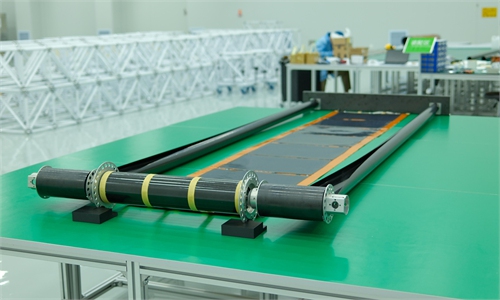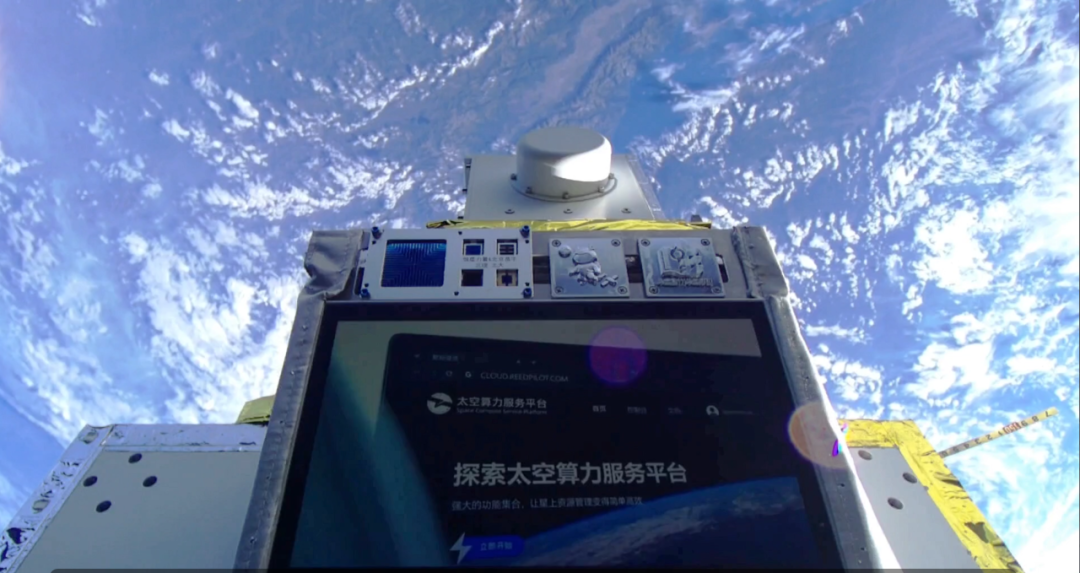
A view of China-launched space computing cloud running in-orbit. Photo: courtesy of Beijing University of Posts and Telecommunications
China has put into operation the world's first orbital computing cloud capable of providing regular in-orbit experimental services, according to the Science and Technology Daily. A Chinese analyst noted that the move marks a step closer to the commercial operation of China's space-based computing network as the global artificial intelligence (AI) industry enters a period of explosive growth.
The platform, led by the Beijing University of Posts and Telecommunications (BUPT), officially entered steady-state service, the university announced on its WeChat account on Sunday.
According to BUPT, the orbital computing cloud is built around three core components: an in-orbit space computing service platform, a ground station service platform, and an operations service platform. Together, these systems connect satellite platforms, space servers, ground stations and terrestrial data centers through task orchestration, computing scheduling, data processing and service delivery.
The system allows users to submit tasks, deploy software, monitor execution and receive results through a full life-cycle service model. In practical terms, the platform enables automated workflow for space-based computing experiments.
Space-based computing refers to the deployment of computing capacity in space, which enables seamless global coverage through satellite networking. Compared with terrestrial data centers, its greatest advantages lie in real-time responsiveness and global coverage, the Xinhua News Agency reported.
Since entering service, the platform has supported key scenarios, including in-orbit big-data computing, 6G communications trials and distributed storage experiments. It has completed hundreds of orbital computing calls for more than 100 users, according to the university.
The university said the platform is built on the domestic-produced software and hardware ecosystem. Performance metrics show the system delivers large-model inference at an energy efficiency of 10 tokens per joule using domestically developed hardware and software, while its orbital computing service coverage has exceeded 10 percent.
According to the university, the space-based computing cloud has developed three core technological capabilities. First, it has built an independently controllable, open and compatible "space operating system" ecosystem, transforming one-off in-orbit experiments into a reusable and upgradable platform-based service. Second, it has established a cloud-native software runtime foundation tailored for the space environment, enabling flexible in-orbit software deployment, on-demand evolution, and reliable long-term operations. Third, it has achieved coordinated scheduling of satellite payloads, providing a critical foundation for real-time on-orbit processing of space data and autonomous satellite decision-making.
Industry observers said these capabilities are significant because traditional satellite systems have typically been designed to collect data and send it back to Earth for processing. In contrast, onboard computing can shorten response times, reduce downlink pressure and support more intelligent operations in orbit.
BUPT said the space computing cloud is now providing continuous service in areas such as real-time data processing, low-latency intelligent decision-making and iterative upgrades of satellite network capabilities.
The university added that the project's long-term value lies in helping the space information industry move from "delivering hardware" to "continuously delivering services." That change, if scaled, could open new commercial opportunities for satellite internet operators, telecom providers and commercial space companies.
China has been accelerating development in commercial space and satellite internet in recent years, with growing investment in reusable launch vehicles, low-Earth-orbit satellites and space-ground integrated networks. Against that backdrop, the launch of a routine in-orbit computing cloud could become an important building block for future space infrastructure, Xiang Ligang, director-general of the Zhongguancun Modern Information Consumer Application Industry Technology Alliance, told the Global Times on Monday.
The space computing platform is supported by the Tiansuan Constellation, an open-source space and satellite research platform initiated in 2021 by a BUPT research team that allows scientists to run computing and networking experiments in orbit.