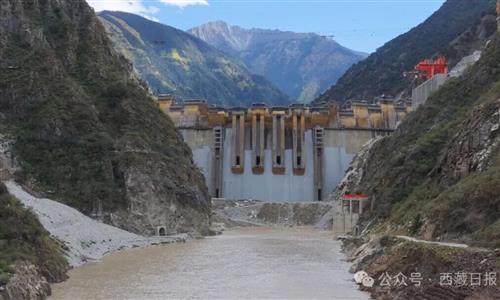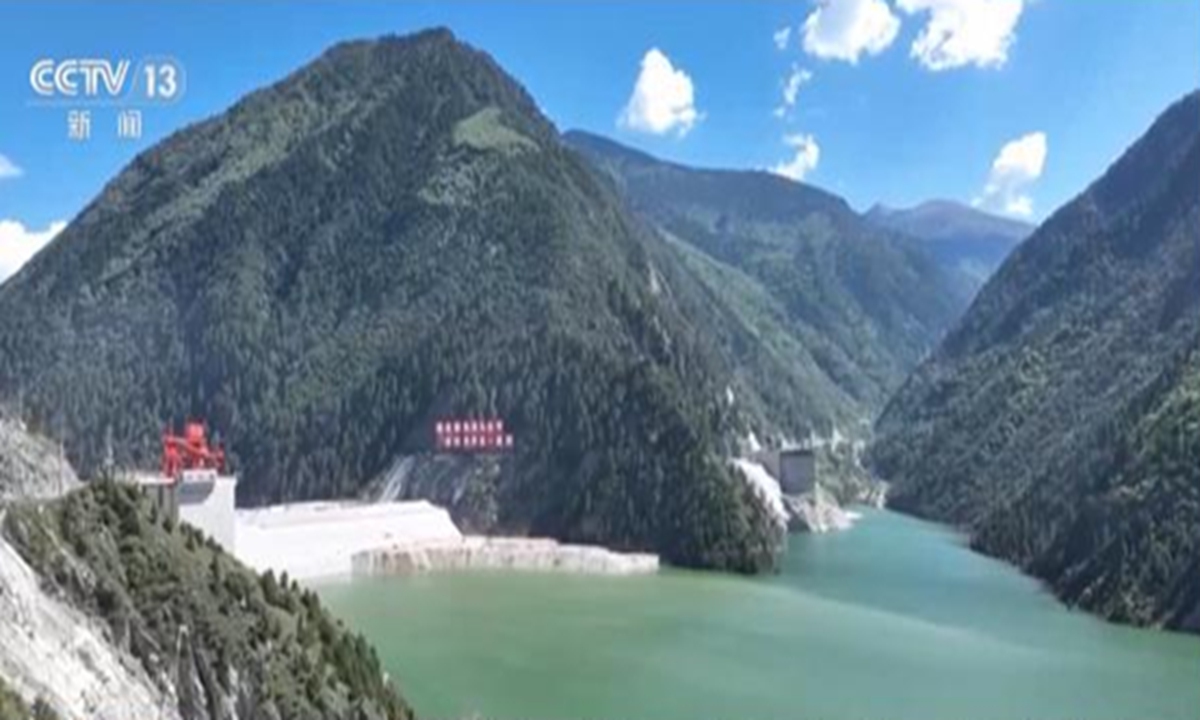
The Shuangjiangkou Hydropower Station, featuring the world's tallest dam at 315 meters, is seen in Aba Tibetan and Qiang Autonomous Prefecture, Southwest China's Sichuan Province. Photo: screenshot of China Media Group's report
The Shuangjiangkou Hydropower Station on the Dadu River in Southwest China's Sichuan Province, home to the world's tallest dam, has put all three generating units of its first phase into operation, China Energy Investment Corp said on Monday, according to China Media Group.The latest step represents another big achievement in China's development of large-scale hydropower infrastructure and high-dam engineering.
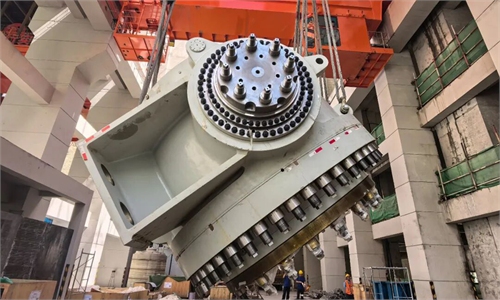
The Shuangjiangkou Hydropower Station is a key national energy project and the 315-meter-high dam is the tallest in the world. The station has a total installed capacity of 2 million kilowatts, with four 500,000-kilowatt Francis turbine generating units, and a reservoir capacity of 2.9 billion cubic meters.
It is a key control project on the upper reaches of the Dadu River, serving multiple functions including flood control, power generation and water-resource allocation.
Since the first unit began operation in June, the project team has brought three units online to help meet peak summer power demand in the Chengdu-Chongqing economic circle. The station has delivered a cumulative 500 million kilowatt-hours of clean hydropower, strengthening summer power supply in Sichuan Province and the Chengdu-Chongqing region.
Once all units are operational, the station is expected to generate about 7.7 billion kilowatt-hours of electricity annually, while boosting annual power generation at downstream cascade hydropower stations by about 6.6 billion kilowatt-hours. The project is also expected to further improve the comprehensive utilization of water resources in the Dadu River basin.
The completion of the Shuangjiangkou Hydropower Station, home to the world's tallest dam, reflects China's world-class capabilities in large-scale hydropower and high-dam construction, Lin Boqiang, director of the China Center for Energy Economics Research at Xiamen University, told the Global Times on Monday.
Built at high altitude under complex geographic and geological conditions, the project also faced low temperatures and a relatively short effective construction season, making both its design and construction highly challenging.
Lin said that the project's significance goes beyond clean power generation. Its large reservoir gives it strong regulating capacity, allowing water to be stored when inflows are abundant and generation to be increased when demand rises or during dry periods. This will strengthen peak regulation, power supply security and grid stability in Sichuan.
Such flexibility is becoming increasingly important as wind and solar capacity expands rapidly, Lin noted. Large reservoir hydropower stations can help offset fluctuations in intermittent renewable generation, provide balancing support for surrounding wind and solar projects, and improve the power system's ability to integrate a higher share of renewable energy while maintaining stable operation.
Experts said that the project's commissioning shows that China possesses the full-chain capability to independently build the world's highest-grade rock-fill dams, breaking foreign technological dominance in ultra-high rock-fill dams and high-head flood-discharge systems.
In recent years, China has accelerated the development of hydropower and other clean-energy infrastructure, with continued engineering advances further strengthening its capacity to deliver complex, large-scale projects and support the country's energy transition.
The National Energy Administration said on July 30 that China added 6.03 million kilowatts of hydropower capacity in the first half of the year - 3.03 million kilowatts of conventional hydropower and 3 million kilowatts of pumped-storage capacity. As of the end of June, the country's total installed hydropower capacity stood at 454 million kilowatts.
In the first half, hydropower generation by major power producers totaled 588.6 billion kilowatt-hours, while the average utilization of hydropower facilities nationwide stood at 1,452 hours.
RELATED ARTICLES