New expressway sections funded by Chinese companies in Serbia open to traffic on Monday
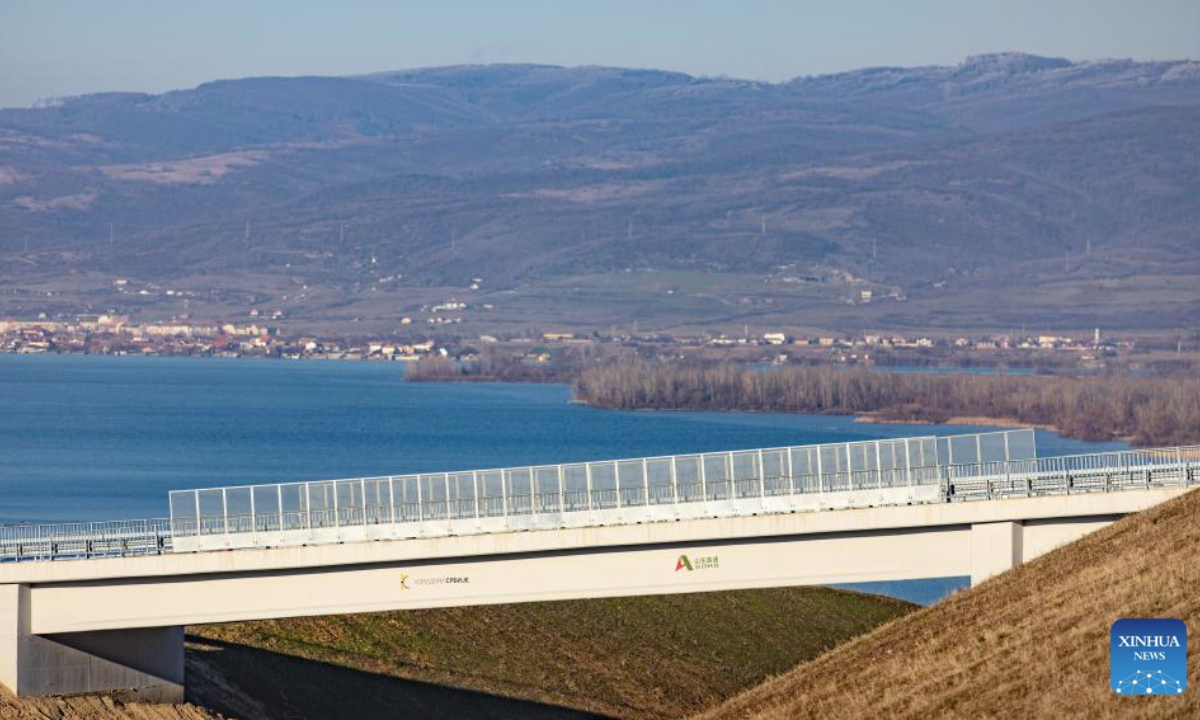
This photo taken on Dec. 29, 2025 shows the construction site of the Chinese-built Danube Corridor fast road in Golubac, Serbia. Vucic said the road would significantly improve connectivity along the Danube and support economic development in eastern Serbia, expressing satisfaction with the quality of construction and confidence in the Chinese builders.(Photo by Wang Wei/Xinhua)
New sections totaling 28 kilometers of the Danube Corridor expressway, built by Chinese companies, opened to traffic in Serbia on Monday, bringing the 68-kilometer strategic infrastructure project “close to full completion”.
A ceremony marking the latest progress of the 68-km corridor built along the Danube River was held on Sunday and attended by Serbian President Aleksandar Vucic, other Serbian government officials, and Zhang Zhe, charge d'affaires of the Chinese Embassy in Serbia, Xinhua News Agency reported.
The opening came a day after the launch of Serbia’s first humanoid robot factory in Sabac, a project built in collaboration with automotive supplier Minth Group and Chinese robotics company AgiBot.
While Chinese experts described the expressway project as another important outcome of high-quality China-Serbia cooperation under the China-proposed Belt and Road Initiative (BRI), the new Danube Corridor section is seen as part of a broader pattern of infrastructure cooperation between China and Serbia.
According to Xinhua, Vucic said during the opening ceremony that the expressway serves Serbia’s national interests, helps boost tourism, and promotes economic growth in the country’s eastern regions.
Zhang said he expected more visitors to travel to Serbia’s scenic eastern areas as the expressway moves closer to full completion, adding that roads connect not only cities but also people, friendship and opportunities for future development.
The Danube Corridor expressway runs from Pozarevac to Golubac in the Branicevo district of eastern Serbia and was constructed by Shandong Hi-Speed Group. Work began in 2021 on the four-lane expressway, designed for speeds of up to 100 kilometers per hour. It serves as a key branch of the European E75 highway network.
“With the latest section now open, the entire 68-kilometer corridor is close to being fully operational,” the Chinese Embassy in Serbia said in a WeChat post.
A representative from Shandong Hi-Speed Group said the project is designed as a dual carriageway with four lanes and a speed limit of 100 kilometers per hour. It is expected to ease a major transport bottleneck in eastern Serbia and improve connectivity with countries and regions along the E75 corridor.
The company’s representative told the Global Times that the project will improve access to tourism destinations in the Danube region, reduce logistics costs, and create better conditions for investment in eastern Serbia, adding that the road is expected to play an important role in regional economic development and Serbia’s broader integration with European transport networks.
The Danube Corridor expressway adds to a growing list of Chinese-built transport projects in Serbia. In 2013, a Chinese company began construction of the E763 highway — the first highway China built in Europe and the inaugural infrastructure project under the China-Central and Eastern Europe cooperation framework.
The 258-kilometer E763 highway links Belgrade to Montenegro’s Port of Bar. Since its completion in August 2019, travel time between the Serbian capital and the Adriatic seaport has been cut from eight hours to four, significantly improving logistics efficiency and helping Serbian agricultural and mineral products reach European markets more easily, according to domestic media reports.
"Infrastructure connectivity has always been a priority in China’s cooperation with BRI partner countries," Zhou Mi, a senior research fellow at the Chinese Academy of International Trade and Economic Cooperation, told the Global Times on Monday.
He said the project helps enhance Serbia's internal connectivity and regional complementarity.
As an integral part of the EU highway network, it will help Serbia integrate more deeply into European markets and serve as a bridge for Danube regional economic cooperation, Zhou said.
Zhou added that the benefits extend beyond asphalt. "What we see is a synergy of logistics systems, industrial collaboration and regional economic upgrading. China and European countries enjoy strong complementary strengths in standards, technology, funding and construction capacity. Cooperation that responds to real market demands is naturally welcomed," he said.
The project has also gained broad support because it responds to practical market demand, Zhou said. As Serbia continues to develop as a transport and trade hub, project like this one are expected to play a positive role in advancing regional integration and supporting long-term growth.
According to Zhou, in the future the expressway will unlock new potential in tourism, logistics and cross-border trade, demonstrating how high-quality BRI cooperation can translate concrete infrastructure into sustained economic momentum.
RELATED ARTICLES