China clones calves from 16-year-old Bull, setting new national record for oldest livestock somatic cell donor
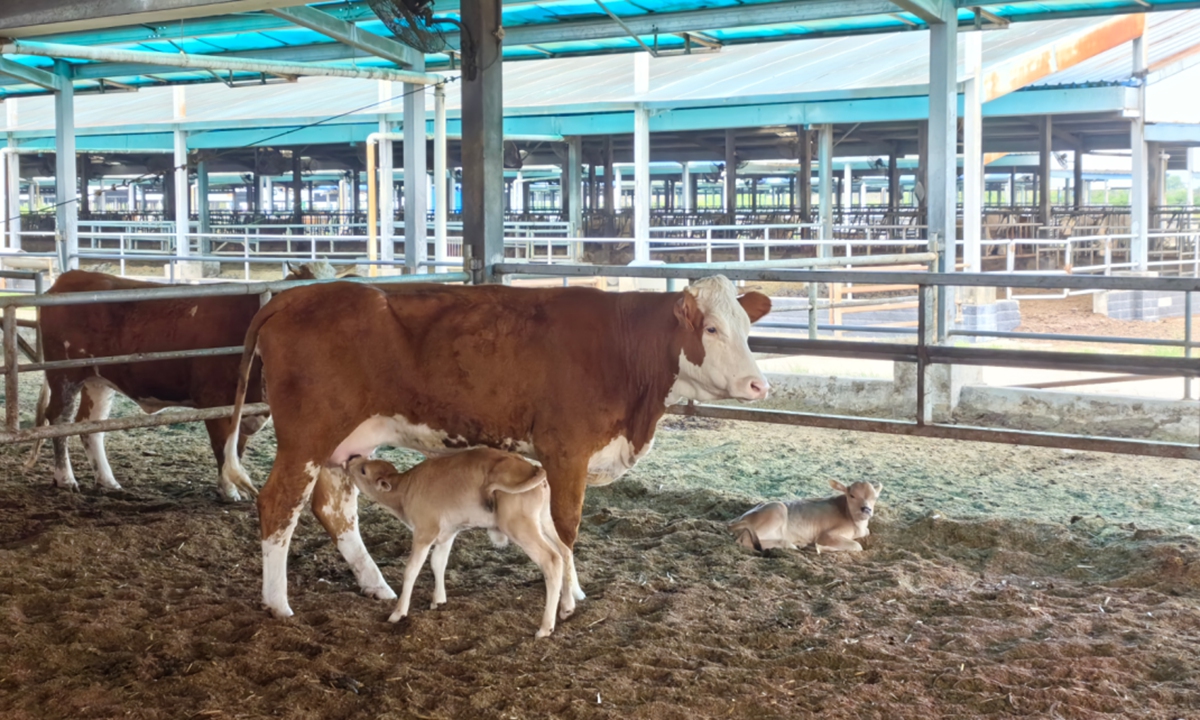
Photo: Screenshot from the Science and Technology Daily
An institute in Central China's Hubei Province has successfully cloned four Jersey calves using cells from a 16-year-old breeding bull, setting a new national record for the oldest somatic cell donor in livestock cloning, the Science and Technology Daily reported on Monday.
Two healthy calves, named "Nongnong" and "Xiaoke," have already been born, while two other surrogate cows remain in stable pregnancy, according to the report.
The cloning was conducted by a research team in the Hubei Academy of Agricultural Sciences.
For cattle, 16 years is considered extremely advanced age. The donor bull had already lost its natural reproductive ability, putting its valuable genetic traits at risk of being lost forever. To rescue and preserve this rare elite germplasm, the research team launched a technical effort focused on cloning from aged somatic cells.
Hua Zaidong, a researcher of the academy said that aged somatic cells present major technical challenges, including the accumulation of aging-related epigenetic modifications, difficulty in restoring embryonic totipotency, and low cloning efficiency. The team developed an "epigenetic regulation + somatic cell cloning" technical system. By applying targeted activation and modification treatments to the aged donor cells, they raised the blastocyst development rate of cloned embryos constructed from these cells from less than 20 percent to 40 percent.
In this experiment, 50 high-quality cloned embryos were selected and transferred into 40 surrogate cows. Ten cows became pregnant. Six of these later experienced pregnancy loss, while four pregnancies were successfully maintained to full term, per the report.
The successful cloning from the 16-year-old Jersey breeding bull represents the highest publicly reported age for male breeding bull somatic cell cloning in China. The complete set of epigenetic regulation and cloning techniques developed for aged cells has reached an internationally advanced level in similar research, said the report.
"After the cloned calves are born, we will continue to monitor their growth, conduct performance evaluations, and, once they reach sexual maturity, assess their frozen semen production and offspring performance to confirm their actual breeding value," Hua said.
His team will use this achievement as an opportunity to further improve the rare germplasm somatic cell bank and position cloning technology as an important complement to traditional breeding methods, helping to rescue and protect aging precious breeding bull resources in Hubei, the report noted.
Global Times
RELATED ARTICLES