IN-DEPTH / IN-DEPTH
US teacher Sakolsky plants seeds of kindness in China. What grew from them?
Sown and Grown
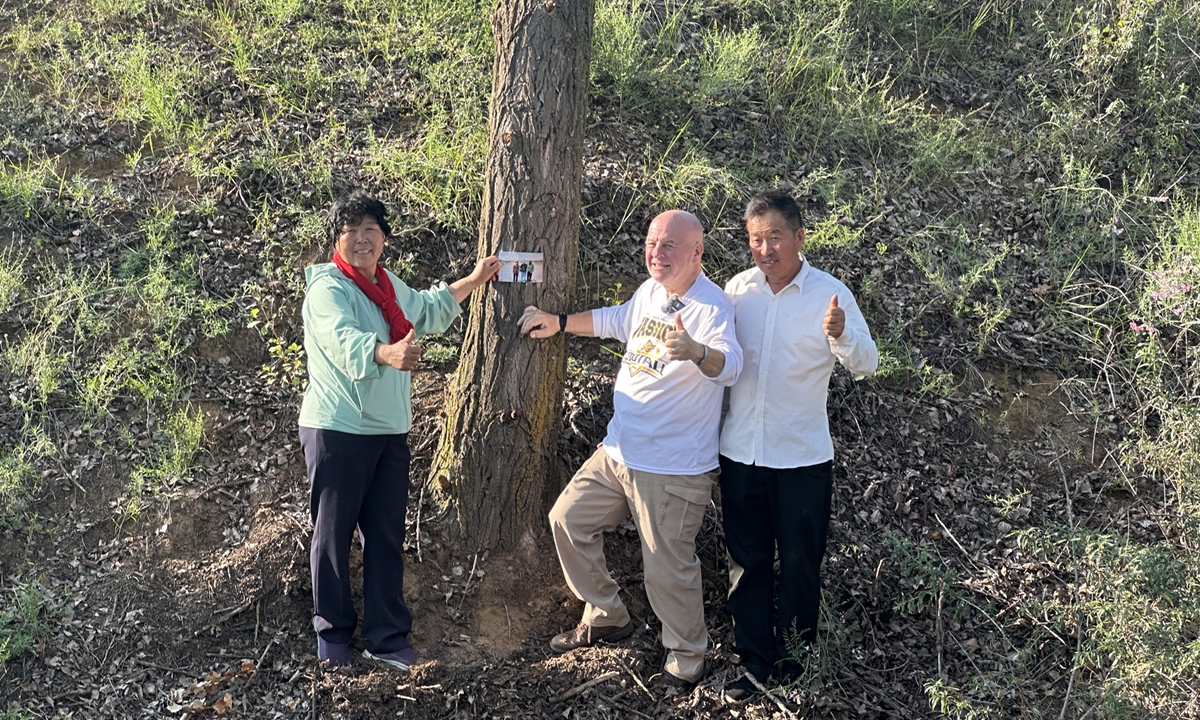
Yin Yuzhen (left), Ronald Sakolsky (center) and Yin's husband pose for a photo in front of a tree planted by Sakolsky 26 years ago, on August 24, 2026. Photo: Lin Xiaoyi/GT
On September 1, American teacher Ronald Sakolsky will leave China after a 10-day return visit, carrying with him memories of old friendships renewed.His journey took him from Beijing to North China's Inner Mongolia Autonomous Region and Central China's Henan Province, where reunions, embraces and tears brought a decades-old story of friendship between ordinary people in China and the US into sharper public view.
The story began with a barren stretch of desert that slowly turned green - and with a chance encounter more than two decades ago that neither side forgot.
In 1999, Sakolsky came to Luoyang, Henan Province, as part of a China-US teacher exchange program organized by the China Education Association for International Exchange (CEAIE). There, he was deeply moved by the story of Yin Yuzhen, a local woman who had devoted her life to fighting desertification and planting trees in the Maowusu Desert.
At the time, Sakolsky did not know Yin. But after seeing her story on television, he felt compelled to help. He donated $5,000 to support her afforestation efforts and, the following year, traveled to the heart of the Maowusu Desert, where he planted saplings with Yin and her husband.
Today, 27 years later, those fragile seedlings have become part of a vast forest of some 50,000 trees.
The two lost touch over the years, but the memory of that encounter endured. In May this year, Yin launched a public campaign to find her old American friend. Tens of millions of Chinese internet users joined the search, and within 48 hours, the two friends separated by the Pacific had found each other again.
Three months later, at the invitation of the CEAIE, Sakolsky returned to China.
Over the next 10 days, he found himself meeting the people and places that had been part of his life more than two decades earlier. And everywhere he went, he saw traces of what had grown from those early encounters: a desert transformed by trees, former students inspired to look beyond their own classrooms, and people-to-people ties that have endured across time and borders.
What began with a handful of saplings had, in ways Sakolsky could never have known at the time, grown far beyond the desert.
Donation turns a desert into a forest
When Sakolsky returned to the Maowusu Desert in Uxin Banner, Ordos, in Inner Mongolia, Yin brought out an old photograph.
Together, they recreated it.
In the first photograph, taken 26 years ago, Yin, her husband and Sakolsky stood in a sea of sand. Between them was a sapling no thicker than a finger.
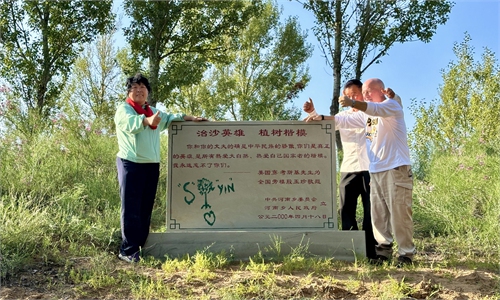
In the new photograph, the three stood in front of the same grove, now named after Sakolsky. The barren landscape had been replaced by green. The fragile sapling in the old photograph had become a tall, sturdy tree.
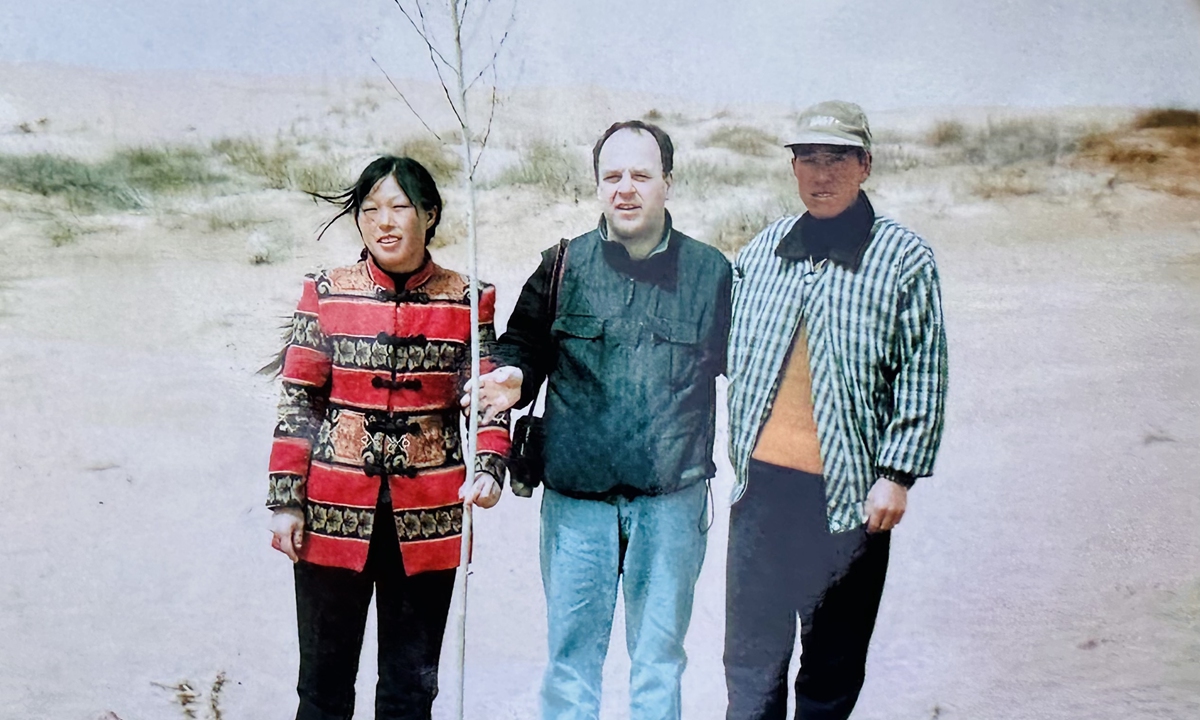
File photo: Yin Yuzhen (left), Ronald Sakolsky (center) and Yin's husband pose for a photo when Sakolsky planted a tree 26 years ago. Photo: Courtesy of Bai Guocai
The connection between the two began in 1999, when Sakolsky had been teaching in Luoyang for only two months. He saw Yin's story on television: an ordinary Chinese farming family planting trees one after another in a desert where greenery was hard to find."I suddenly started crying as I watched," he told the Global Times. He could not explain exactly why. He only knew that he had to do something.
At the time, he did not know Yin. He emailed several foundations in the US, telling them about her efforts in the Chinese desert. The campaign eventually helped secure a $5,000 donation.
Sakolsky later put the amount into perspective. Yin's annual income at the time was roughly the equivalent of $250. The donation was worth about 20 years of her savings.
The following spring, accompanied by Bai Fan, then vice principal of Luoyang Foreign Language School, Sakolsky traveled deep into the Maowusu Desert for the first time.
Bai still remembers the details. The seedlings were no thicker than a finger. Water had to be carried from far away. Yin watered the trees one scoop at a time.
Faced with the barren landscape, Sakolsky repeatedly said that it seemed "impossible."
"He found it difficult to imagine that trees could really grow in a place like this," Bai said.
Yin remembers the failures, too. She married into the Maowusu Desert from Northwest China's Shaanxi Province at 19. In those days, sandstorms could bury the entrance to a house overnight. She vowed that she would rather work herself to death planting trees than allow the sand to destroy her life.
In 1986, she sold a sheep to buy 600 saplings and planted them around her home. After a major windstorm, fewer than 10 survived.
But she did not stop. "If 10 out of 600 can survive, that means trees can grow here," she recalled thinking.
She gradually learned which species could withstand drought, where water was likely to collect and how to keep seedlings from being blown away. "There was no shortcut," she said. "You fail, then try again. If something works, you keep doing it. And you do it year after year."
Yin told the Global Times she has long spoken of trees almost as if they were family members - or soldiers under her command. She sometimes talks to them on the hillsides. "The trees know my hardships and my exhaustion," she said.
For her, restoring the desert requires a reciprocal commitment. "If you plant a tree with care and do everything you can to help it survive," she said, "it will be strong and do everything it can to survive, too."
Today, green is the most striking feature of the Yin family's home. Trees shade the courtyard, while the fruits and vegetables on the table come from the family's forest.
Tasting the harvest, Sakolsky remarked that the lush land is the most genuine reward for decades of unrelenting desert restoration.
"A promise is a promise. Mrs Yin fulfilled her promise," Sakolsky said. After 27 years, the wasteland is green, and Sakolsky and Yin are "brother and sister."
Seed of education takes root
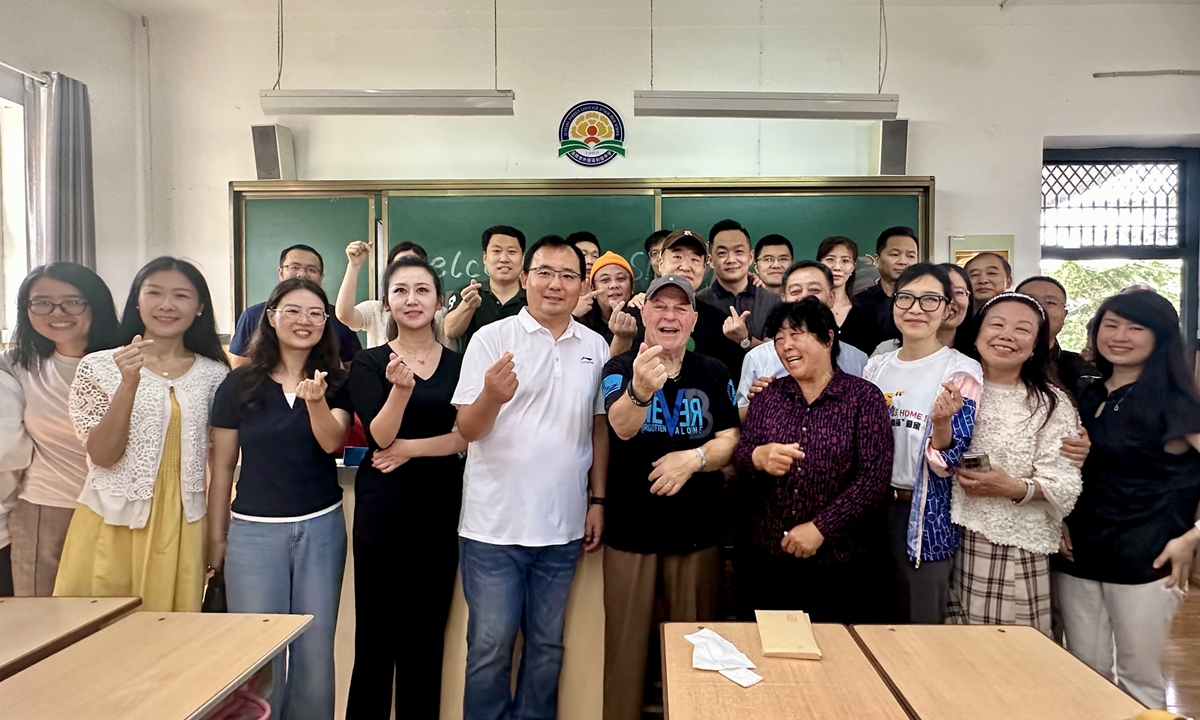
Ronald Sakolsky poses for a group photo with Yin Yuzhen and his former Chinese students at Luoyang Foreign Language School on August 28, 2026. Photo: Lin Xiaoyi/GT
On August 26, Sakolsky and Yin visited the High School Affiliated to Inner Mongolia Normal University for a student and teacher exchange.In his remarks, Sakolsky said that what he had done was never about the spotlight or recognition. He noted that in classrooms where he once taught in China and the US, he had kept a saying on the wall that he believed deeply: "No act of kindness, no matter how small, is ever wasted."
He added that he was heartened to see that same willingness to help in the eyes of the students and teachers before him.
This spirit extended far beyond Inner Mongolia's campus.
Two days later, Sakolsky returned to Luoyang Foreign Language School, where he had once taught. Former students traveled from different parts of the world to see him again.
As familiar faces appeared one after another, Sakolsky struggled to contain his emotions and wept several times. "I planted the seed with each and every one of you and you have grown into trees," he said.
Li Yuanzhi, one of his former students, flew back from New Zealand for the reunion. More than two decades later, he still remembered Sakolsky's unconventional teaching style. To explain a single English word, Sakolsky might laugh, jump around or even lie down on the floor. Outside class, he joined his students on the basketball court. When he noticed that the school's basketball nets were worn out, he quietly bought new ones, Li recalled.
Those small moments left more than memories of laughter.
A generation that had been encouraged to look outward began encouraging others to do the same.
Another former student, Li Wenwen, is now an English teacher at Luoyang Foreign Language School. "I was 17 and had just started 11th grade," she told the Global Times. "Sakolsky opened a window to the world for us. Now, through more exchanges, I try to look outward myself, and then bring what I have seen and the openness and kindness I have experienced back to my students. I encourage them to step into the world and take part in cross-cultural exchange."
Bridge built on common ground
When Sakolsky visited Yin's home, he deliberately wore a jersey from a women's football team in his hometown of Pittsburgh.
The word "Passion" was printed prominently on the shirt, with four words above it: "Respect," "Loyalty," "Family" and "Integrity." Pointing to them, Sakolsky said they described Yin well.
During their conversations, he learned that Uxin Banner covers about one-third of the Maowusu Desert. In the 1950s, more than 90 percent of the area's land was affected by desertification. In 1980, forest coverage stood at 7.2 percent. After decades of work by successive generations, forest coverage has risen to 32.92 percent and vegetation coverage to 85 percent.
"The goal for Yin from being a little girl was to make the desert beautiful. She never quit. I asked her, 'Do you still go into the forest?' She replied, 'Yes,'" Sakolsky said this deeply touched him. "She taught her children, and they taught their children. It tells you about the Chinese people's respect, loyalty and love, not just of the family, but of China."
Sakolsky also saw that Yin was far from alone. Across China, many ordinary families have taken part in ecological restoration. The transformation of the desert into green land, he said, was not the result of individual determination alone. It reflected the combination of personal perseverance and sustained government support for ecological restoration.
Having witnessed the transformation with his own eyes, Sakolsky said the experience of ordinary people persisting for decades, supported by government investment in ecological restoration, offered lessons that could be shared beyond China. "We share the same planet. These experiences should be shared with the world."
Yin offered her own response before he left. She gave him a cross-stitch she had spent more than two months making. On it were the words: "One Earth, One Dream."
The same sense of connection appeared at the school.
Sakolsky returned to Luoyang Foreign Language School, wearing a T-shirt bearing a single word: "Never."
He explained that it was his message to his former Chinese students: No matter how many years had passed, he would never forget them.
For Bai, the most valuable lesson Sakolsky brought was the importance of seeing each child as an individual, recognizing differences between cultures and learning to understand, accept and respect those differences.
"That is the foundation for different civilizations to live together," he said.
Sakolsky also echoed the idea during his conversation with students and teachers.
Bridges between people, and between countries, cannot be built with words alone, he said. They require action. And sustained exchanges between teachers and students are among the most important ways to build them, he said.
"Rather than focusing on how different we are, we should first look at what we have in common," he said. "Students everywhere want to be understood and respected. And whether in China or the US, teachers love their students."
Fu Bo, standing council member of the CEAIE, who accompanied Sakolsky throughout his visit, told the Global Times that decades of educational exchange between China and other countries had never been a one-way process. "It had been a genuine exchange in both directions," Fu said.
From the late 1990s teacher exchange programs that brought Sakolsky to China to China's initiative of inviting 50,000 young Americans to China on exchange and study programs in the next five years, exchange forms have evolved from traditional pen pal letters and teacher visits to online seminars and cross-border summer camps.
In May, Chinese Foreign Ministry announced that the "50,000 in Five Years" initiative was reached two and a half years ahead of schedule.
"Just as our seedlings became a 50,000-tree forest," Sakolsky commented. He hoped that the number of students benefiting from such exchanges would eventually grow from 50,000 to 100,000, 200,000 and beyond.
RELATED ARTICLES