Major Chinese smartphone makers raise prices as costs of memory chips, other components spike
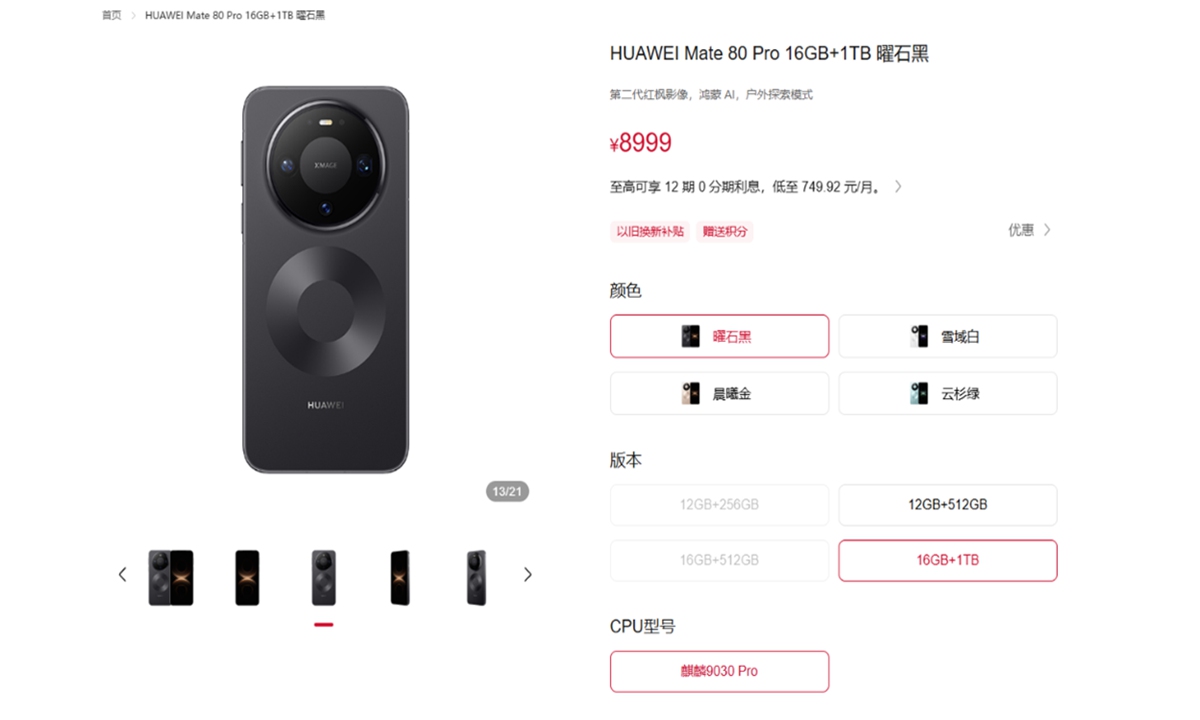
Photo: screenshot of the price of Huawei Mate 80pro 16GB+1TB
Major Chinese smartphone producers, including Huawei, Xiaomi and Honor, raised prices on selected models on Tuesday by 200 yuan ($28) to 1,000 yuan, spanning flagship and mid-range devices, as rising costs for memory chips and mobile processors increasingly feed through to consumers.
Huawei raised prices for several Mate 80 Pro variants by 1,000 yuan, with the 12GB+256GB version rising from 5,999 yuan to 6,999 yuan and the 16GB+1TB version from 7,999 yuan to 8,999 yuan. Prices for two Mate 80 Pro Max variants rose by 1,000 yuan, while prices across the Mate 80 series rose by 800 yuan.
Xiaomi raised prices across several models, with the starting prices of the Xiaomi 17 and 17 Pro each up 300 yuan, and the Xiaomi 17 Pro Max up 500 yuan. The REDMI K90 Max and K90 Ultra each rose by 400 yuan, while the REDMI Turbo 5 Max increased by 200 yuan. Honor also raised prices for its Power2 and Magic8 series.
Unlike past price adjustments for flagship models, which were tied to product life cycles or promotional strategies, this round of price hikes involves many manufacturers across multiple price ranges, sparking market concerns over whether the smartphone industry is entering a new cycle of price hikes.
Rising costs across the chip supply chain are seen as a key driver. Qualcomm, a major supplier of flagship Android smartphone chipsets whose Snapdragon platforms are widely used by Xiaomi, Honor, OPPO, vivo and Samsung, said in July that prices for products shipped after September 1 would rise by more than 10 percent across major chip lines, and it had "exhausted its ability to absorb rising supplier costs" despite efforts to find cheaper alternatives.
Since the start of the year, tighter supplies of dynamic random-access memory (DRAM) and other memory chips, coupled with the rapid expansion of artificial intelligence (AI) servers and data centers, have pushed up demand for high-end memory and raised procurement costs for consumer electronics makers.
Xiaomi President Lu Weibing has said that memory-price increases may ease during the rest of the year, but the upward trend is likely to persist, keeping storage costs elevated, according to media reports.
Ma Jihua, a veteran industry analyst, told the Global Times that the latest smartphone price hikes were driven largely by rising component costs, particularly for memory chips and processors. The rapid expansion of AI-related demand has diverted part of global semiconductor capacity toward AI servers and data centers, tightening supplies for consumer electronics and pushing up costs for handset producers. While manufacturers previously absorbed some increases through supplier negotiations, configuration adjustments and thinner margins, the latest round of price hikes suggests that such pressure has become increasingly difficult to absorb.
Whether the latest price hikes develop into a broader industry trend will depend largely on memory and processor prices. If upstream chip prices remain elevated, more brands or newly launched models could follow, although intense competition will still force vendors to balance costs, sales and market shares, Ma said. At the same time, higher prices could further weaken consumers' willingness to replace their phones, eventually feeding back into upstream demand and pushing the market toward a new supply-demand balance.
The latest price increases also underscore the importance of strengthening China's indigenous semiconductor capabilities, Ma said. Chinese chip producers have made substantial progress in recent years, but gaps remain in some cutting-edge processors, manufacturing processes and production capacity compared with leading global suppliers. For high-end smartphones in particular, dependence on external suppliers in some key areas means changes in overseas chip prices and supply conditions can still be transmitted directly to domestic handset producers.
China's semiconductor production capacity has continued to expand. In the first seven months of 2026, output reached 334.2 billion units, up 23.1 percent year-on-year, according to data from the National Bureau of Statistics.
Ma said that continued breakthroughs in advanced chips, semiconductor equipment and materials, together with greater production capacity, will be crucial to reducing vulnerability to external supply fluctuations.
"In this sense, the latest smartphone price hikes once again demonstrate the necessity and urgency of building a more independent, secure and controllable semiconductor industrial chain," Ma said. Stronger domestic capabilities would not only improve the resilience of China's electronics industry, but also add to global chip supplies and provide more diversified choices for the international market, he added.
RELATED ARTICLES