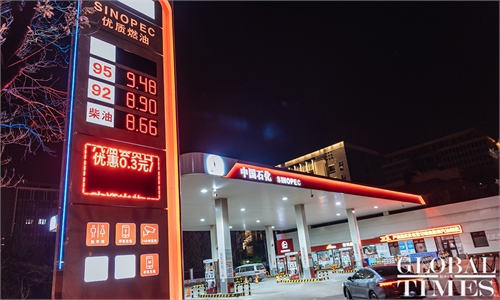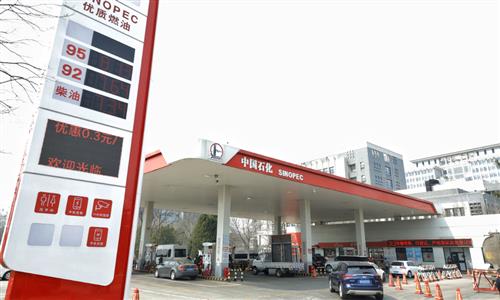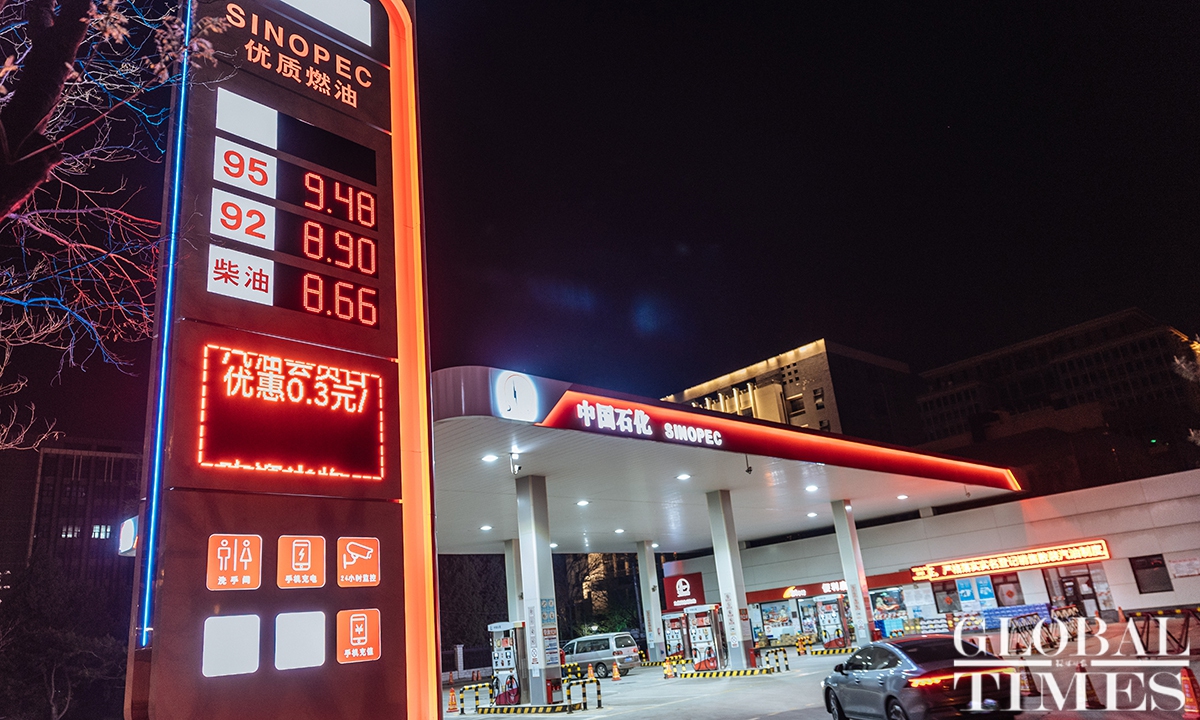
Car owners wait to refuel at a gas station in Beijing at 24:00 on April 7, 2026 from which point the actual increases in domestic gasoline and diesel prices will be capped at 420 yuan ($61.02) and 400 yuan per ton instead of 800 yuan and 770 yuan per ton under the current pricing mechanism. Photo: Li Hao/GT
On Tuesday, China's National Development and Reform Commission (NDRC) announced that, effective from midnight, domestic prices of gasoline would be raised by 800 yuan ($116) per ton and diesel (standard products) by 770 yuan per ton, with actual increases of 420 yuan per ton for gasoline and 400 yuan per ton for diesel after adjustment. This marks another pricing adjustment following the previous one on March 23.
Price changes of fuels have drawn widespread attention. How does China adjust its domestic refined oil prices? Under what conditions are adjustment measures taken, and how might authorities respond if global crude prices rise sharply? Relevant authorities and experts have offered their responses.
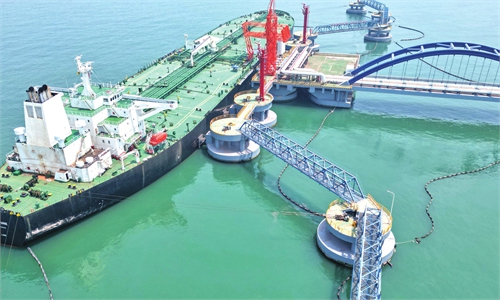
China's current pricing mechanism is based on the Regulations on the Management of Petroleum Prices issued by the NDRC in 2016. As a major oil importer, China sources more than 70 percent of its crude from overseas. Under the current mechanism, domestic gasoline and diesel prices are adjusted every 10 working days in line with changes in international crude oil prices.
Lü Zhichen, a deputy director at the Price, Cost and Certification Center of the NDRC, said the mechanism has three key features. First, it adopts a basket approach. Domestic gasoline and diesel prices are linked to the average price of a basket of international crude oils, meaning adjustments are influenced by multiple benchmarks rather than a single crude price.Second, it is based on average pricing. Adjustment levels are determined by comparing the average price of the basket over the 10 working days prior to the current adjustment with that of the previous cycle, rather than short-term fluctuations at specific points.
Also, it allows for range-based regulation. Under certain circumstances, the government may step in with price control measures.
In recent years, China's domestic refined oil prices have been adjusted in line with the mechanism. In 2023, refined oil prices saw 10 increases, 12 decreases and 3 periods of no change; in 2024, there were 9 increases, 9 decreases and 7 unchanged adjustments; and in 2025, there were 7 increases, 12 decreases and 6 unchanged adjustments. This brings the three-year total to 26 increases, 33 decreases and 16 unchanged outcomes.
Recently, global crude oil prices have fluctuated sharply, with prices in the Middle East in particular hitting record highs. These factors have directly pushed up China's oil import and fuel costs, contributing to an overall upward trend in domestic refined oil prices.
As a result, temporary adjustments help cushion the impact of sharp global oil price spikes.
Under the current mechanism, price adjustments are triggered when the average price of a basket of international crude oils exceeds $130 per barrel or falls below $40 per barrel over a 10-working-day period, said Tian Lei, a deputy director of the Economic Center at the Energy Research Institute of the Chinese Academy of Macroeconomic Research.
Given that crude prices have not breached the $130 ceiling, why have temporary adjustments been implemented twice recently? The main basis lies in Article 7 of the pricing mechanism, which allows authorities to suspend or delay adjustments, or narrow the adjustment range, under special circumstances such as significant increases in the overall domestic price level, major emergencies, or abnormal fluctuations in global oil prices.
"Temporary adjustments to domestic fuel prices within the existing mechanism help balance the interests of consumers and producers, cushion the impact of abnormal global oil price spikes, ease the burden on downstream users, and support stable economic and social conditions," Tian said.
"The gasoline and diesel prices released by the NDRC are for standard products priced per ton, namely 92-octane gasoline and No. 0 diesel," Lü said.
Taking the March 23 adjustment as an example, domestic prices for gasoline and diesel (standard products) were set to rise by 2,205 yuan and 2,120 yuan per ton, but the actual increases were 1,160 yuan and 1,115 yuan after regulation. This translated into increases of about 0.87 yuan per liter for 92-octane gasoline and 0.95 yuan for No. 0 diesel, around 0.85 yuan per liter less than without intervention.
For the April 7 adjustment, the increases were reduced by about 0.31 yuan per liter for gasoline and 0.32 yuan for diesel.
"If the average price of a basket of international crude oils continues to rise and exceed $130 per barrel — roughly corresponding to a domestic retail price of just above 10 yuan per liter for 92-octane gasoline — the upper price control threshold will be triggered," Tian said.
For the portion exceeding the ceiling, domestic maximum retail prices for gasoline and diesel will either not be raised or will see smaller increases. Meanwhile, to ensure stable supply, the government may also introduce fiscal and tax support measures, he added.
Past experiences show that the Russia-Ukraine conflict in 2022 triggered a sharp surge in global oil prices. At the time, authorities made clear that once prices exceeded the $130-per-barrel threshold, domestic fuel prices would not be raised for a short period (less than two months), while refiners were granted temporary subsidies.
The NDRC said it will guide major state oil companies, including CNPC, Sinopec and CNOOC, to ensure adequate production and distribution of refined oil products, maintain stable market supply, and strictly implement national pricing policies.
Relevant authorities across regions are required to strengthen market supervision and inspections, and take strict action against violations of pricing policies to safeguard normal market order. Consumers can report price-related violations through the 12315 platform.
This article was originally published by the People's Daily.
RELATED ARTICLES