China’s top economic planner will continue regulating refined oil prices
Institutional strengths help cushion crude surge, support economic stability
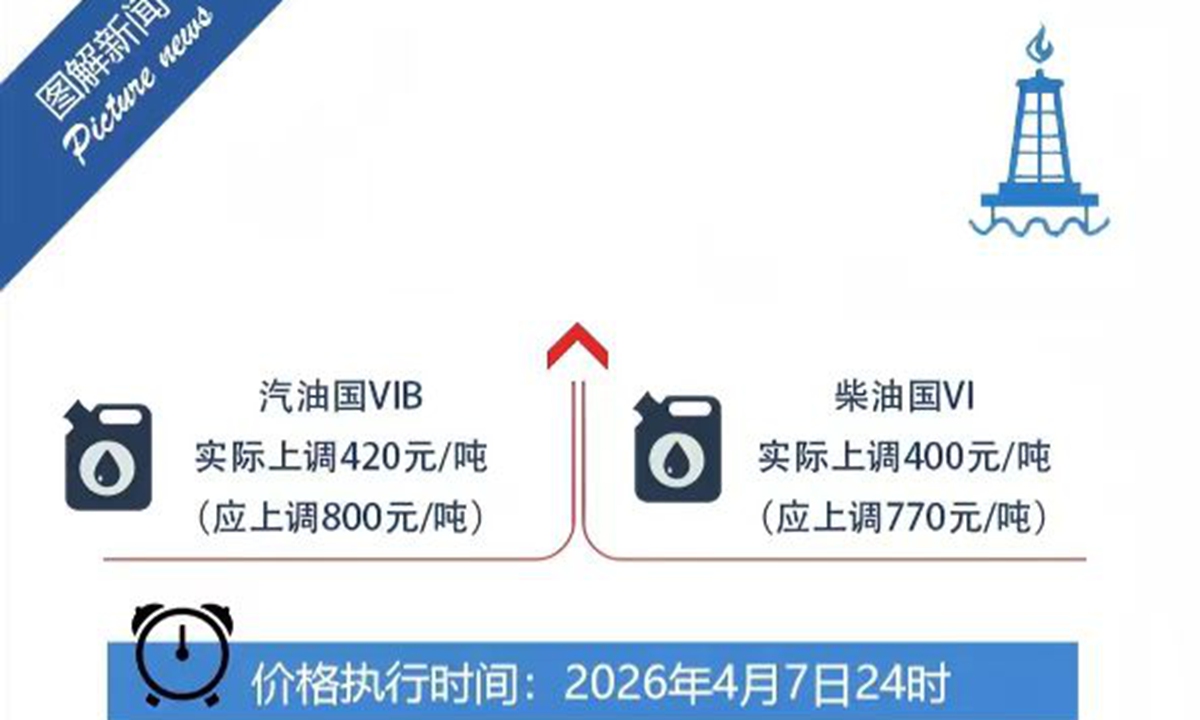
A screenshot of China's National Development and Reform Commission's official WeChat account
The National Development and Reform Commission (NDRC), China's top economic planner, said on Tuesday that it will continue to regulate refined oil prices to cushion the impact of rising international crude oil prices on the domestic market.
Effective from midnight on Tuesday, the actual increases of domestic gasoline and diesel prices will be capped at 420 yuan ($61.02) and 400 yuan per ton instead of 800 yuan and 770 yuan per ton under the current pricing mechanism, according to an NDRC statement.
This marks the second time this year that the commission has stepped in to regulate refined oil prices, in a move aimed at shielding the economy and consumers from recent spikes in international crude prices.
After the regulatory adjustment on Tuesday, the maximum retail prices for gasoline and diesel increased by 380 yuan and 370 yuan less per ton respectively, which is equivalent to reductions of 0.31 yuan per liter for 92 octane gasoline and 0.32 yuan per liter for 0 octane diesel.
The Xinhua News Agency's Tuesday preliminary estimates show that after the regulation, private car owners would spend about 15 yuan less to fill up a tank, while truck drivers would save roughly 150 yuan to 200 yuan per full tank, the report said.
Experts noted that since the latest domestic refined oil price adjustment on March 23, international crude prices have fluctuated sharply, according to the Xinhua report. The latest adjustment was also aimed at cushioning the impact of rising global oil prices on the domestic market, the report said, citing an expert note.
Under China's domestic refined oil pricing mechanism, the maximum retail prices of gasoline and diesel are adjusted every 10 working days based on changes in the average prices of a basket of international crude oils, according to Xinhua.
Meanwhile, the intensity of state regulation over refined oil prices needs to balance multiple factors, including supply security and the ability of downstream users to absorb higher costs. Policymakers must both prevent excessive price volatility from placing too much pressure on downstream users and appropriately pass through crude import costs to ensure stable refined oil supply, said Xinhua.
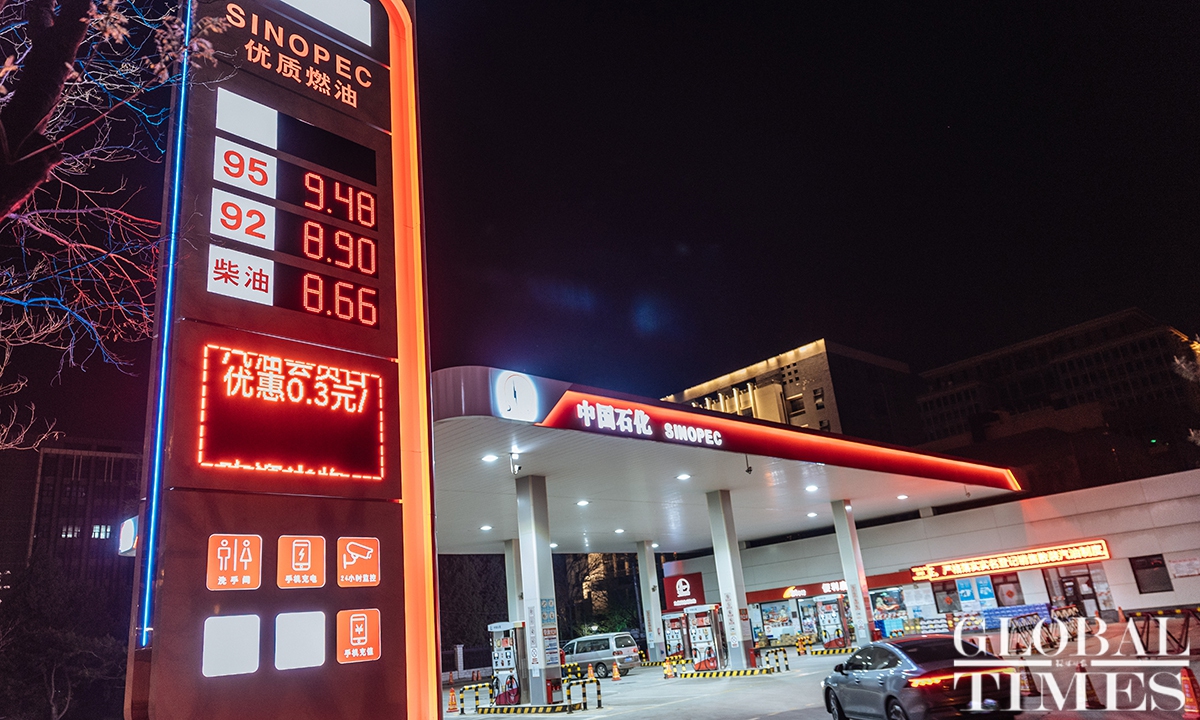
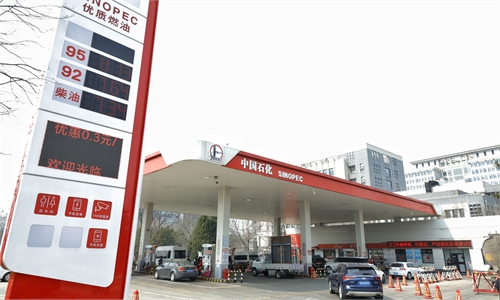
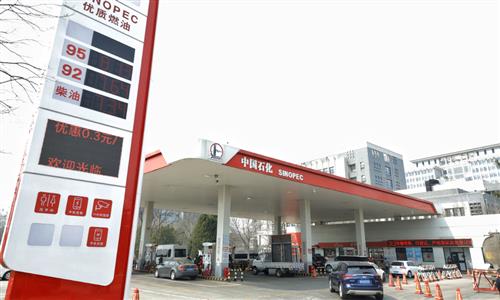
Car owners wait to refuel at a gas station in Beijing at 24:00 on April 7, 2026 from which point the actual increases in domestic gasoline and diesel prices will be capped at 420 yuan ($61.02) and 400 yuan per ton instead of 800 yuan and 770 yuan per ton under the current pricing mechanism. Photo: Li Hao/GT
Effective from midnight on March 23, the commission had already adopted regulatory measures on refined oil prices. This marked the first regulatory intervention since the mechanism was introduced in 2013, the Xinhua News Agency reported.
"Recent policy supports reflect the institutional strength of China's refined oil pricing mechanism and the broader advantages of its energy price governance system," Lin Boqiang, director of the China Center for Energy Economics Research at Xiamen University, told the Global Times on Tuesday.
Lin noted that the nation has stronger policy coordination and execution capacity in energy price regulation.
"That allows authorities to move quickly when global oil prices swing sharply, contain the pass-through of excessive price increases along the industrial chain, and ease pressure on businesses and households."
Sharp oil price increases typically ripple through upstream and downstream sectors and can eventually weigh on broader economic growth, Lin said. He noted that China's domestic market has remained relatively stable despite heightened international volatility, as authorities can use the pricing mechanism to temper the pace of domestic increases, while the relatively low share of oil and gas in the country's energy mix - with coal still dominant - also helps limit the transmission of external price shocks.
Recent media reports also showed that surging oil prices are already feeding into some regions' business costs, families' energy bills and broader inflation expectations.
The eurozone's private-sector expansion weakened sharply in March as the Middle East war drove up energy costs and disrupted supply chains, with overall demand - a key gauge of economic health - falling for the first time in eight months, a survey showed on Tuesday, Reuters reported on the same day.
Input cost inflation surged to its highest in slightly more than three years, with manufacturing seeing a record one-month jump, the report said. Meanwhile, firms raised prices charged to customers at the fastest pace since February 2024, though the increase was more modest than the spike in their own costs.
Also, JPMorgan Chase CEO Jamie Dimon cautioned that turmoil in oil and commodity markets could ripple through the economy, affecting everything from gasoline prices to manufacturing costs, the Associated Press reported on Tuesday.
The EU's energy commissioner Dan Jørgensen said that the EU's executive arm is preparing measures designed to help families and businesses weather the huge spike in oil prices that have resulted in about a 70 percent price hike for gas and 60 percent for oil in Europe, the AP reported on April 1.
"If international oil prices continue to rise sharply, authorities are likely to stick with the current regulatory approach and intervene in refined oil prices when necessary, in line with domestic economic conditions and the market's capacity to absorb higher costs, so as to help ensure stable supply, prices and expectations," Lin said.
According to the NDRC's notice in 2013, in special circumstances - such as a significant rise in the overall domestic price level, the occurrence of major emergencies, or sharp fluctuations in international oil prices over a short period - that necessitate adjustments to refined oil product prices, temporary regulatory measures shall be implemented in accordance with the law. Upon approval by the State Council, as requested by the NDRC, price adjustments may be suspended, postponed, or the magnitude of such adjustments reduced.
RELATED ARTICLES